
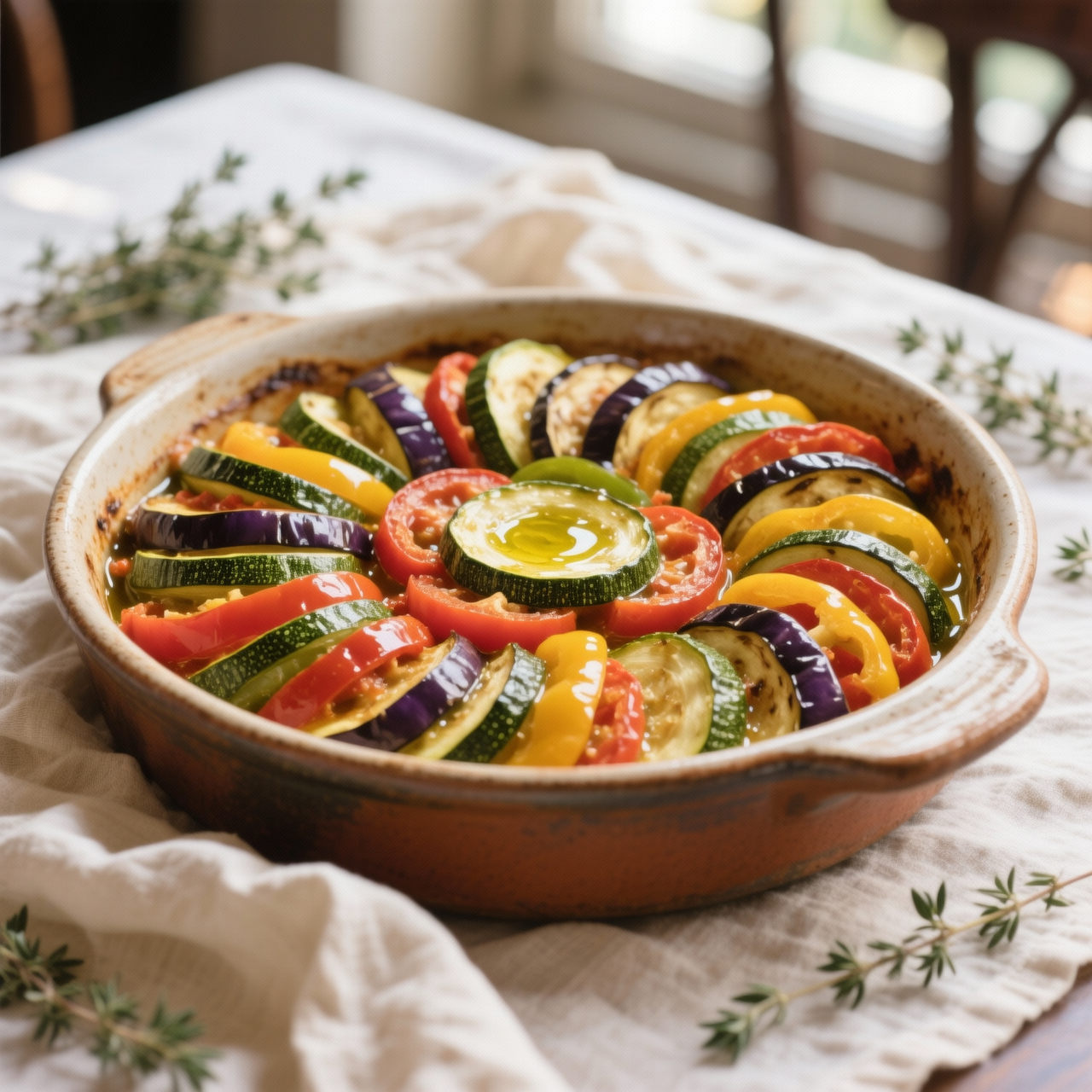
Ratatouille
When I first learned to coax a ratatouille into being, I quickly understood that this humble Provençal stew is less about rigid technique and more about honoring the rhythm of the Mediterranean summer. Born in the sun-drenched hills around Nice, it was originally peasant fare—a way to stretch whatever eggplants, zucchini, bell peppers, and tomatoes ripened on the vine into something deeply satisfying. To me, ratatouille matters precisely because it resists culinary pretension. It asks for patience, not precision, and rewards the cook with layers of flavor that only emerge when vegetables are allowed to surrender their moisture slowly over low heat. Yet this very simplicity is where most kitchens stumble. I have watched countless cooks rush the process, tossing everything into a scorching pan and expecting magic, only to end up with a bitter, soggy mash. The true pitfall lies in overcrowding the skillet and neglecting to cook each vegetable in stages before they finally marry. Another common misstep is relying on heavy broths or dairy to mask underdeveloped flavors, which completely betrays the dish’s elegant, plant-based roots. I always remind myself to treat the olive oil as a bridge, not a crutch, and to let the tomatoes break down naturally into a glossy, herb-scented foundation. When you respect the individual texture of each squash and pepper, the result is a quiet masterpiece that tastes of earth and sunshine. It is proof that restraint, more than extravagance, yields the most enduring comfort.
Nutrition
| Per serving | Calories | Protein | Carbs | Fat | Sat fat | Fibre | Sugar | Sodium |
|---|---|---|---|---|---|---|---|---|
| beginner | 348kcal | 5g | 24g | 29g | 4g | 8g | 13g | 780mg |
| intermediate | 348kcal | 5g | 24g | 29g | 4g | 8g | 13g | 780mg |
| expert | 348kcal | 5g | 24g | 29g | 4g | 8g | 13g | 780mg |
Per serving · Ava-estimated — a guide, not a clinical figure.
- 450 geggplant— firm and heavy for size
- 400 gzucchini— medium size, unpeeled
- 200 gred bell pepper— seeds and membrane removed
- 500 groma tomato— ripe but firm
- 150 gyellow onion— peeled
- 15 ggarlic— cloves peeled
- 120 mlextra virgin olive oil— high-quality, cold-pressed
- 10 gfresh thyme— leaves only
- 5 gfresh basil— whole leaves
- 8 gfine sea salt
- 3 gblack pepper— freshly cracked
This version strips away the intimidation factor, focusing on building a reliable foundation without demanding advanced knife skills or precise heat control. You will rely on a forgiving, one-pot approach that layers ingredients sequentially rather than individually, using a jarred tomato base to guarantee consistent acidity and thickness right from the start. The goal here is confidence: learning to recognize the exact moment vegetables soften without collapsing, and understanding how olive oil carries flavor through the entire dish. Watch closely for sizzling sounds that turn into a gentle simmer; if the pan smokes or smells sharp, your heat is too aggressive. The shortcut saves time but still rewards attention. You will notice how the eggplant and zucchini release water, and you will learn to wait patiently for that liquid to reduce into a cohesive sauce. By the end, you will have a vibrant, deeply comforting meal that proves technique is simply repeated attention. Trust the process, keep your movements steady, and let the aromatics guide your timing.
Equipment
- Heavy-bottomed pan— non-stick is fine here
Method
- 1
Wash and dice all vegetables into uniform one-inch cubes to ensure even cooking.
Keep cuts consistent.
dicing~ 5 min - 2
Heat olive oil in the pan over medium heat until it shimmers but does not smoke.
Oil should ripple gently.
heating~ 2 min - 3
Add the diced onion and cook until translucent, stirring occasionally to prevent sticking.
Edges should soften without browning.
sweating~ 4 min - 4
Stir in the minced garlic, tomato base, and fresh thyme until fragrant and deeply colored.
Avoid scorching the garlic.
blooming~ 1 minTricky bit - 5
Add the eggplant, peppers, and tomatoes, then reduce heat to low and cover tightly to trap steam.
Condensation will form on the lid.
braising~ 20 min - 6
Uncover, fold in zucchini and fresh basil, then simmer until all excess moisture evaporates and vegetables are tender.
Sauce should coat the back of a spoon.
reduction~ 5 min