
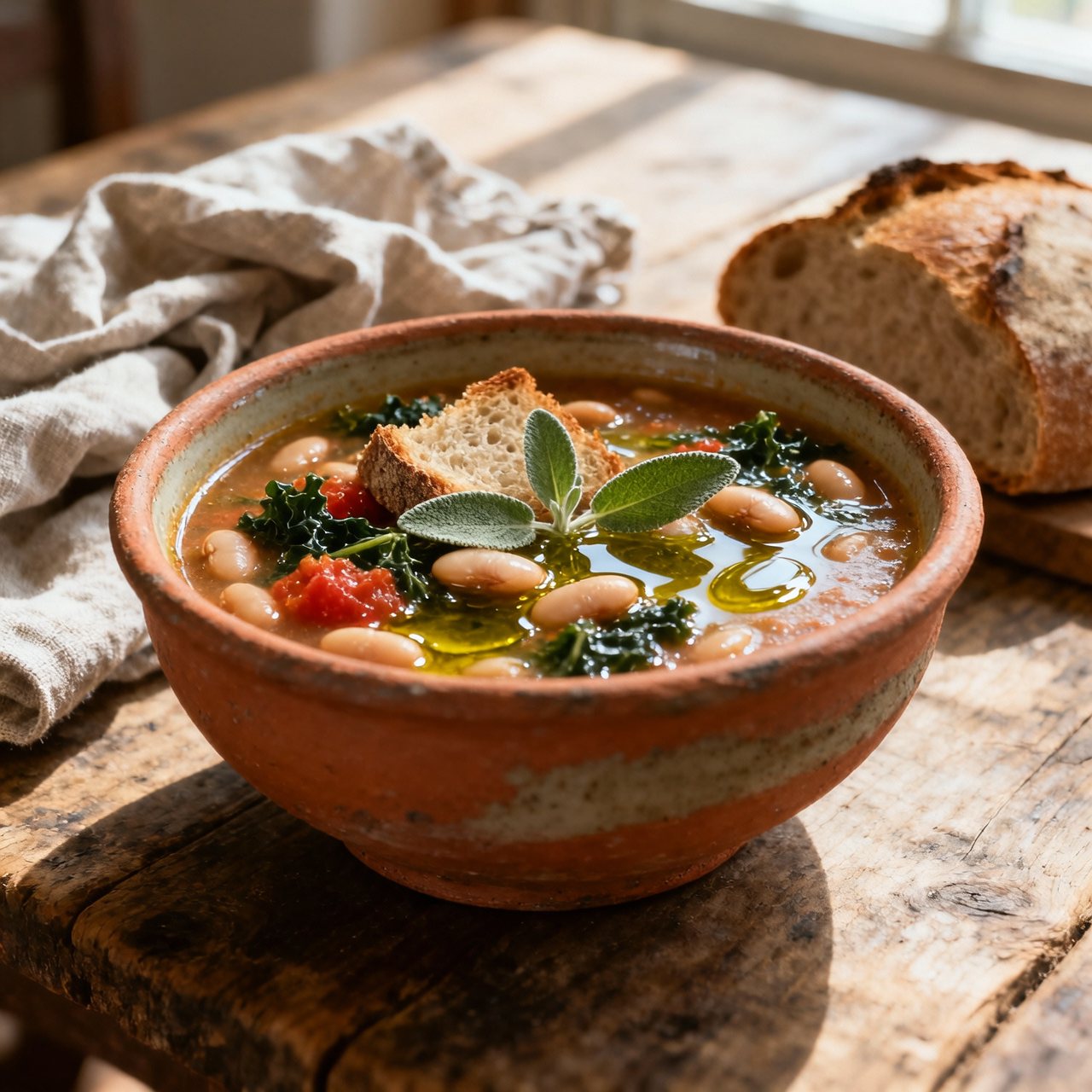
Ribollita
I have always believed that the greatest Italian dishes are not born in pristine restaurant kitchens, but in the quiet, practical hands of home cooks who refuse to let anything go to waste. Ribollita, whose name literally translates to reboiled, stands as a testament to that philosophy. Originating in the Tuscan countryside centuries ago, it began as a peasant staple: yesterday’s vegetable stew, leftover cannellini beans, and stale bread combined, then simmered again until the flavors married into something profoundly comforting. To me, this dish matters precisely because it defies the modern culinary obsession with novelty. It is a quiet lesson in patience, resourcefulness, and the dignity of making do. Yet, despite its humble roots, ribollita is notoriously easy to mishandle. The most frequent pitfall is rushing the process. True ribollita demands a slow, gentle simmer that allows the vegetables to soften completely without disintegrating into mush. Another common mistake is using bread that is too fresh or adding it too early; you want crusty, day-old loaves that will absorb the broth and thicken the pot without turning gluey. And please, never skip the resting period. The real magic happens when you let it sit off the heat, then reheat it the following day, allowing the flavors to deepen and the texture to settle into that signature, spoon-coating richness. When you honor these quiet rules, ribollita stops being just a soup and becomes a living archive of Tuscan resilience, entirely plant-based by tradition and deeply satisfying in every bowl.
Nutrition
| Per serving | Calories | Protein | Carbs | Fat | Sat fat | Fibre | Sugar | Sodium |
|---|---|---|---|---|---|---|---|---|
| beginner | 440kcal | 17g | 58g | 14g | 2g | 13g | 8g | 1450mg |
| intermediate | 440kcal | 17g | 58g | 14g | 2g | 13g | 8g | 1450mg |
| expert | 440kcal | 17g | 58g | 14g | 2g | 13g | 8g | 1450mg |
Per serving · Ava-estimated — a guide, not a clinical figure.
- 200 gstale sourdough bread— day-old, crust removed
- 400 gcannellini bean— cooked and drained
- 150 gcavolo nero— tough stems removed
- 150 gcarrot— finely diced
- 100 gcelery stalk— finely diced
- 150 gyellow onion— finely diced
- 15 ggarlic clove— minced
- 60 gtomato paste— double concentrated
- 1000 mlvegetable broth— low sodium
- 45 mlextra virgin olive oil— high quality
- 2 gdried thyme
- 2 gdried rosemary
- 10 gsalt— fine sea salt
- 3 gblack pepper— freshly cracked
This version is designed for your absolute first encounter with Ribollita, prioritizing confidence and simplicity over rigid tradition. We lean heavily on convenient pantry staples and pre-measured shortcuts to eliminate guesswork. You will use a ready-made vegetable base instead of manually sweating the aromatics, and the herbs are added as a convenient pre-mixed blend rather than measured individually. The goal is to teach you the core rhythm of the dish: building a flavorful broth, softening the greens, and incorporating the bread to achieve that signature thick, stew-like texture. Watch the heat carefully during the initial sauté; even with shortcuts, burning the base will introduce a bitter note that ruins the delicate balance. Keep the lid slightly ajar during the simmer to allow excess moisture to evaporate, ensuring your soup doesn't become watery. Stir gently but frequently to prevent the beans and bread from sticking to the bottom of the pot. By the time you finish, you will have a deeply comforting, cohesive bowl that proves how accessible Tuscan comfort food can be. Trust the process, taste as you go, and adjust the seasoning at the very end. You will be amazed at how quickly a few straightforward steps yield a restaurant-worthy starter.
Equipment
- Large heavy-bottomed pot— non-stick is fine here
- Wooden spoon— for gentle stirring
- Chef's knife— for chopping vegetables
Method
- 1
Dice the onion, carrot, celery, and garlic into uniform small pieces.
Uniformity ensures even cooking.
chopping~ 5 min - 2
Heat olive oil in the pot and add the diced vegetables, cooking until softened.
Keep heat at medium-low to avoid browning.
sweating~ 7 min - 3
Stir in the tomato paste, dried herbs, and vegetable broth until fully combined.
Scrape the bottom to release any stuck bits.
simmering~ 2 min - 4
Add the beans, kale, and bread cubes to the pot.
Press kale down so it submerges in the liquid.
folding~ 3 min - 5
Cover partially and simmer gently, stirring occasionally until thickened.
A gentle bubble prevents breaking the beans.
reducing~ 20 min