
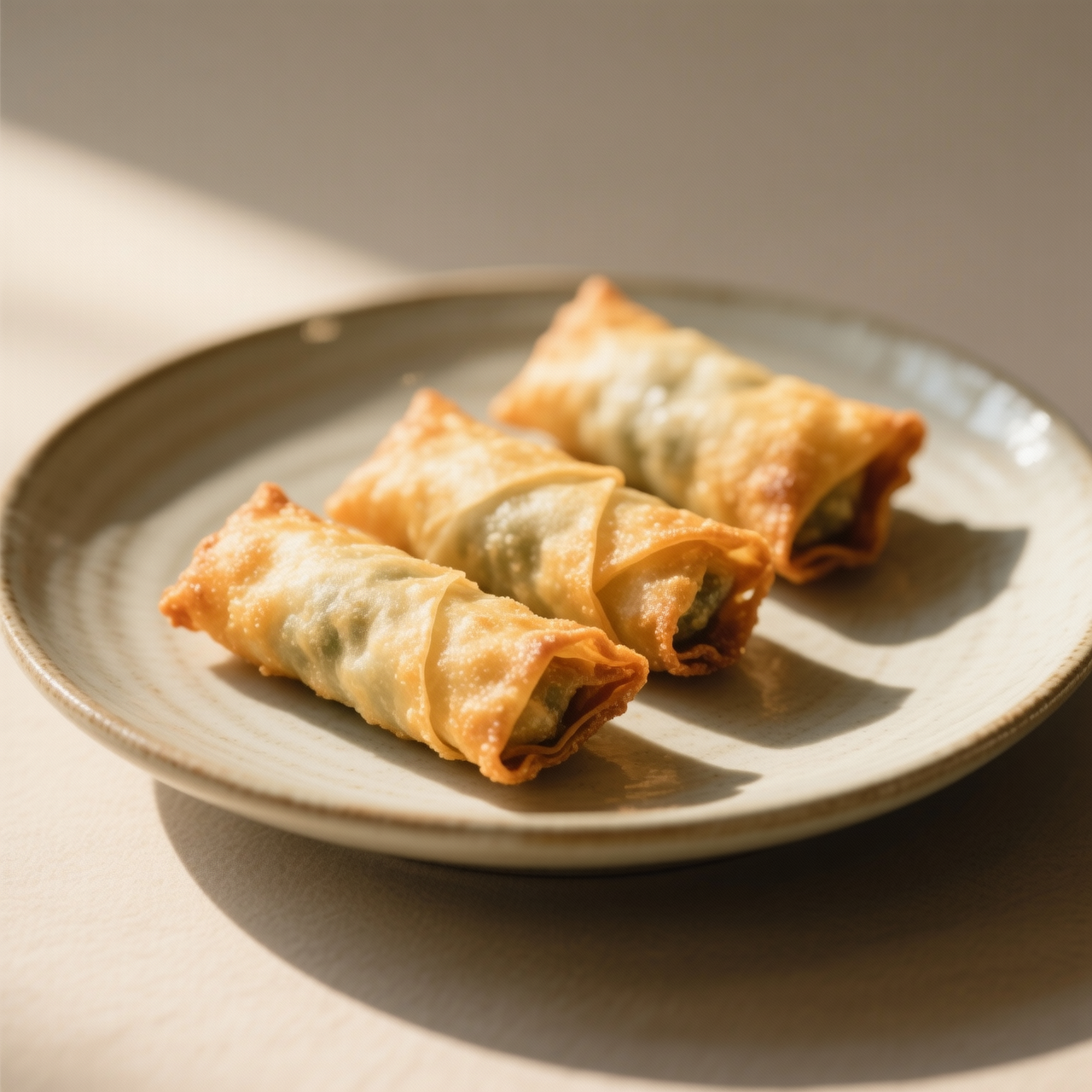
Risoles
I still remember my first encounter with supermarket risoles, sitting in a chilled aisle next to other frozen compromises. They cost about four dollars for six, promising a quick Indonesian snack, but what you actually get is a sad, uniform disc of cheap filler, preservatives, and cardboard-thick crepes wrapped in stale, pre-mixed breading. That is exactly why I refuse to compromise when I make these at home. Risoles arrived in Indonesia through Dutch colonial trade routes, slowly shedding their European pastry roots to become something entirely our own: a delicate, hand-made crepe cradling a rich, savory ragout of chicken, vegetables, and béchamel, then crumb-coated and fried to a crisp. Making them from scratch matters because the texture and depth simply cannot be engineered in a factory. The real magic happens when you treat the crepe like a living thing, cooking it thin and pliable, then sealing it carefully around a thickened, properly cooled filling. The pitfalls are almost always born of impatience. If your filling is too wet, the crepe will split. If you coat them while the crepe is still warm, the crumbs will slough off. If your oil is too hot, the outside burns before the center warms. When you build these yourself, you control the balance: real butter in the white sauce, finely diced carrots and potatoes for sweetness, and fresh eggs and flour for the wash and crust. I batch them every few weeks, rolling out a dozen, freezing them raw on a tray, then packing them away. They are the ultimate make-ahead comfort, and once you taste the homemade version, the store-bought alternative becomes impossible to justify.
Nutrition
| Per serving | Calories | Protein | Carbs | Fat | Sat fat | Fibre | Sugar | Sodium |
|---|---|---|---|---|---|---|---|---|
| beginner | 465kcal | 19g | 44g | 21g | 6g | 3g | 5g | 480mg |
| intermediate | 385kcal | 19g | 34g | 19g | 6g | 3g | 5g | 560mg |
| expert | 410kcal | 18g | 36g | 20g | 8g | 4g | 5g | 550mg |
Per serving · Ava-estimated — a guide, not a clinical figure.
- 130 gall-purpose flour— divided for crepe batter and filling roux
- 250 mlmilk— room temperature for smoother batter
- 3 largeegg— 2 for crepe batter, 1 for dipping
- 150 mlwater
- 5 gsalt— adjust to taste
- 30 mlvegetable oil— mixed into crepe batter to prevent sticking
- 200 gchicken breast— finely diced or shredded
- 150 gpotato— peeled and finely diced
- 100 gcarrot— peeled and finely diced
- 40 gunsalted butter— for sautéing vegetables and making roux
- 200 mlchicken stock— low sodium preferred
- 2 gblack pepper— freshly ground
- 1 gnutmeg— freshly grated
- 200 gpanko breadcrumb— for coating
- 1000 mlneutral cooking oil— for deep frying
Indonesian risoles are golden, crepe-wrapped parcels filled with a creamy chicken and vegetable ragout. While frozen supermarket packs run nine to twelve dollars for eight and rely on stabilizers, cheap oils, and rubbery, preservative-soaked wrappers, making them at home delivers a tender, lightly browned crepe encasing a rich, properly seasoned filling. This beginner approach keeps every element strictly from-scratch but streamlines the technique for reliable results. Instead of tempering a traditional béchamel, you will whisk milk into a cornstarch slurry directly off the heat for a silky, foolproof binder that will not curdle. The crepe batter is mixed in one bowl and rested briefly to relax the gluten, eliminating lumps without needing a specialized strainer. Assembly focuses on a simple roll-and-tuck method that seals tightly so the ragout stays put during frying. Watch your oil temperature closely; a gentle three hundred twenty-five to three hundred forty degree Fahrenheit fry ensures the crust crisps before the crepe absorbs excess grease. Once cooled slightly, coat each risole in fine homemade breadcrumbs and freeze flat before bagging. They thaw and fry beautifully straight from the freezer, giving you a ready-made snack that actually tastes like real food.
Equipment
- Non-stick skillet— eight-inch diameter works best
- Large mixing bowl— for batter and resting
- Deep pot or Dutch oven— holds enough oil for safe frying
Method
- 1
Whisk all-purpose flour, whole milk, eggs, melted butter, and a pinch of salt in a large bowl until completely smooth.
Rest the batter for twenty minutes to prevent tearing.
resting~ 15 min - 2
Sauté diced chicken breast, carrots, and potatoes in a medium saucepan until lightly browned.
Cut vegetables uniformly so they cook evenly.
sautéing~ 7 min - 3
Stir in fresh milk, a cornstarch-water slurry, and a dash of ground nutmeg, then simmer gently until thick and glossy.
Keep the heat medium-low to avoid scorching the bottom.
reducing~ 6 minTricky bit - 4
Pour a ladle of batter into a lightly oiled eight-inch non-stick skillet, tilting to spread, and cook until edges lift and the surface looks dry.
Flip only once for an even, pale-golden finish.
pan-cooking~ 1 min - 5
Place two tablespoons of cooled filling near one edge of each crepe, fold the bottom up, tuck in the sides, and roll tightly into a cylinder.
Keep the seam side down to prevent unraveling.
rolling~ 10 minTricky bit - 6
Dip each rolled crepe in a beaten egg wash, then press firmly into fine homemade breadcrumbs to coat evenly.
Pat the crumbs gently so they adhere without crushing the wrapper.
dredging~ 8 min - 7
Freeze coated risoles on a parchment-lined tray until completely solid, then carefully lower them into preheated oil until deeply golden.
Do not thaw before frying to maintain structural integrity.
deep-frying~ 4 minTricky bit
Cooking from frozen
Fry directly from frozen in 325°F oil until deeply golden and piping hot through, about 6 to 7 minutes.
Storage times are a guide — always use your judgement and store food safely.