
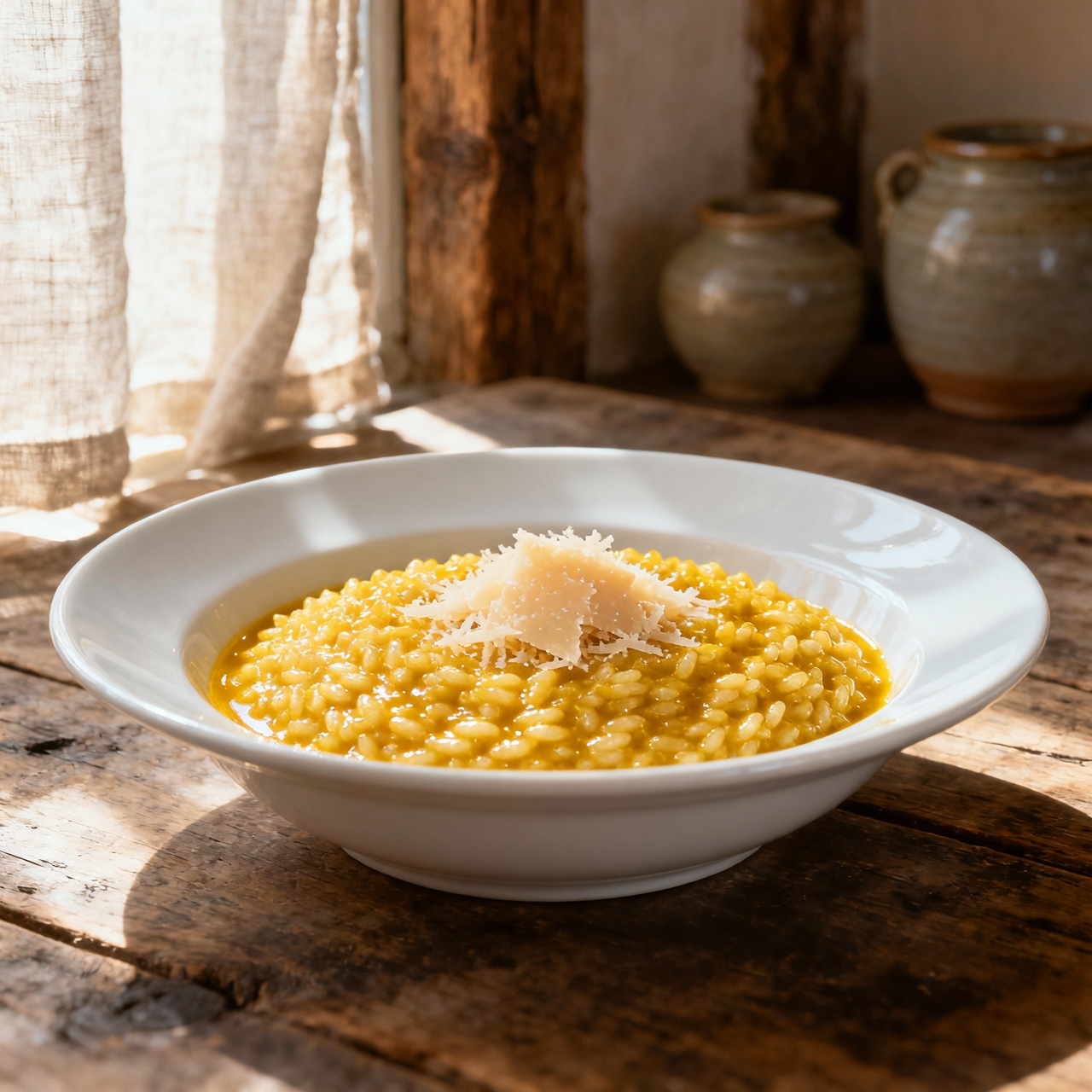
Risotto alla Milanese
I’ve always believed that Risotto alla Milanese is less of a recipe and more of a meditation on patience, a golden thread connecting centuries of Lombard tradition to the modern kitchen. Born in the sixteenth century, legend whispers that a glassmaker’s apprentice spilled precious saffron into a wedding feast, transforming simple rice into a radiant masterpiece. Whether myth or history, the dish remains a testament to Milan’s soul—unpretentious yet profoundly elegant. What makes it so vital to my cooking philosophy is its deceptive simplicity. It demands respect for the fundamentals: a proper soffritto, the slow coaxing of starch from Arborio or Carnaroli rice, and the unwavering commitment to stirring. Yet, I constantly see it ruined by the very impatience that modern life encourages. The most common pitfalls I encounter are rushing the broth addition, which starves the grains of their creamy release; using low-quality saffron that yields a muddy hue instead of a luminous gold; and finishing with heavy cream instead of the traditional mantecatura of cold butter and aged Parmigiano. True Milanese risotto should never be soupy nor stiff, but rather all’onda—flowing like a gentle wave. When you honor the rhythm of the ladle and the quiet alchemy of heat and time, the result isn’t just dinner. It’s a warm, saffron-kissed embrace that reminds us why slow cooking still matters in a hurried world.
Nutrition
| Per serving | Calories | Protein | Carbs | Fat | Sat fat | Fibre | Sugar | Sodium |
|---|---|---|---|---|---|---|---|---|
| beginner | 525kcal | 13g | 70g | 21g | 13g | 1g | 2g | 820mg |
| intermediate | 525kcal | 13g | 70g | 21g | 13g | 1g | 2g | 820mg |
| expert | 525kcal | 13g | 70g | 21g | 13g | 1g | 2g | 820mg |
Per serving · Ava-estimated — a guide, not a clinical figure.
- 320 gArborio rice— short-grain, high amylopectin content
- 150 gYellow onion— finely minced
- 80 gUnsalted butter— cold, cubed
- 120 mlDry white wine— unoaked, high acidity
- 1200 mlVegetable broth— kept at a gentle simmer
- 0.5 gSaffron threads— high-grade, deep red stigmas
- 60 gParmigiano-Reggiano cheese— aged 24 months, freshly grated
- 10 gFine sea salt
- 3 gBlack peppercorns— freshly cracked
This pathway prioritizes confidence and consistency over strict tradition, making it ideal for your first attempt. You will lean on a few reliable shortcuts, including a pre-mixed vegetable broth base and jarred saffron infusion paste, which guarantee even color distribution without the guesswork. The primary goal is to develop a steady stirring rhythm and recognize the exact moment the rice transitions from chalky to creamy. Watch the heat closely; beginners often keep the burner too high, causing the bottom layer to scorch while the top remains undercooked. Keep the pan covered between additions to trap steam and soften the grains evenly. If the rice begins to look dry or stick aggressively, add an extra splash of broth immediately. Trust your eyes over the clock. The final texture should resemble a slow-moving lava flow, holding its shape briefly before settling. Do not rush the resting period, as the emulsion needs a few quiet minutes to stabilize. This version strips away intimidation while preserving the essential golden soul of the dish.
Equipment
- Heavy-bottomed pan— non-stick is fine here
- Wooden spoon— flat edge helps scrape corners
- Ladle— standard soup size
Method
- 1
Bring the vegetable broth to a gentle simmer in a separate pot and maintain low heat throughout cooking.
Keep it on the back burner.
simmering~ 5 min - 2
Melt half the unsalted butter over medium-low heat in a heavy skillet, then add the finely chopped yellow onion.
Sweat until translucent, never brown.
sweating~ 6 minTricky bit - 3
Add the arborio rice to the skillet and stir constantly until the grains become translucent around the edges.
Listen for a faint clicking sound.
toasting~ 2 minTricky bit - 4
Pour in the dry white wine and stir vigorously until the liquid fully evaporates and the alcohol aroma dissipates.
Scrape the bottom to release fond.
deglazing~ 2 min - 5
Add one ladle of warm broth and the jarred saffron infusion paste, stirring until the liquid is nearly absorbed.
The paste ensures instant golden color.
absorption~ 3 min - 6
Continue adding broth one ladle at a time, stirring constantly and waiting for full absorption before the next addition.
Maintain a steady, unhurried pace.
reduction~ 18 minTricky bit - 7
Remove from heat, fold in the remaining butter and grated Parmigiano-Reggiano, cover, and let rest for five minutes.
Do not skip the resting phase.
mantecatura~ 5 min