
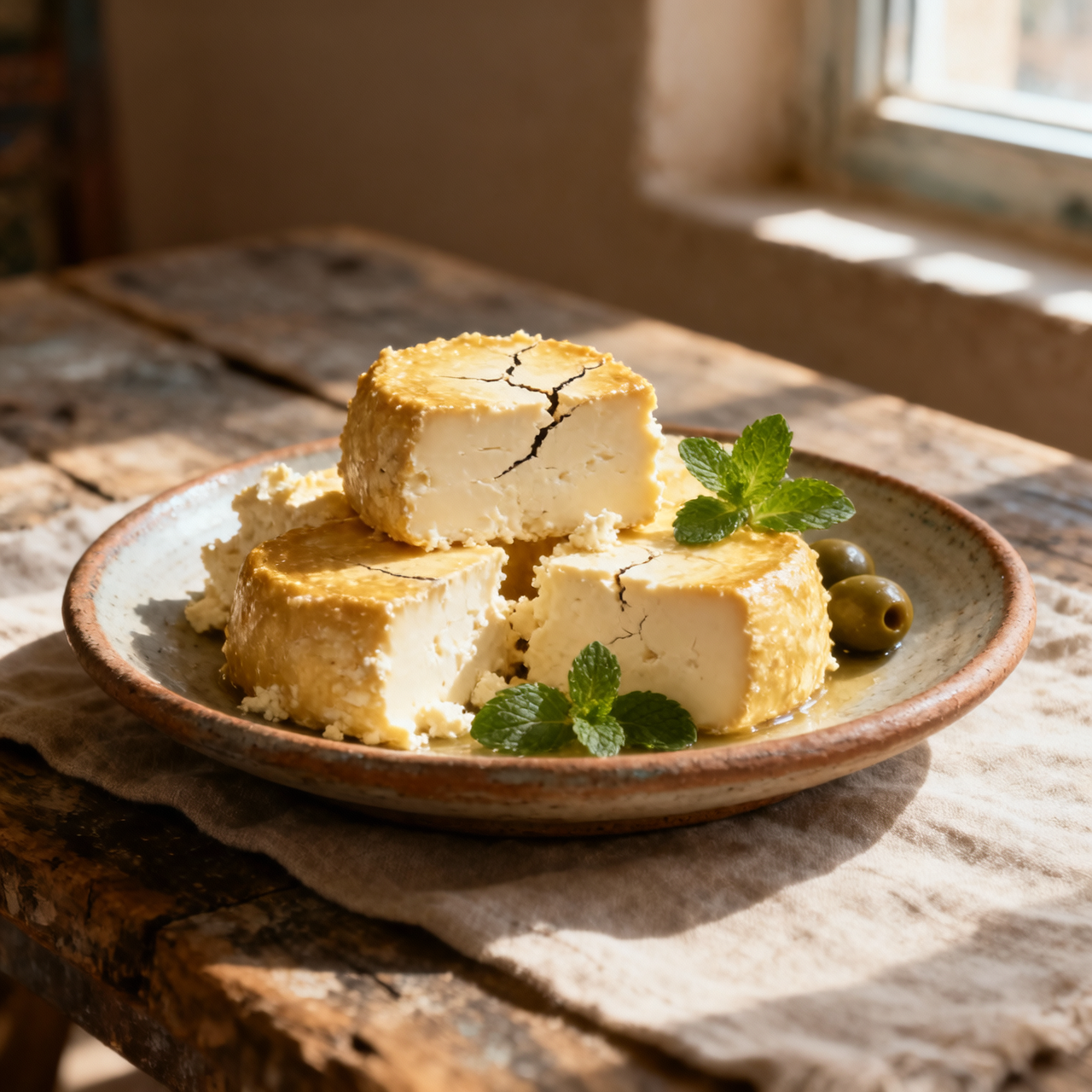
Roomy cheese (gibna roumi)
When I first learned to make gibna roumi in a sunlit Cairo kitchen, I quickly understood why this cheese is the quiet backbone of Egyptian home cooking. Unlike the pale, rubbery wheels you find shrink-wrapped in supermarkets—which routinely run you upwards of eight dollars a kilo while delivering a hollow, overly salty bite masked by stabilisers and artificial colouring—true roomy cheese is a patient alchemy of whole milk, natural rennet, and time. The name itself hints at its journey, echoing the Roman and Levantine dairy traditions that settled along the Nile centuries ago. Making it at home strips away the industrial shortcuts and returns you to the fundamental rhythm of curdling, pressing, brining, and waiting. What matters most here is patience and temperature control; rushing the acidification or skipping the brine bath will yield a rubbery, split mess rather than a firm, golden wheel that sings with tang. The most common pitfall I see is using pasteurised milk without a starter culture to lower the pH, which leaves the curds too weak to hold their shape during pressing. Another is salting unevenly, which invites spoilage instead of preservation. When done right, this aged hard cheese develops a dense, sliceable texture and a sharp, lactic depth that transforms simple fava bean stews, molokhia, and morning bread into something profound. It is not just a side; it is a testament to how slow food outlasts convenience. Every crack in the rind, every granular bite, tells you that you waited, you trusted the milk, and you let time do the heavy lifting.
Nutrition
| Per serving | Calories | Protein | Carbs | Fat | Sat fat | Fibre | Sugar | Sodium |
|---|---|---|---|---|---|---|---|---|
| beginner | 285kcal | 20g | 1g | 22g | 14g | 0g | 1g | 460mg |
| intermediate | 340kcal | 24g | 1g | 26g | 16g | 0g | 1g | 820mg |
| expert | 162kcal | 10g | 1g | 13g | 8g | 0g | 0g | 610mg |
Per serving · Ava-estimated — a guide, not a clinical figure.
- 4000 mlwhole cow milk— Preferably raw or lightly pasteurized for authentic flavor development
- 0.5 gmesophilic starter culture— Freeze-dried powder, activate at 30C before use
- 2 mlvegetable rennet— Dilute in non-chlorinated water before adding to milk
- 80 gfine sea salt— Used for both salting the curds and preparing the aging brine
- 1.5 mlcalcium chloride(optional)— 30% solution, essential if using commercially pasteurized milk
Store-bought gibna roumi often costs upwards of £8 per block, relies on heavy preservatives and anti-caking agents, and lacks the rich, nutty depth that develops naturally during aging. This beginner-friendly, from-scratch version strips away the need for specialized aging caves, humidity chambers, or precise pH monitoring. Instead, it uses a forgiving stovetop water bath and a straightforward salt-rub curing method that fits neatly on a standard refrigerator shelf. The key difference here is patience over precision: you will use gentle, even pressure to form the curd rather than heavy mechanical presses, and rely on a simple weekly flip schedule for flavor development. Watch closely during the initial heating phase; milk scorches easily and ruined milk cannot be recovered. Keep your thermometer in hand and stir with slow, deliberate figure-eight motions to prevent the curds from matting together too tightly. Once drained and salted, the cheese will mature safely in a sealed container. Expect a firm, sliceable wheel ready in just four to six weeks, delivering a sharp, tangy profile perfect for grating over pasta or serving alongside fresh bread.
Equipment
- Heavy-bottomed pot— Stainless steel or enamel works best for even heat distribution
- Digital thermometer— Essential for hitting exact curd-setting temperatures
- Fine-mesh colander— Must be food-safe plastic or stainless steel
- Clean cotton cheesecloth— Pre-washed to remove lint and detergent residue
Method
- 1
Pour whole milk into a heavy-bottomed pot and gently heat over medium-low to 32°C.
Use a digital thermometer; scorching ruins the batch irreversibly.
heating~ 10 minTricky bit - 2
Whisk plain yogurt into the warm milk until fully dissolved, then slowly stir in diluted rennet.
Use gentle up-and-down motions to avoid breaking the forming curd structure.
inoculation~ 3 min - 3
Cover the pot and leave completely undisturbed for 45 minutes until a firm, jelly-like curd sets.
Test by inserting a clean knife at an angle; it should split cleanly.
setting - 4
Slice the set curd into uniform 1cm cubes and slowly raise the temperature to 39°C while stirring.
Keep the spoon moving in slow figure-eights to expel whey evenly.
cooking~ 15 minTricky bit - 5
Ladle the curds into a cheesecloth-lined colander, fold the cloth over, and apply light pressure.
A heavy plate or small cast-iron skillet provides steady, even weight.
draining~ 10 min - 6
Remove the cheese from the cloth, rub all sides with coarse salt, and seal in a container for aging.
Flip the block daily and wipe away excess moisture to prevent unwanted mold.
curing~ 5 min
Cooking from frozen
Thaw slowly in the fridge; best grated into hot dishes as freezing alters its sliceability.
Storage times are a guide — always use your judgement and store food safely.