
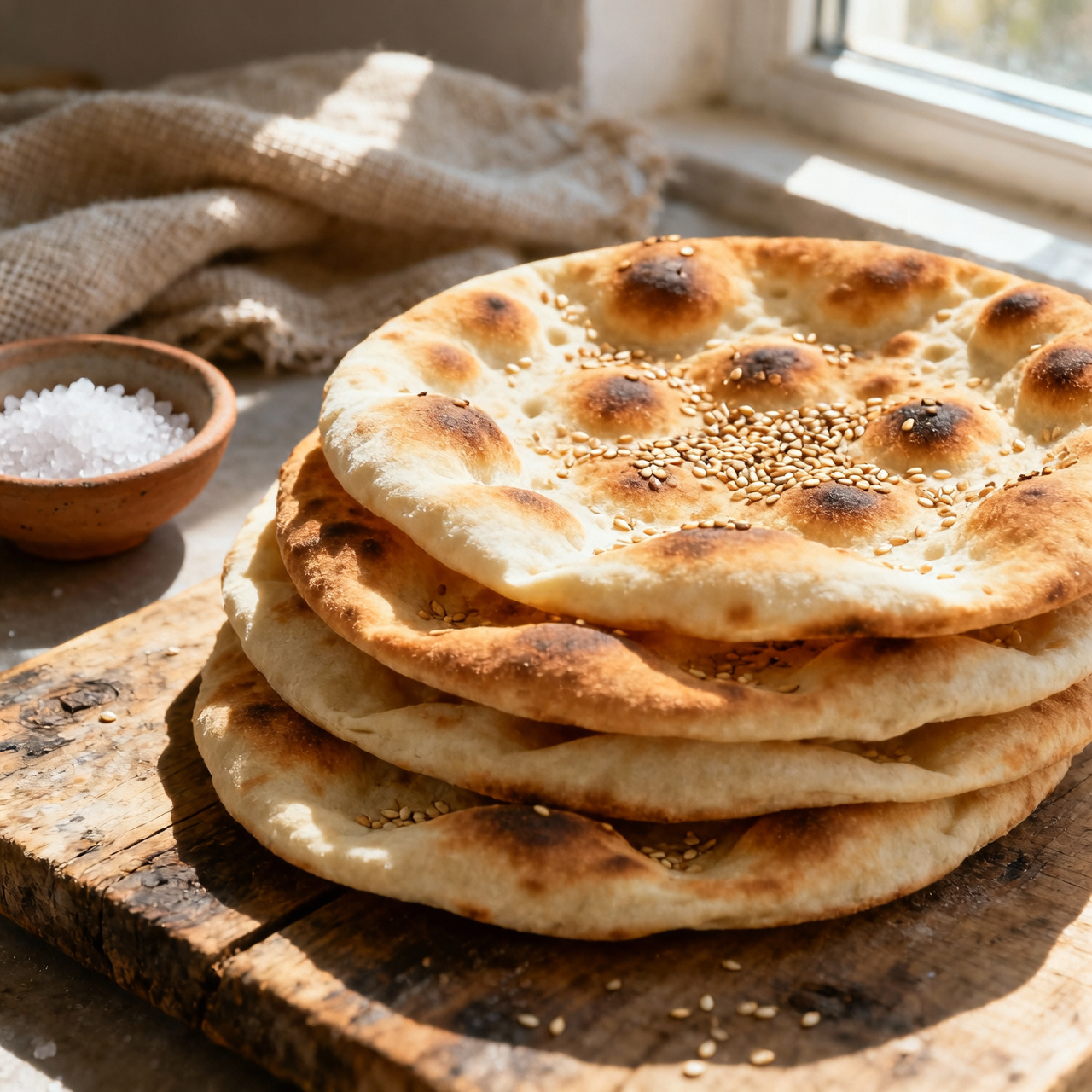
Sangak flatbread
I’ve always believed that bread is the quiet heartbeat of a kitchen, and nowhere is that more evident than in Sangak, the ancient Persian flatbread traditionally baked over a bed of heated river stones. You’ve likely seen it sold in plastic sleeves at Middle Eastern grocers—stiff, dry, and costing a premium for what is essentially a vehicle for kebabs and dips. That shop-bought version strips away the bread’s defining character: a crisp, blistered crust that gives way to a tender, slightly chewy crumb, all carrying the faint, mineral whisper of the stones it kissed. Making it from scratch isn’t about chasing perfection; it’s about reclaiming a centuries-old craft with ingredients you can actually pronounce. The secret to a great Sangak lies in hydration and patience. Too little water and it bakes into cardboard; too much and you’ll wrestle a slack, unmanageable dough. The traditional technique relies on stretching the dough by hand over a damp canvas before transferring it to a scorching stone bed, creating those signature irregular bubbles and a lightly dimpled surface. Common pitfalls include rushing the fermentation, which starves the yeast of flavor, or using high-protein bread flour that makes the bread tough rather than supple. Whole wheat flour is non-negotiable here—it delivers the earthy depth and rustic texture that define authentic Sangak. In my library, I’ve structured this recipe to meet you exactly where your kitchen comfort begins. Whether you’re shaping your first loaf on an inverted baking tray or mastering a cold-fermented dough stretched over a linen peel, you’ll end up with a warm, fragrant flatbread that outshines anything wrapped in cellophane.
Nutrition
| Per serving | Calories | Protein | Carbs | Fat | Sat fat | Fibre | Sugar | Sodium |
|---|---|---|---|---|---|---|---|---|
| beginner | 460kcal | 19g | 85g | 9g | 1g | 14g | 5g | 780mg |
| intermediate | 460kcal | 19g | 85g | 9g | 1g | 14g | 5g | 780mg |
| expert | 460kcal | 19g | 85g | 9g | 1g | 14g | 5g | 780mg |
Per serving · Ava-estimated — a guide, not a clinical figure.
- 500 gwhole wheat flour— stone-ground preferred for authentic texture
- 350 mlwater— lukewarm, around 35°C
- 7 gactive dry yeast— one standard sachet
- 8 gfine sea salt— do not substitute fine table salt
- 5 ggranulated sugar— feeds the yeast, not for sweetness
- 15 gsesame seeds— raw or lightly toasted
This version strips away the intimidation of traditional stone baking and replaces it with reliable, home-friendly techniques. You will work with a standard hydration level that keeps the dough firm and easy to handle, avoiding the sticky frustration that often discourages first-time bread makers. Instead of a tandoor or river stones, you will use an inverted heavy baking sheet to capture intense bottom heat, which reliably mimics a professional baking surface. Watch the dough closely during the initial rise; if it doubles too quickly in a hot kitchen, it will develop an overly sour flavor and lose structural integrity. Keep your kneading method consistent, using the heel of your hand to develop just enough gluten for a tender crumb. The shaping process relies on gentle palm pressure rather than forceful rolling, preserving the irregular air pockets that give Sangak its signature chew. Preheat your oven thoroughly before loading the loaves, as a cold pan will result in pale, dense bread. Bake until the crust sounds distinctly hollow when tapped. The result is a forgiving, deeply aromatic flatbread that builds your confidence without demanding professional tools.
Equipment
- Heavy baking sheet— inverted to mimic a stone surface
- Kitchen scale— essential for accurate flour measurement
- Wooden spoon— for initial mixing
Method
- 1
Combine the warm water, granulated sugar, and active dry yeast in a large bowl and stir gently.
Wait until a light foam forms on the surface.
proofing~ 5 min - 2
Add the whole wheat flour and fine sea salt to the yeast mixture and stir until a shaggy dough forms.
Use a wooden spoon or silicone spatula.
mixing~ 3 min - 3
Turn the dough onto a lightly floured surface and knead vigorously until smooth and elastic.
Push away with the heel of your palm, fold, and repeat.
kneading~ 5 min - 4
Place the dough in a lightly oiled bowl, cover with a damp cloth, and let it rise until doubled.
Aim for 30 to 40 minutes in a warm, draft-free spot.
bulk fermentation~ 40 min - 5
Divide the dough into four equal portions, roll each into a ball, and flatten by hand into rough ovals.
Aim for about 1 cm uniform thickness.
shaping~ 4 min - 6
Place a heavy baking sheet upside down in your oven and preheat to 230°C.
Allow the pan to reach temperature fully before baking.
preheating~ 20 min - 7
Transfer the flattened dough to the hot baking sheet, sprinkle generously with sesame seeds, and bake until golden.
The bottom should sound hollow when tapped.
baking~ 8 min
Cooking from frozen
Thaw at room temperature for 20 minutes, then wrap in foil and warm in a 180°C oven until pliable.
Storage times are a guide — always use your judgement and store food safely.