
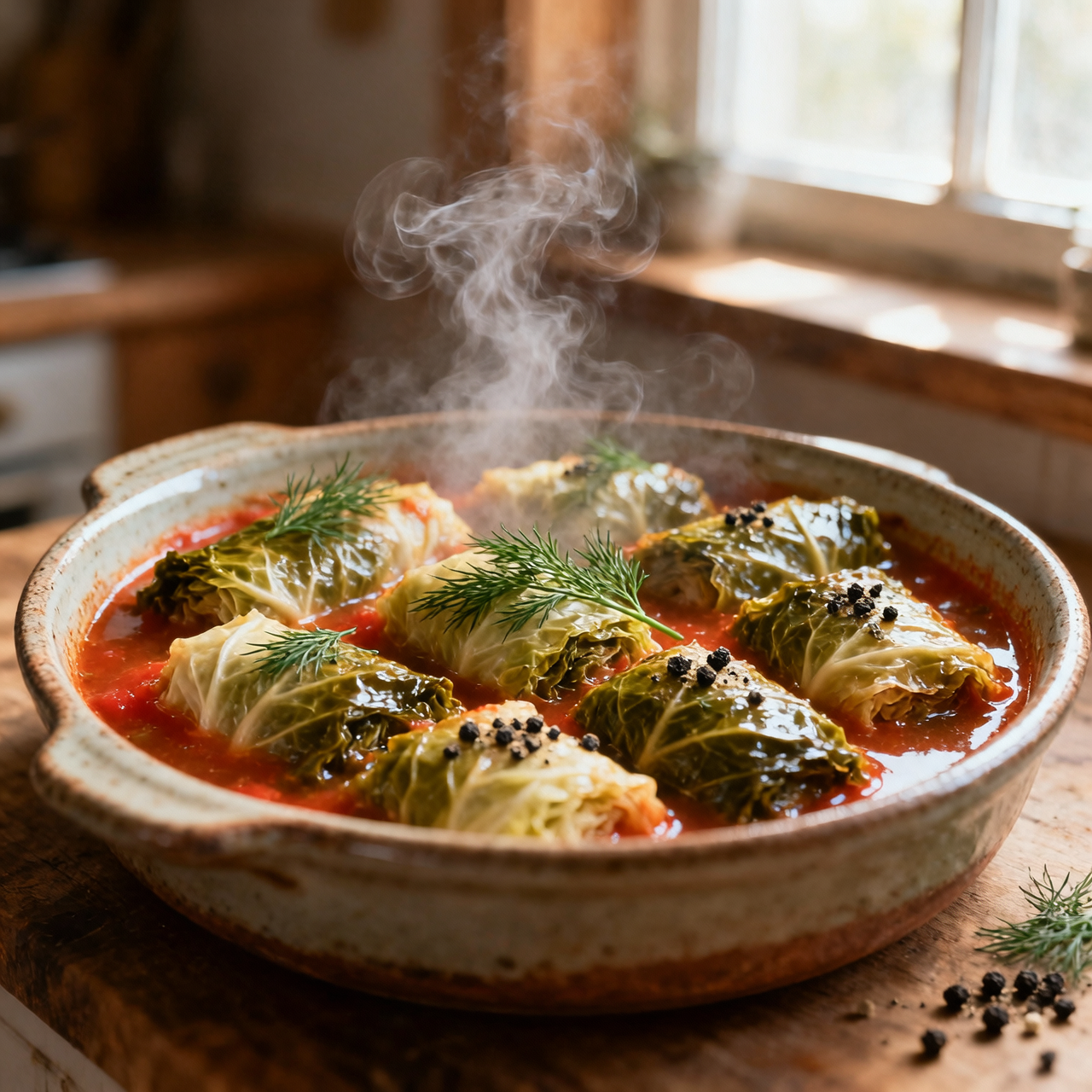
Sarma
I remember the first time I watched my grandmother layer fermented cabbage leaves with spiced pork and rice, her hands moving with the quiet certainty of generations. Sarma is not merely a dish; it is a slow, simmering testament to Balkan resilience and hospitality. Born from the necessity of preserving summer harvests for harsh winters, these rolled cabbage parcels traveled with Ottoman armies, adapted by Slavic, Romanian, and Hungarian kitchens, and eventually settled as the undisputed centerpiece of our holiday tables. What makes it matter is the patience it demands. In a world that prizes speed, sarma refuses to be rushed. The magic happens during those long, low hours on the stove, when the brine softens, the meat surrenders its fat, and the smoked ribs infuse every layer with a deep, wood-kissed aroma. Yet, so many miss the mark because they treat it as a simple stuffing exercise. The most common pitfall is using fresh cabbage instead of properly fermented leaves, which strips away the essential tang that balances the richness. Others pack the rolls too tightly, suffocating the rice as it expands and turning the dish into a dense, gummy block. Under-seasoning the filling is another quiet tragedy, as cabbage is notoriously stubborn about absorbing flavor. You must trust the process: roll snugly but gently, layer smoked meats between the seams, and let it breathe. When done right, each bite unwinds like a memory—tart, savory, and profoundly comforting.
Nutrition
| Per serving | Calories | Protein | Carbs | Fat | Sat fat | Fibre | Sugar | Sodium |
|---|---|---|---|---|---|---|---|---|
| beginner | 670kcal | 33g | 49g | 36g | 11g | 9g | 9g | 3100mg |
| intermediate | 670kcal | 33g | 49g | 36g | 11g | 9g | 9g | 3100mg |
| expert | 670kcal | 33g | 49g | 36g | 11g | 9g | 9g | 3100mg |
Per serving · Ava-estimated — a guide, not a clinical figure.
- 800 gfermented cabbage leaf— whole leaves from brined head, rinsed
- 400 gground pork— 80/20 fat ratio preferred
- 200 gground beef— coarse chuck grind
- 150 gshort-grain rice— uncooked
- 150 gyellow onion— finely minced
- 20 ggarlic clove— peeled and grated
- 15 gsmoked paprika— high-quality sweet or hot blend
- 60 gtomato paste— concentrated and unsweetened
- 3 piecesbay leaf— dried
- 750 mlvegetable broth— low-sodium or homemade
- 30 mlsunflower oil
- 10 gfine sea salt— for seasoning
- 5 gblack peppercorn— whole
This path prioritizes confidence and consistency over tradition, making your first sarma an absolute success without overwhelming technique. You will rely on a high-quality jarred tomato base to bypass the time-consuming sofrito stage, and pre-rinsed rice to eliminate guesswork with starch levels. The rolling method is simplified: lay leaves flat, place filling near the base, and use a gentle tuck-and-fold motion rather than the traditional tight cylinder. Watch closely for moisture balance; the jarred sauce often contains thickeners and extra sodium, so taste your broth before adding salt. The biggest hurdle here is overpacking the rolls, which guarantees bursting during the simmer. Keep portions modest, about two tablespoons per leaf, and leave a clear margin on the sides. This version bakes covered for the majority of the cook time, ensuring even heat distribution and forgiving any slight inconsistencies in your folds. By the end, you will have mastered the structural fundamentals and developed an intuitive sense for how the leaves soften and tighten. Once you feel comfortable with the rhythm of assembly, you will be perfectly prepared to graduate to the intermediate stage.
Equipment
- rectangular baking dish— 9x13 inch standard size
- large mixing bowl— stainless steel or glass
- measuring spoons— standard set
- kitchen scissors(optional)— for trimming leaves
Method
- 1
Preheat the oven to 175 degrees Celsius and lightly coat a rectangular baking dish with sunflower oil.
Oven rack should sit in the center position.
preheating~ 2 min - 2
Rinse the short-grain rice under cold running water until the liquid runs completely clear.
Removes excess starch to prevent gumminess.
rinsing~ 1 min - 3
Combine the ground pork, ground beef, minced onion, grated garlic, smoked paprika, and black pepper in a large mixing bowl.
Mix just until uniform to keep the texture light.
combining~ 3 min - 4
Lay a single cabbage leaf flat, place a two-tablespoon portion of meat near the base, and fold the sides inward.
Do not overfill or the seams will split.
rolling~ 5 minTricky bit - 5
Continue rolling each leaf upward into a compact cylinder and arrange them seam-side down in the prepared dish.
Pack them snugly so they support each other.
arranging~ 2 min - 6
Whisk the vegetable broth, tomato paste, jarred tomato sauce, and bay leaves together in a pitcher until smooth.
Check for added sodium before seasoning further.
emulsifying~ 2 min - 7
Pour the liquid mixture evenly over the arranged rolls, cover the dish tightly with foil, and bake for 60 minutes.
The liquid should reach halfway up the rolls.
baking~ 60 min