
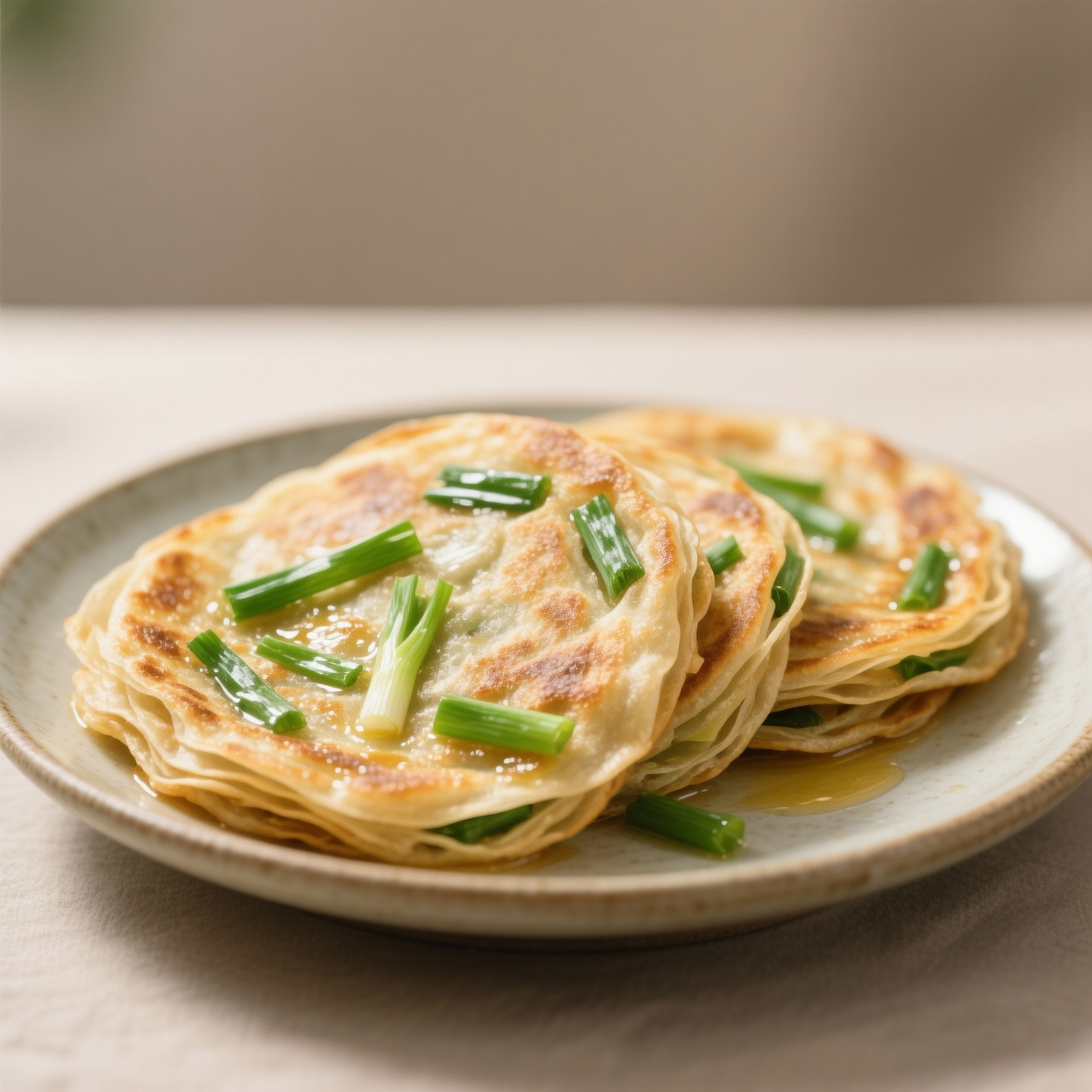
Scallion Pancakes (Cong You Bing)
I’ve always been baffled by the frozen aisle scallion pancakes, those sad, rubbery discs that cost nearly three pounds for a pack of four and taste faintly of oxidized oil and stale dough. Real cong you bing, born from the bustling street stalls of northern China, shouldn’t require a microwave resurrection or a chemical preservative list. They are a celebration of patience and simple alchemy: flour, water, salt, and a generous tangle of fresh scallions, laminated with oil until they shatter into golden, flaky layers when you tear into them. The magic isn’t in complexity, but in technique, which is exactly why homemade versions falter. Most home cooks either knead their dough too vigorously, developing gluten that turns the pancake tough and bread-like, or skip the crucial resting period, making the dough impossible to roll thin without snapping back. Others drown the scallions in heavy seasoning or use cold oil that fails to create the delicate steam pockets responsible for that signature puff. When you commit to making these from scratch, you’re trading a bland, overpriced convenience for something that crackles on the griddle and fills your kitchen with an earthy, allium perfume. You control the quality of every ingredient, ensuring a truly clean, vegan preparation without relying on hidden animal fats or dough conditioners. The real victory is in the rhythm: roll, oil, coil, rest, flatten, and pan-fry. Once you feel the dough relax and watch the layers separate under your spatula, you’ll never look at a supermarket freezer section the same way again.
Nutrition
| Per serving | Calories | Protein | Carbs | Fat | Sat fat | Fibre | Sugar | Sodium |
|---|---|---|---|---|---|---|---|---|
| beginner | 310kcal | 5g | 38g | 15g | 2g | 2g | 1g | 240mg |
| intermediate | 480kcal | 10g | 65g | 18g | 2g | 3g | 1g | 380mg |
| expert | 365kcal | 7g | 46g | 16g | 2g | 2g | 1g | 450mg |
Per serving · Ava-estimated — a guide, not a clinical figure.
- 300 gall-purpose flour— sifted before measuring
- 210 mlwater— heated to approximately 80°C
- 6 gfine salt— divided between dough and layer seasoning
- 60 gscallion— green parts only, thinly sliced and thoroughly dried
- 45 mlvegetable oil— neutral variety, divided for dough resting and pan-frying
- 15 mlsesame oil(optional)— toasted, for brushing between dough layers
Store-bought frozen scallion pancakes typically cost four dollars for a pack of four and rely on cheap palm oil, stale preservatives, and a dense, cardboard-like crumb. This beginner-friendly version skips the traditional multi-layer laminating process in favor of a forgiving coil-and-flatten method that guarantees reliable flakiness with minimal handling. You will work with a simple hot-water dough that stays pliable and resists tearing, making rolling and shaping stress-free. The key to success here is patience during the resting phase; letting the gluten relax ensures the dough stretches easily into thin sheets without snapping back. When layering, keep your oil-and-scallion mixture light but even to avoid pooling, which can cause the layers to slide apart during cooking. Watch your heat carefully: a medium flame coaxes a slow, steady fry that crisps the exterior while gently steaming the interior. Freeze raw portions between parchment sheets for a quick, restaurant-quality snack that costs pennies per piece and delivers a vibrant, fresh scallion aroma you simply cannot find in supermarket freezers.
Equipment
- Large mixing bowl— roomy enough for vigorous kneading
- Rolling pin— wooden or silicone works well
- Heavy-bottomed skillet— non-stick or seasoned cast iron
- Pastry brush(optional)— for even oil distribution
Method
- 1
Combine all-purpose flour and hot water in a large bowl until a shaggy dough forms.
Water should be just off the boil to partially gelatinize the starch.
hydration~ 3 min - 2
Knead briefly on a clean surface until smooth, then cover with a damp towel and rest.
Do not skip the rest; relaxed dough prevents tearing.
resting~ 20 min - 3
Divide the rested dough into four equal pieces and roll each into a thin rectangle.
Aim for uniform thickness to ensure even cooking.
rolling~ 5 min - 4
Brush each rectangle lightly with neutral oil, scatter chopped scallions and salt evenly, then roll tightly into a coil.
Keep fillings away from the very edges to prevent leaking.
laminating~ 4 minTricky bit - 5
Press each coil flat with your palm and gently roll into a 15-centimeter disc.
Use light pressure to avoid squeezing out the layers.
shaping~ 3 min - 6
Pan-fry each disc in a lightly oiled skillet over medium heat until golden and crisp on both sides.
Flip only once to preserve the flaky structure.
pan_frying~ 7 min
Cooking from frozen
Reheat directly from frozen in a dry skillet over medium-low heat, covering briefly to thaw the center before crisping both sides.
Storage times are a guide — always use your judgement and store food safely.