
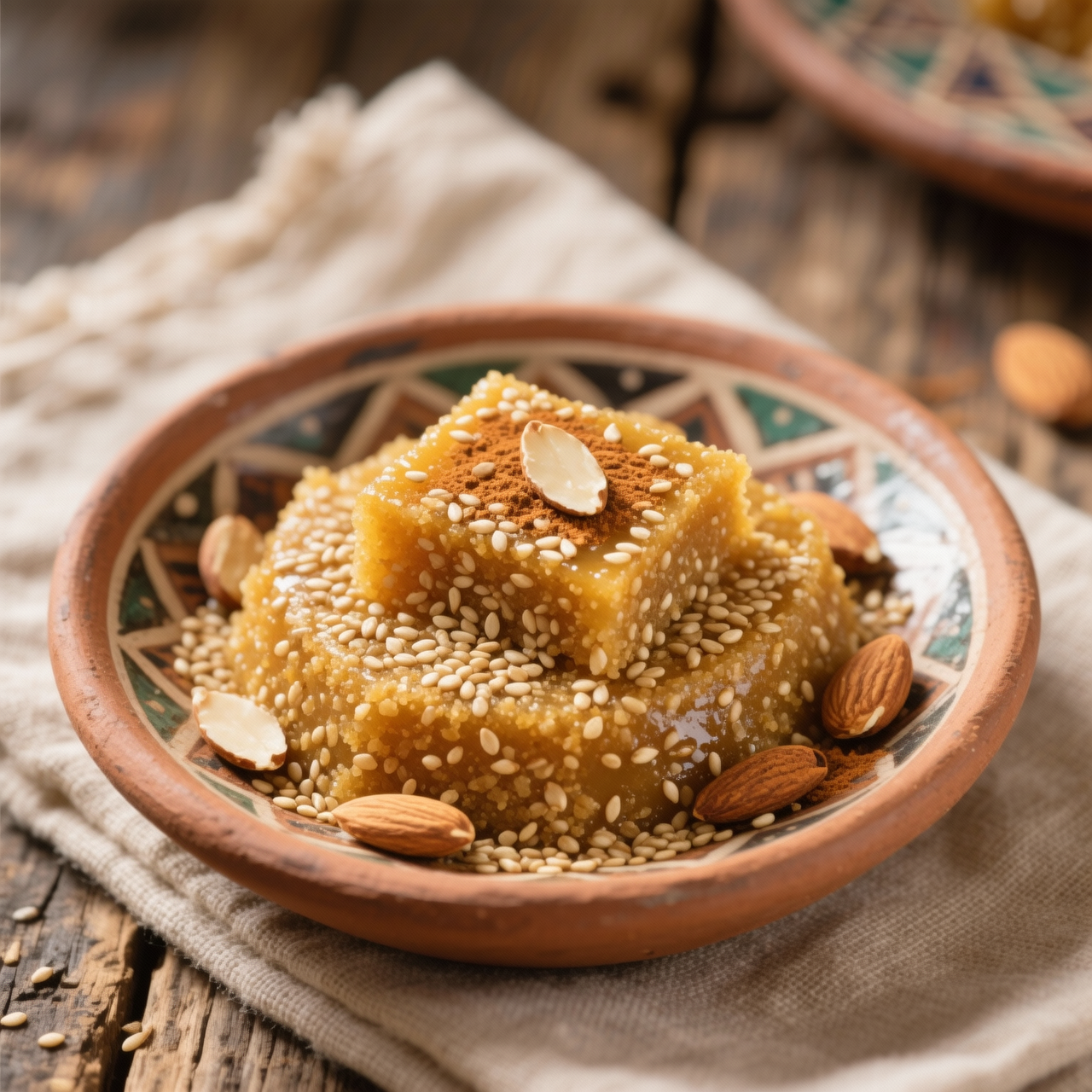
Sellou (sesame-almond sweet)
I first encountered sellou during a long Ramadan evening in Fez, where it wasn’t treated as a mere sweet, but as a sustaining, almost ceremonial energy paste meant to carry families through fasting hours. At its heart lies toasted wheat flour, slow-roasted until it smells of toasted hazelnuts and warm earth, then blended with ground almonds, sesame seeds, warm spices like fennel and cinnamon, and bound with melted butter and honey. This matters because the modern snack aisle has flooded us with mass-produced energy bites and protein bars that retail for nearly five pounds a box. Those shop-bought impostors rely on palm oil, isolated soy protein, and synthetic stabilisers to mimic texture, sacrificing depth for shelf stability and leaving you with a chalky, one-note sweetness that vanishes on the tongue. True sellou demands patience, but rewards it with a profoundly layered, nutty richness that actually nourishes rather than just spikes your blood sugar. The most common pitfall I see is rushing the flour toast. If the pan is too hot, the wheat burns bitter before it develops its signature amber depth. If it’s too cool, you’ll end up with a raw, pasty grit instead of a melt-in-your-mouth paste. You must stir constantly over medium-low heat for at least twenty minutes, trusting your nose more than the clock, and allow the mixture to cool completely before working in the warm butter and honey. Only then will the fats emulsify properly, yielding that dense, fudge-like consistency that keeps beautifully in a cool pantry. When you finally press it into a jar and slice off a piece, you’re tasting centuries of Moroccan hospitality, not a factory line.
Nutrition
| Per serving | Calories | Protein | Carbs | Fat | Sat fat | Fibre | Sugar | Sodium |
|---|---|---|---|---|---|---|---|---|
| beginner | 520kcal | 11g | 48g | 32g | 4g | 5g | 14g | 15mg |
| intermediate | 295kcal | 5g | 34g | 15g | 5g | 2g | 14g | 30mg |
| expert | 395kcal | 8g | 38g | 23g | 6g | 4g | 15g | 8mg |
Per serving · Ava-estimated — a guide, not a clinical figure.
- 500 gall-purpose flour— Sift before toasting for even browning
- 200 galmond— Blanched and lightly toasted
- 100 gsesame seed— Hulled or unhulled, toasted until fragrant
- 200 gunsalted butter— Clarified butter or smen can be substituted
- 150 mlhoney— Warm slightly to improve mixability
- 10 ganise seed— Dry-toasted and finely ground
- 5 gcinnamon— Freshly ground for optimal aroma
- 30 mlorange blossom water(optional)— Adds traditional floral notes
- 2 gsalt— Fine sea salt balances sweetness
Store-bought sellou often masks low-quality, pre-toasted flour with excessive refined sugar and cheap hydrogenated oils, costing up to twelve dollars a pound while delivering a gritty, artificial aftertaste. This beginner-friendly version skips the commercial blend but keeps the authentic energy-dense profile by simplifying the traditional technique. Instead of the constant vigilance required for slow-smen toasting, you will use a wider pan and steady medium-low heat to toast plain flour until deeply golden and fragrant, which drastically reduces scorch risk. A food processor replaces the laborious mortar-and-pestle grind, giving you a uniformly fine crumb without overworking the natural oils in the almonds and sesame seeds. Watch the flour color closely during toasting; it should match the shade of peanut butter, not dark caramel, as residual heat will continue browning it off the stove. The honey-butter binder is gently warmed to ensure it coats every particle without making the dough greasy. Pressing firmly into an oiled dish guarantees clean slices that hold together for weeks in the pantry, making batch preparation effortless and reliable.
Equipment
- Wide heavy-bottomed skillet— large surface area ensures even, forgiving toasting
- Food processor— standard blade attachment
- 8x8 inch baking dish— line with parchment for easy removal
- Rubber spatula— heat-resistant for mixing
Method
- 1
Spread the flour evenly across the wide skillet and toast over medium-low heat, stirring constantly until it turns a uniform golden brown and smells deeply nutty.
Keep heat moderate to prevent scorching; the color will darken slightly off the heat.
dry-toasting~ 15 min - 2
Transfer the toasted flour to a large mixing bowl and quickly wipe the pan clean with a dry towel.
Remove every trace of burnt residue to protect the delicate flavor of the nuts.
transferring~ 1 min - 3
Add the raw almonds and sesame seeds to the clean pan and toast over medium heat until lightly fragrant, then spread them on a plate to cool completely.
Cooling prevents the nuts from sweating and clumping during grinding.
roasting~ 5 min - 4
Pulse the cooled nuts and seeds in a food processor until finely ground but not oily, then fold the powder into the toasted flour.
Stop pulsing as soon as the mixture resembles coarse breadcrumbs to avoid releasing too much nut oil.
pulsing~ 2 minTricky bit - 5
Warm the honey and butter together in a small saucepan until the butter melts, then pour the liquid over the dry ingredients and fold until a cohesive, clumping dough forms.
The mixture should hold together when squeezed without leaving greasy residue on your fingers.
binding~ 3 min - 6
Pack the dough tightly into the oiled rectangular dish, smooth the surface with the back of a spoon, and refrigerate until completely firm.
Firm pressing is critical for clean slices and long-term pantry storage.
setting~ 10 min
Cooking from frozen
Thaw overnight in the fridge to restore its pliable, fudgy texture.
Storage times are a guide — always use your judgement and store food safely.