
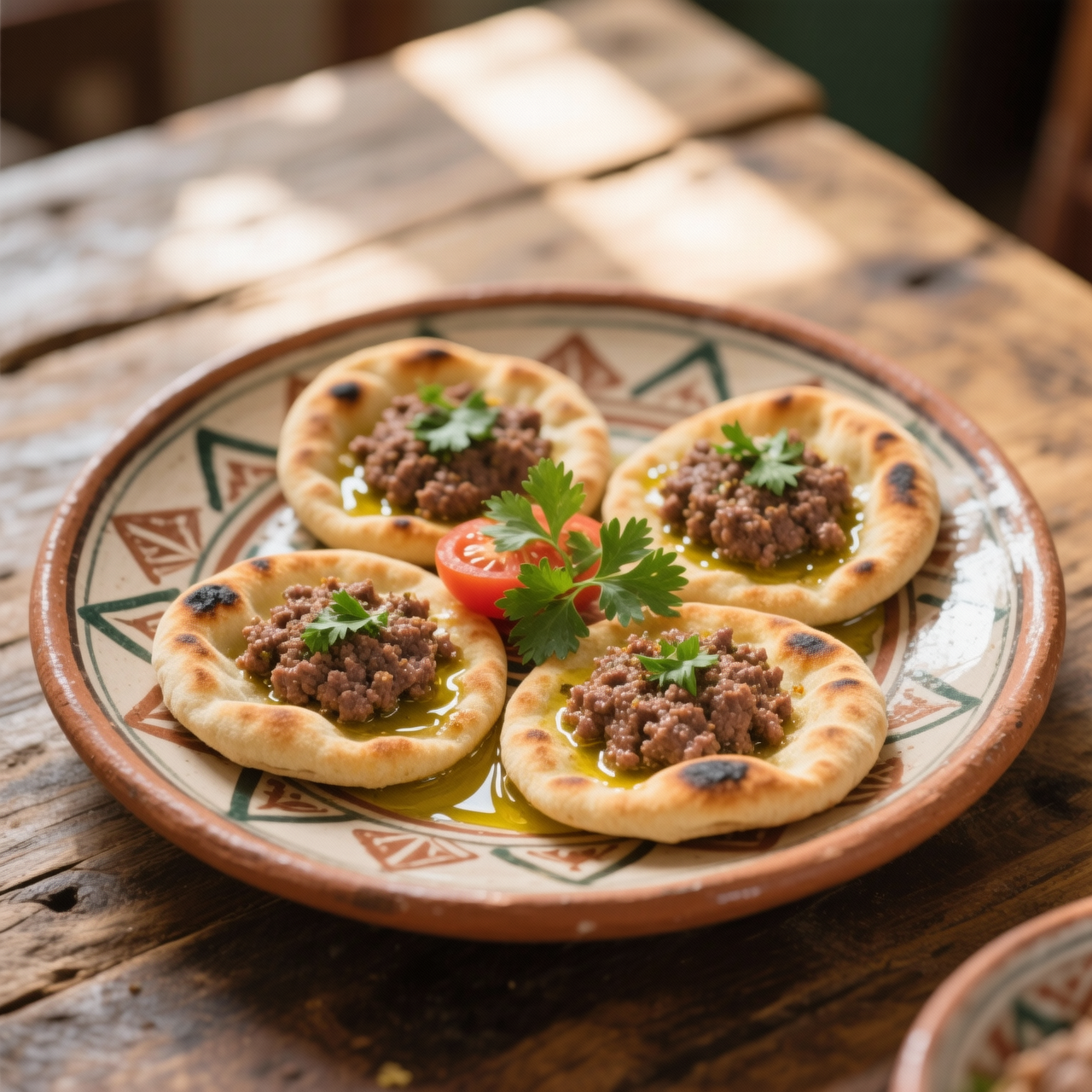
Sfiha (meat flatbreads)
I’ve always believed that the true soul of Lebanese street food lives in the quiet corners of neighborhood bakeries, where sfiha was never meant to be a mass-produced afterthought. Born in the Levant and perfected across generations, these open-faced meat flatbreads were originally a humble way to stretch precious minced beef, stretching it with bright pomegranate molasses, toasted pine nuts, and warming spices like seven-spice. Today, you can easily find them in supermarket freezers, usually boxed and priced around six pounds for four pale, doughy rounds. The shop-bought versions are almost always heavy on cheap fillers, bland with preservatives, and wrapped in a dough that turns leathery the moment it’s microwaved. Making them from scratch restores their rightful character: a crisp, blistered crust giving way to a richly spiced, tangy beef topping that actually tastes like home. The biggest pitfall I see cooks stumble into is overworking the dough or drowning the meat mixture in liquid, which guarantees a soggy centre and tough edges. You must keep your hands cold, knead just until the gluten relaxes, and trust that a brief, high-heat bake is all it takes to set the topping without drying it out. Another common mistake is skipping the resting stage; letting the dough relax ensures it stretches without springing back, giving you that perfect, thin base. When you build these by hand, you control every layer of flavour and texture. The result isn’t just a snack—it’s a deeply satisfying ritual that freezes beautifully, ready to pull from the oven whenever hunger strikes, proving that taking the long way home is always worth the extra effort.
Nutrition
| Per serving | Calories | Protein | Carbs | Fat | Sat fat | Fibre | Sugar | Sodium |
|---|---|---|---|---|---|---|---|---|
| beginner | 495kcal | 28g | 46g | 18g | 5g | 4g | 8g | 640mg |
| intermediate | 480kcal | 28g | 45g | 20g | 6g | 4g | 6g | 780mg |
| expert | 345kcal | 24g | 36g | 13g | 4g | 3g | 7g | 590mg |
Per serving · Ava-estimated — a guide, not a clinical figure.
- 500 gall-purpose flour— For dough base
- 7 ginstant yeast
- 15 gsalt— Divided between dough and filling
- 15 gsugar— To activate yeast
- 90 mlolive oil— Divided between dough and filling
- 300 mlwarm water
- 400 gground beef— Lean, finely ground
- 200 gonion— Finely diced or grated
- 30 gtomato paste
- 45 mlpomegranate molasses
- 10 ggarlic— Minced
- 5 gallspice
- 3 gground cinnamon
- 3 gground cumin
- 2 gblack pepper— Freshly ground
- 30 gpine nut(optional)— Lightly toasted
This beginner-friendly approach to Lebanese sfiha strips away the intimidation of traditional flatbread making while keeping the recipe entirely from-scratch. Instead of relying on expensive, additive-heavy frozen versions from the grocery aisle—which often cost upwards of eight dollars for a bland, dough-heavy pack loaded with preservatives and stabilisers—you will craft a vibrant, meaty topping on a tender, quick-rising dough you can mix by hand. The key difference here is a streamlined proofing window and a forgiving dough hydration that resists tearing, allowing you to stretch and fill without wrestling with sticky gluten development. Watch your filling’s moisture closely; if the onions and tomatoes release too much liquid, the flatbreads will turn soggy. A quick pre-cook of the beef mixture solves this while concentrating flavour. When assembling, leave a narrow border around each circle so the topping doesn’t spill during baking. These freeze exceptionally well part-baked, making them ideal for weeknight snacks. Simply cool slightly, stack with parchment, and freeze. Reheat straight from the freezer for a crisp, homemade result that outshines any supermarket shortcut.
Equipment
- Large mixing bowl— at least four-litre capacity
- Rolling pin— wooden or silicone
- Heavy-bottomed skillet— for drying the meat topping
- Two rimmed baking sheets— lined with parchment paper
Method
- 1
Combine flour, instant yeast, salt, sugar, olive oil, and warm water in a bowl until a cohesive dough forms.
Water should feel comfortably warm, roughly forty degrees Celsius, to activate the yeast safely.
hydration~ 5 min - 2
Knead the dough on a clean surface for five minutes until smooth, then place in a covered bowl and rest for forty minutes.
The dough is ready when a gentle poke slowly springs back.
bulk fermentation~ 40 min - 3
Brown the ground beef in a skillet over medium heat, then add diced onion, chopped tomato, olive oil, and spices, cooking until all excess moisture evaporates.
A dry topping prevents the flatbread base from turning soggy during baking.
reduction~ 10 minTricky bit - 4
Divide the dough into equal portions, roll each into a thin circle, and spread a thin, even layer of the cooled meat mixture across the surface.
Keep a narrow border free of topping to contain juices and ensure a crisp edge.
shaping~ 8 minTricky bit - 5
Bake the flatbreads on a hot tray until the edges turn golden and the meat topping sets.
For freezing, stop when the dough just sets, cool completely, then stack with parchment paper.
par-baking~ 15 min
Cooking from frozen
Bake directly from frozen at 200°C for 12–15 minutes until the crust is golden and the meat is piping hot.
Storage times are a guide — always use your judgement and store food safely.