
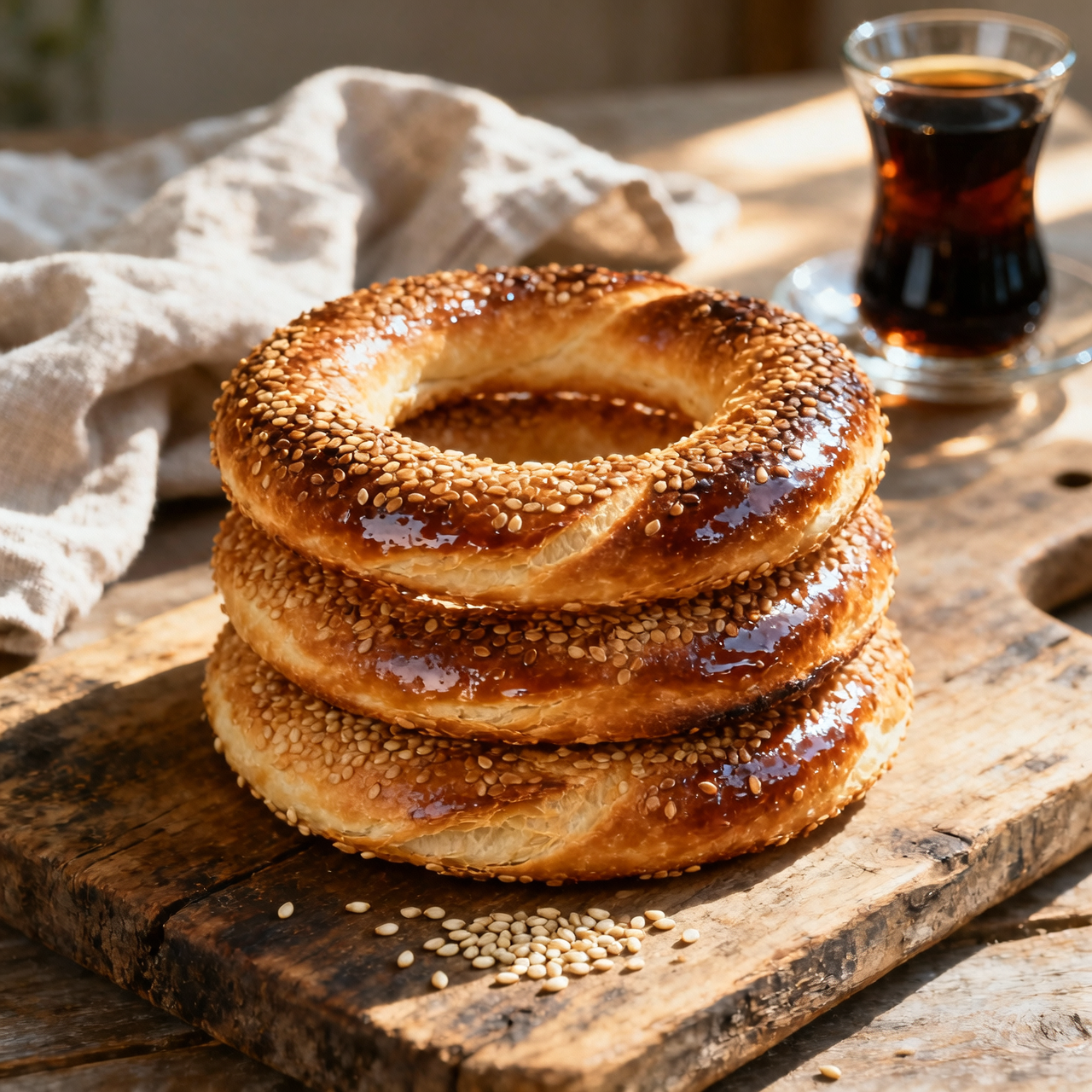
Simit (sesame bread ring)
I have always been captivated by the simit, that gleaming, sesame-crusted ring that anchors Turkish mornings. Historically traced to the Ottoman imperial kitchens and immortalised by street vendors who once sold them from brass trays balanced on their heads, this bread is more than a simple carb delivery system; it is a daily ritual. A truly great simit balances a shatteringly crisp, mahogany crust with a tender, slightly chewy crumb that yields without collapsing. The sesame coating must adhere uniformly, toasted to a nutty fragrance, while the interior carries a faint, natural sweetness from grape molasses and a whisper of olive oil. Most home attempts fail at the shaping stage, leaving uneven rings that bake into dense, pale pucks, or they skip the traditional alkaline dip, sacrificing that signature glossy finish. You will find packaged, vacuum-sealed versions in supermarkets for roughly two pounds, but they are a hollow compromise: dry, overly sweetened, and coated in a stale, oxidised layer of seeds that flakes away at the first bite. Making it from scratch takes barely more time than waiting for a delivery, yet returns a living, breathing bread that snaps audibly when torn. The process is forgiving if you respect the dough’s hydration and give the yeast a proper environment to bloom. My library presents three paths to this same result, all using identical, uncompromising ingredients. Whether you are folding your first ring or mastering the traditional stretch-and-twist, the reward is the same: a warm, fragrant circle that tastes like the Bosphorus itself.
Nutrition
| Per serving | Calories | Protein | Carbs | Fat | Sat fat | Fibre | Sugar | Sodium |
|---|---|---|---|---|---|---|---|---|
| beginner | 710kcal | 19g | 102g | 23g | 3g | 4g | 7g | 800mg |
| intermediate | 710kcal | 19g | 102g | 23g | 3g | 4g | 7g | 800mg |
| expert | 710kcal | 19g | 102g | 23g | 3g | 4g | 7g | 800mg |
Per serving · Ava-estimated — a guide, not a clinical figure.
- 500 gstrong white bread flour— 12% protein minimum for optimal gluten structure
- 260 mlwarm water— approximately 38°C to activate yeast without killing it
- 7 ginstant yeast— freshly opened for reliable leavening
- 10 gcaster sugar— feeds the yeast and aids crust caramelisation
- 8 gfine sea salt— strengthens gluten and balances flavour
- 30 mlextra virgin olive oil— adds tenderness and subtle fruitiness
- 45 ggrape molasses— traditional pekmez, provides the signature dark glaze
- 120 graw sesame seeds— untoasted for maximum adhesion during baking
- 2 gbaking soda— creates alkaline wash for deep Maillard browning
- 600 mlwater— reserved exclusively for the dipping bath
Focuses on reliability and forgiving technique. Uses a standard stand mixer or vigorous hand-kneading for gluten development, a simple roll-and-twist method instead of complex stretching, and a straightforward dip-and-roll process. The goal is consistent hydration and even shaping without overthinking gluten development. Watch for dough that feels too sticky during mixing; resist adding extra flour, which will immediately compromise the soft, open crumb you are aiming for. The proofing stage is kept brief but sufficient, relying on properly warmed water to kickstart the yeast quickly. Shaping is achieved by rolling a uniform log, cutting it cleanly, and joining the ends rather than stretching a long rope, which prevents accidental tearing or thin spots. The molasses dip uses a wide, shallow bowl to ensure full, rapid coverage, and the bake is monitored closely by colour rather than strict timing. This path guarantees a successful, bakery-worthy ring on your very first attempt, proving that gentle handling and patience matter far more than pedigree.
Equipment
- large mixing bowl— non-reactive material preferred
- baking sheet— line with parchment for easy release
- rolling pin— standard wooden type
- silicone spatula— for folding and scraping
Method
- 1
Dissolve the instant yeast and caster sugar in the warm water and let it sit until frothy.
Foam indicates active yeast.
blooming~ 5 min - 2
Combine the bread flour, fine sea salt, and olive oil in a large bowl and mix until a shaggy mass forms.
Do not overmix at this stage.
hydration~ 2 min - 3
Knead the dough vigorously by hand or with a dough hook until smooth and elastic.
Surface should be tacky but not sticky.
kneading~ 8 minTricky bit - 4
Cover the bowl and let the dough rest in a warm spot until it visibly relaxes and doubles slightly.
A kitchen towel works well to trap humidity.
resting~ 15 min - 5
Divide the dough into four equal pieces, roll each into a short rope, and press the ends together to form rings.
Seal seams thoroughly to prevent splitting.
shaping~ 5 min - 6
Whisk the grape molasses with the baking soda and reserved dipping water in a wide, shallow dish.
Baking soda will fizz slightly.
whisking~ 1 min - 7
Dip each ring into the diluted molasses for five seconds, then press generously into a tray of raw sesame seeds.
Rotate quickly for even coating.
coating~ 2 minTricky bit - 8
Bake the rings on a lined tray until deeply golden and hollow-sounding when tapped.
Rotate tray halfway for uniform colour.
baking~ 25 min
Cooking from frozen
Defrost overnight in the fridge, then reheat in a 180°C oven for 8-10 minutes until crisp.
Storage times are a guide — always use your judgement and store food safely.