
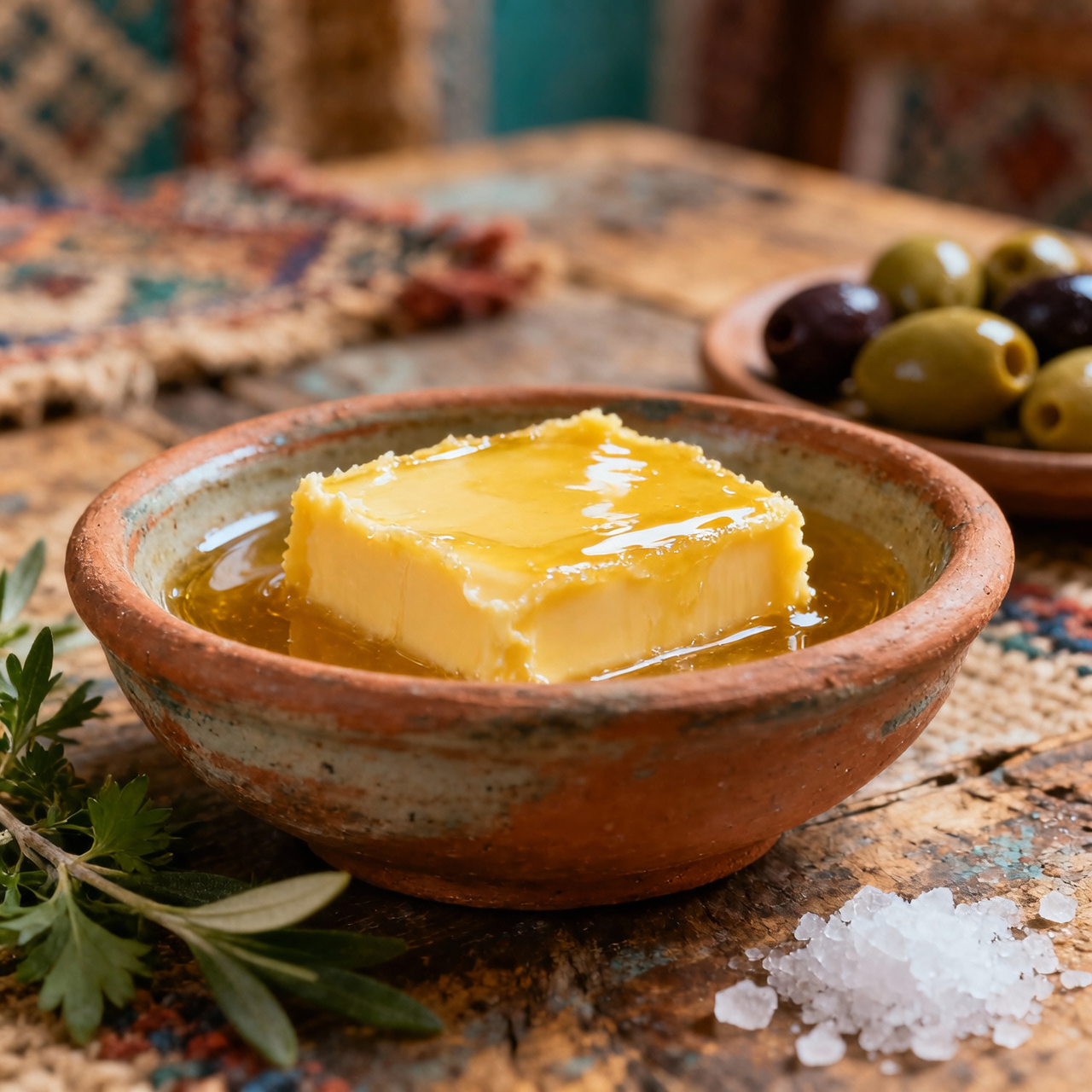
Smen (fermented butter)
I first encountered smen in a Marrakech kitchen, where an elderly cook lifted the heavy clay lid off a cellar jar and the air instantly grew thick with the scent of sharp blue cheese, toasted nuts, and sun-warmed earth. This Moroccan fermented butter is far more than a cooking fat; it is a centuries-old preservation method that transforms simple salted butter into a deeply umami-rich, tangy powerhouse. Unlike the sterile, one-note aged butters you sometimes spot on specialty shelves for fifteen to twenty dollars a tiny jar—which are often rushed with commercial starters or masked with artificial flavor enhancers—true smen relies entirely on slow, natural fermentation and patient aging. Making it from scratch is remarkably economical and strips away the shortcuts that rob the butter of its complex, living character. The process itself is deceptively simple but unforgiving if rushed. The most common pitfall is failing to wash the curds out completely during the initial clarification; any lingering buttermilk will sour into rancidity rather than clean fermentation. Another frequent mistake is using iodized salt or skipping the sterilization of your storage vessel, both of which disrupt the delicate microbial ecosystem. Smen demands time, cool cellar temperatures, and a respectful distance from modern kitchen impatience. Yet, when you finally spoon a pinch of properly aged smen into a simmering tagine or fold it into dough for msemen, the result is a profound, savory depth that no factory-processed shortcut could ever hope to replicate. It is a testament to how patience and tradition can elevate the most humble ingredients into something extraordinary.
Nutrition
| Per serving | Calories | Protein | Carbs | Fat | Sat fat | Fibre | Sugar | Sodium |
|---|---|---|---|---|---|---|---|---|
| beginner | 105kcal | 0g | 0g | 12g | 7g | 0g | 0g | 240mg |
| intermediate | 205kcal | 0g | 0g | 24g | 15g | 0g | 0g | 290mg |
| expert | 190kcal | 0g | 1g | 22g | 14g | 0g | 0g | 410mg |
Per serving · Ava-estimated — a guide, not a clinical figure.
- 500 gunsalted butter— High-fat cultured or European-style butter yields the best fermentation
- 20 gcoarse sea salt— Essential for preservation and traditional flavor development during aging
- 5 gdried thyme(optional)— Traditional aromatic added for earthy depth during cellaring
This beginner-friendly approach demystifies traditional Moroccan smen by replacing unpredictable cellar aging with a controlled, short-term fridge fermentation that still delivers that signature funky, tangy depth. Unlike commercial aged butter spreads or flavored ghee—which typically cost eight to ten dollars a jar and rely on artificial flavorings, stabilizers, and pasteurization that strip away live cultures—this method relies entirely on real, unadulterated ingredients and natural lactic fermentation. You will gently clarify high-quality unsalted butter, carefully remove the milk solids to prevent spoilage, and blend it with precise amounts of sea salt and toasted fenugreek. The key difference at this level is the emphasis on strict sterilization and temperature management, ensuring a safe, reproducible result without needing a root cellar or months of waiting. Watch closely during the simmering phase; the butter must reach a steady, gentle bubble without browning, and the milk solids should turn a pale gold rather than deep brown. Once strained and seasoned, the mixture is packed tightly into a sterilized glass jar. Though traditional smen matures for months, this version achieves a bright, complex profile after just two weeks in the refrigerator, making it an accessible, pantry-stable foundation for tagines and couscous.
Equipment
- Heavy-bottomed saucepan— light-colored interior helps monitor browning
- Fine-mesh strainer— line with double-layer cheesecloth
- Sterilized glass jar— 16-ounce capacity with tight seal
- Instant-read thermometer(optional)— optional but prevents overheating
Method
- 1
Place high-quality unsalted butter in the heavy-bottomed pan and melt over medium-low heat until fully liquid.
Do not rush the melt; gentle heat preserves the milk proteins.
clarifying~ 2 min - 2
Reduce heat to low and maintain a bare simmer, allowing water to evaporate and milk solids to separate and sink to the bottom.
The surface should show tiny, steady bubbles, not a rolling boil.
simmering~ 10 minTricky bit - 3
Skim the white foam from the surface, then slowly pour the clear golden liquid through the cheesecloth-lined strainer into a clean bowl.
Leave the dark sediment completely behind to avoid spoilage.
straining~ 3 minTricky bit - 4
Whisk fine sea salt and lightly crushed toasted fenugreek seeds into the warm clarified butter until completely dissolved.
Salt acts as the primary fermentation starter and preservative.
seasoning~ 1 min - 5
Transfer the seasoned mixture into the sterilized glass jar, tap firmly on the counter to release trapped air, and seal tightly.
Store in the back of the refrigerator for at least fourteen days to develop flavor.
aging~ 1 min
Cooking from frozen
Thaw slowly in the refrigerator and stir gently to restore texture before using directly in cooking.
Storage times are a guide — always use your judgement and store food safely.