
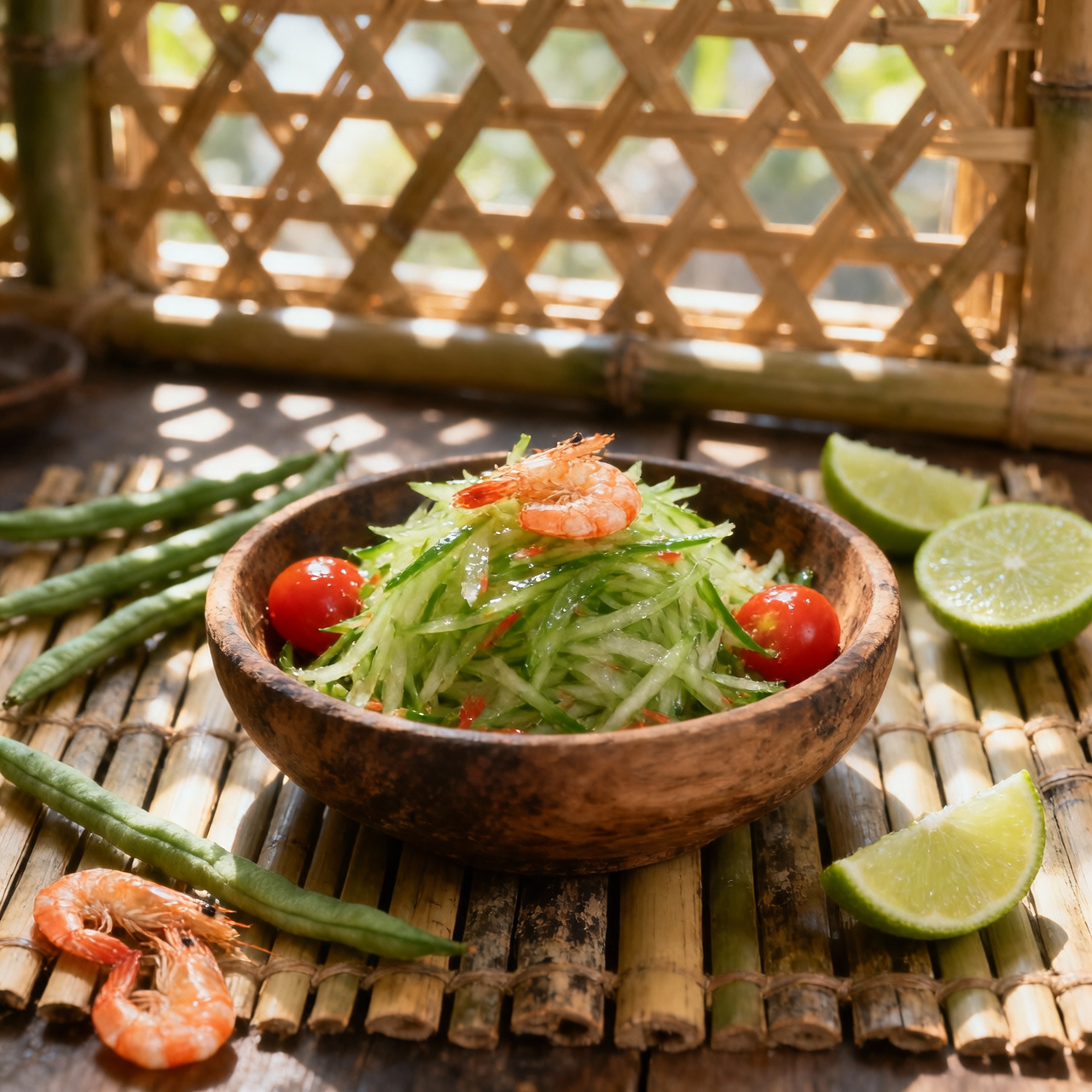
Som Tum
I still remember the first time I truly understood the rhythm of the mortar and pestle, the heavy stone echoing through a humid Bangkok kitchen as I pounded garlic, chilies, and palm sugar into a fragrant paste. Som Tum, Thailand’s beloved green papaya salad, is far more than a starter on a restaurant menu; it is a living conversation between land and palate, born in the Isan region where resourcefulness meets bold flavor. Traditionally, farmers relied on unripe papaya and fermented fish sauce to stretch meals, transforming humble ingredients into something vibrant and deeply satisfying. To me, mastering this dish means honoring that resilience while respecting the delicate balance of sour, salty, sweet, and spicy that defines Thai cuisine. The beauty of Som Tum lies in its immediacy, yet it’s also where most cooks stumble. I’ve watched well-meaning chefs drown the salad in lime juice or skip the crucial step of bruising the chilies and garlic to release their essential oils, leaving the dressing sharp and one-dimensional. Another frequent misstep is overworking the papaya, turning it into mush instead of preserving that essential crisp bite. The mortar isn’t meant to pulverize; it’s meant to coax. When you taste a properly made Som Tum, the flavors should arrive in waves, each element distinct yet perfectly intertwined. It’s a dish that demands patience, intuition, and a willingness to listen to the ingredients rather than force them. That’s why I keep returning to it, again and again.
Nutrition
| Per serving | Calories | Protein | Carbs | Fat | Sat fat | Fibre | Sugar | Sodium |
|---|---|---|---|---|---|---|---|---|
| beginner | 155kcal | 8g | 21g | 5g | 1g | 4g | 13g | 1135mg |
| intermediate | 155kcal | 8g | 21g | 5g | 1g | 4g | 13g | 1135mg |
| expert | 155kcal | 8g | 21g | 5g | 1g | 4g | 13g | 1135mg |
Per serving · Ava-estimated — a guide, not a clinical figure.
- 300 gGreen papaya— firm, unripe, peeled and seeded
- 100 gLong bean— trimmed to 5 cm segments
- 80 gCherry tomato— halved, ripe but firm
- 15 gGarlic— fresh cloves, peeled
- 10 gThai bird chili— fresh, stems removed
- 45 mlFish sauce— clear amber, premium quality
- 25 gDried shrimp— small, rinsed and patted dry
- 40 gRoasted peanut— unsalted, lightly toasted
- 20 gPalm sugar— solid block or granulated
- 45 gLime— freshly juiced, seeds removed
This pathway removes the intimidation factor by streamlining the most demanding techniques. Instead of relying on a heavy stone mortar, you will use a box grater for the papaya and a sturdy rolling pin to bruise the aromatics inside a sealed bag. The dressing is prepared separately in a bowl, allowing you to taste and adjust the balance before combining. Watch closely for texture: the papaya should yield a slight resistance when bitten, not turn mushy. If you over-process, the dish loses its signature crunch. The key is to work methodically, tasting after each addition of fish sauce or lime. Beginners often rush the sweet-sour-salty equilibrium, so keep a mental note of your ratios. This method guarantees a vibrant, restaurant-ready result on your first try. Focus on clean cuts, gentle bruising, and confident seasoning. You are not aiming for perfection; you are building muscle memory for flavor balancing. Trust your palate over rigid measurements. The shortcuts here are bridges, not compromises, designed to get you comfortable with the core flavor profile before advancing to traditional tools.
Equipment
- Box grater— medium shredding holes work best
- Heavy rolling pin— wooden or metal
- Large mixing bowl— stainless steel or glass
- Whisk— small wire whisk
Method
- 1
Grate the green papaya into a large mixing bowl using a box grater.
Aim for thin, uniform shreds that mimic julienne cuts.
julienne~ 2 min - 2
Crush the garlic and chilies inside a heavy zip-top bag using a rolling pin.
Press firmly until the skins split and release their oils.
bruising~ 2 min - 3
Whisk together the fish sauce, lime juice, and dissolved palm sugar in a separate bowl.
Stir until the sugar fully integrates and no crystals remain.
dissolving~ 1 min - 4
Toss the grated papaya, long beans, halved tomatoes, and dried shrimp in a large bowl.
Ensure the vegetables are evenly distributed before adding dressing.
tossing~ 1 min - 5
Pour the dressing over the vegetables and fold gently until evenly coated.
Stop mixing as soon as the shreds glisten to prevent sogginess.
folding~ 1 min