
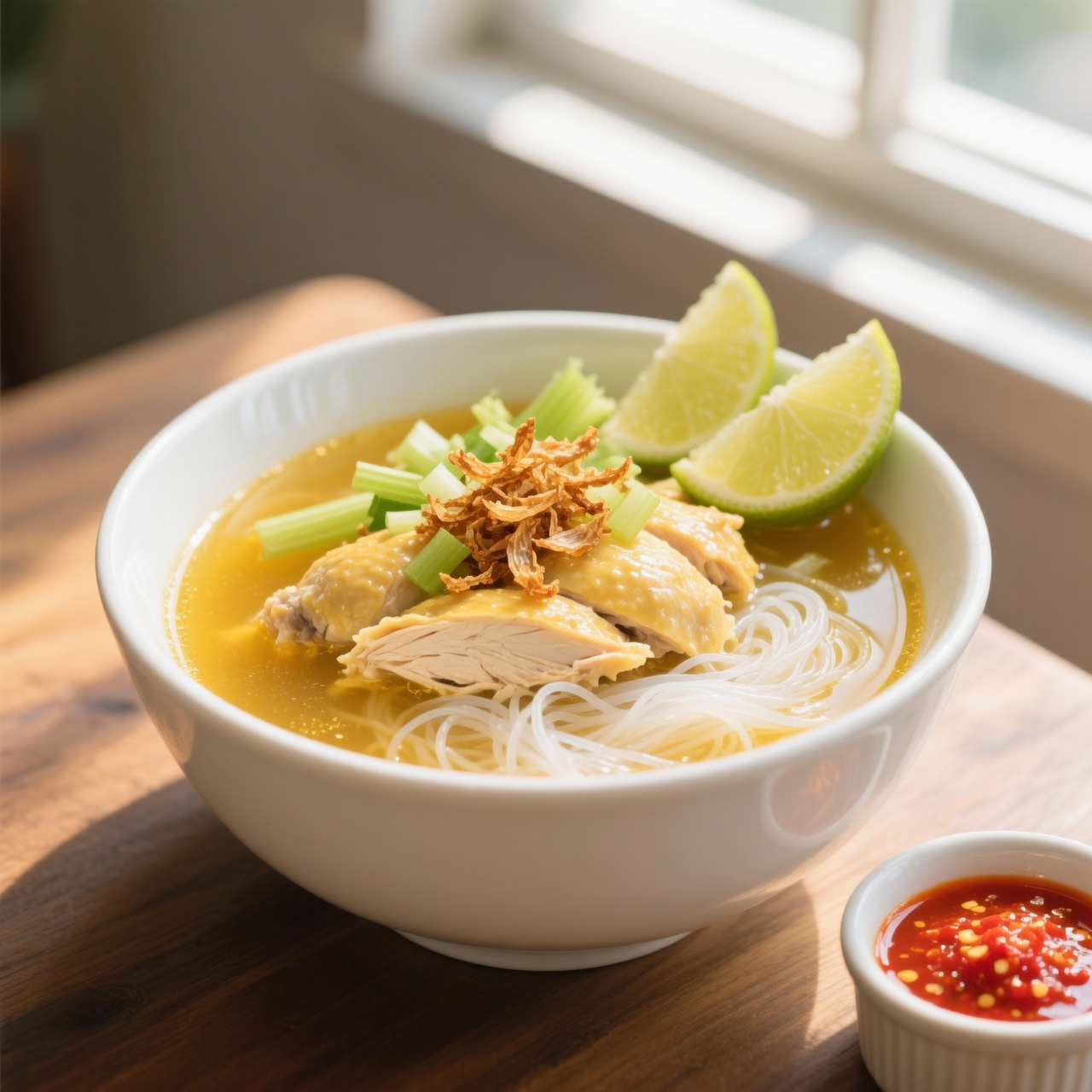
Soto Ayam
Ingredients
- 500 gchicken breast— boneless, skinless, preferably free-range
- 2000 mlwater— for broth base
- 3 piecelemongrass stalk— tender white inner cores only, bruised
- 40 ggalangal root— fresh, peeled and sliced
- 30 gturmeric root— fresh, peeled and roughly chopped
- 100 gshallot— peeled, Asian red variety preferred
- 20 ggarlic clove— peeled
- 40 gcandlenut— lightly toasted, skin removed
- 5 gcoriander seed— whole
- 3 gcumin seed— whole
- 2 gwhite peppercorn— whole
- 4 leafkaffir lime leaf— fresh or frozen, veins removed
- 10 gfine sea salt
- 15 gpalm sugar— shaved or crushed
- 30 mlvegetable oil— for sautéing
- 150 grice vermicelli— dried, thin gauge
- 20 gcelery— finely chopped, leaves reserved
- 20 gfried shallot— for garnish
- 1 piecelime— quartered, for serving
- 15 mlsweet soy sauce— kecap manis
- 15 gsambal ulek— coarse chili paste
Method
Pick a skill levelThis version strips away the technical friction so you can experience the soul of the dish without intimidation. Instead of grinding raw spices and mastering the delicate bloom, you will rely on a high-quality jarred soto paste that delivers the foundational flavor profile instantly. The focus shifts entirely to broth management and assembly. You will learn to gently poach the chicken rather than boiling it aggressively, which preserves a clean, translucent liquid—the hallmark of a proper soto. Pay close attention to the simmer; a rolling boil will cloud your broth and toughen the meat. When seasoning, add salt and palm sugar gradually, tasting as you go, because commercial pastes vary wildly in sodium and sweetness. The assembly stage is just as important as the cooking. Properly soaking and draining the rice vermicelli prevents them from clumping, while layering the garnishes—crisp celery, toasted shallots, and a bright lime squeeze—transforms a simple soup into a complete sensory experience. Watch your heat closely, trust your palate, and do not rush the resting phase. This pathway guarantees a confident first attempt that tastes authentic, balanced, and deeply comforting.
Method
- 1
Bring two liters of water to a rolling boil in a large pot.
Use a wide base for even heat distribution.
boiling~ 5 min - 2
Submerge the chicken breasts and immediately reduce to a gentle simmer for twenty minutes.
Cover partially to maintain temperature.
poaching~ 20 min - 3
Remove the chicken, reserve the cooking liquid, and shred the meat while still warm.
Use two forks for clean separation.
shredding~ 3 min - 4
Heat oil in a separate pan, add the jarred spice paste, and warm for two minutes until fragrant.
Stir constantly to prevent scorching.
warming~ 2 min - 5
Pour the warmed paste into the reserved broth, add lemongrass and lime leaves, then season with salt and palm sugar.
Taste after every addition.
blending~ 2 min - 6
Soak vermicelli in hot water until pliable, drain, place in bowls, and ladle the seasoned broth and chicken over them.
Do not let noodles sit in liquid too long.
assembling~ 5 minTricky bit
Here you step into the rhythm of a confident home cook, trading convenience for control. You will build the spice paste from scratch, toasting whole seeds and grinding them with aromatics to unlock their volatile oils. The critical skill at this level is the bloom: frying the paste in hot oil until it separates and darkens slightly, which eliminates raw harshness and deepens the flavor foundation. You will learn to manage the broth temperature with intention, keeping it at a bare simmer to extract maximum collagen and clarity without agitation. Shredding the chicken while it is still warm allows the fibers to separate cleanly and reabsorb the seasoned liquid. The timing is calibrated to fit within an hour, making it practical for weeknights without sacrificing authenticity. Watch for the moment the oil begins to pool on the surface of the simmering broth—that is your cue that the paste has fully integrated. Season deliberately, remembering that palm sugar should provide a subtle roundness, not overt sweetness. Assemble the bowl thoughtfully, ensuring the noodles are thoroughly rinsed to remove excess starch. This version bridges everyday cooking and culinary craft, rewarding patience with a broth that tastes layered, bright, and unmistakably homemade.
Method
- 1
Toast the coriander, cumin, and white peppercorns in a dry pan until fragrant, then cool.
Shake constantly to avoid uneven browning.
toasting~ 2 min - 2
Grind the toasted spices, shallots, garlic, turmeric, and candlenuts into a coarse paste using a food processor.
Add a splash of water if blades stall.
grinding~ 3 min - 3
Heat oil in a heavy pot, add the spice paste, and sauté until the oil separates and the aroma deepens.
Lower heat if the edges begin to stick.
blooming~ 5 minTricky bit - 4
Pour in two liters of water, add the chicken, lemongrass, and lime leaves, then bring to a gentle simmer.
Do not let it reach a rolling boil.
simmering~ 10 min - 5
Maintain a low simmer for twenty-five minutes until the chicken is tender, skimming foam occasionally.
Use a spoon to remove impurities.
clarifying~ 25 min - 6
Remove the chicken, shred it, season the broth with salt and palm sugar, and return the meat.
Adjust seasoning after the chicken reabsorbs liquid.
seasoning~ 5 min - 7
Blanch the vermicelli in boiling water for ninety seconds, drain, and assemble the bowls with broth, chicken, and fresh garnishes.
Rinse briefly under cold water to stop cooking.
blanching~ 4 minTricky bit
This iteration demands full command of traditional technique, treating the soup as a study in extraction, balance, and restraint. You will grind the spice paste by hand in a stone mortar, applying consistent pressure to bruise rather than pulverize, which preserves the structural integrity of the aromatics and yields a cleaner flavor release. The broth is built in two stages: a gentle initial poach to capture the first run of clear stock, followed by a prolonged, barely-there simmer that extracts deep umami without agitation. You will employ a traditional skimming technique, removing impurities and fat in thin layers to achieve a glass-like clarity. The spice paste is bloomed slowly over low heat until the oil separates and the raw edges dissolve completely, a process that cannot be rushed. Candlenuts are dry-roasted to remove their natural oils before grinding, preventing a greasy mouthfeel. Temperature control is paramount; a thermometer ensures the broth never exceeds the ideal extraction range. Garnishes are treated with equal precision: celery leaves are blanched and shocked, shallots are fried in stages for maximum crispness, and the lime is warmed to release more aromatic oils. This is not merely cooking; it is calibration. The result is a restaurant-grade soto that honors its Javanese lineage with absolute transparency and depth.
Method
- 1
Dry-roast the coriander, cumin, and peppercorns over low heat until they release their essential oils.
Listen for the faint crackle before removing from heat.
toasting~ 3 min - 2
Transfer the roasted spices to a stone mortar, add shallots, garlic, turmeric, and toasted candlenuts, then pound into a uniform paste.
Use a circular bruising motion rather than a straight crush.
pounding~ 7 minTricky bit - 3
Heat oil in a heavy stockpot, add the spice paste, and fry slowly over medium-low heat until the mixture darkens and oil pools on the surface.
Patience prevents bitter scorch marks.
blooming~ 8 minTricky bit - 4
Add two liters of water, the whole chicken, bruised lemongrass, and torn lime leaves, then heat to exactly 85 degrees Celsius.
Monitor closely to maintain precise extraction temperature.
infusing~ 5 min - 5
Maintain a precise bare simmer for forty-five minutes, skimming impurities in thin layers without disturbing the liquid.
Tilt pot slightly to gather surface foam.
clarifying~ 45 minTricky bit - 6
Remove the chicken, rest for ten minutes, then shred by hand along the grain.
Resting allows juices to redistribute.
resting~ 10 min - 7
Strain the broth through a chinois, return to the pot, and season with salt and palm sugar to exact balance.
Taste at serving temperature for accuracy.
straining~ 3 min - 8
Soak vermicelli in warm water, drain, arrange in warmed bowls, and ladle the clarified broth and chicken over them with precision garnishes.
Layer textures deliberately for optimal first bite.
plating~ 4 min