
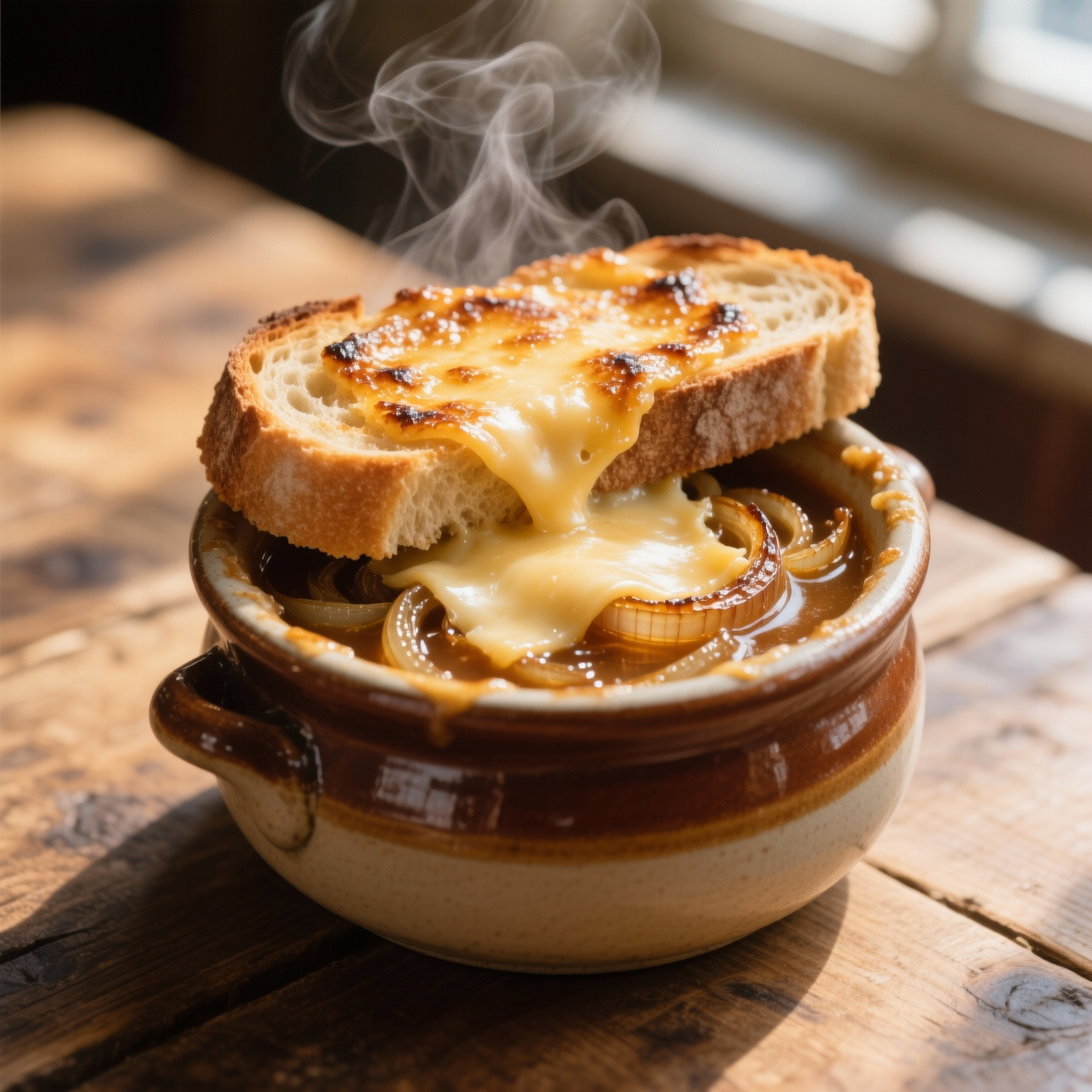
Soupe a l'Oignon
When I first learned to coax the soul out of a mountain of yellow onions, I realized why French bistro cooks treat Soupe à l’Oignon less as a recipe and more as a quiet discipline. Its origins trace back to the humble markets of eighteenth-century Paris, where foraging cooks stretched meager ingredients into something profoundly restorative. To me, this soup matters because it proves that patience is a flavor in its own right. The magic lies not in fancy techniques but in the slow, deliberate breakdown of alliums until they surrender their sharp bite and become deeply sweet. Yet, so many home cooks rush the process, cranking the heat to speed up caramelization, only to burn the sugars and introduce a bitter, acrid edge that no amount of sherry or cheese can mask. Another frequent misstep is neglecting the broth. While some modern variations lean heavily on vegetarian stocks, the canonical version relies on a rich, simmered beef foundation that provides the necessary umami backbone to balance the onions natural sweetness. I have also seen the gratinee ruined by using stale bread that turns to mush or low-melting cheeses that separate into greasy puddles. True success demands a crisp, toasted baguette slice and a proper layer of aged Gruyere or Comte that bubbles and browns under the broiler. When you honor these details, the result is a steaming bowl of liquid comfort that feels like a warm embrace on a cold evening.
Nutrition
| Per serving | Calories | Protein | Carbs | Fat | Sat fat | Fibre | Sugar | Sodium |
|---|---|---|---|---|---|---|---|---|
| beginner | 545kcal | 21g | 50g | 26g | 16g | 6g | 12g | 1100mg |
| intermediate | 545kcal | 21g | 50g | 26g | 16g | 6g | 12g | 1100mg |
| expert | 545kcal | 21g | 50g | 26g | 16g | 6g | 12g | 1100mg |
Per serving · Ava-estimated — a guide, not a clinical figure.
- 1000 gyellow onion— peeled and halved
- 60 gunsalted butter— room temperature
- 150 mldry white wine— un-oaked, such as Sauvignon Blanc
- 1000 mlbeef stock— homemade or high-quality store-bought
- 3 sprigfresh thyme— whole, tied together for easy removal
- 2 leafbay leaf— dried
- 200 gbaguette— day-old, sliced into 1 cm rounds
- 150 gGruyère cheese— freshly grated
- 2 gblack pepper— freshly cracked
This version prioritizes confidence and control over traditional timing. You will use the exact same foundational ingredients, but the workflow is streamlined to prevent common beginner errors like scorching the onions or leaving the cheese under-broiled. Instead of relying on intuition for color changes, we use precise heat settings and visual checkpoints to guide you through each phase. The onions are cooked with a lid for the first half to draw out moisture safely, then uncovered to concentrate their sugars without risking burnt edges. The wine deglaze is handled gently to avoid steam burns, and the broth is added in stages to maintain a steady simmer. For the cheese topping, we recommend pre-slicing your bread and arranging the bowls on a cool baking sheet before transferring to the oven, which eliminates frantic oven movements. Watch closely during the broiling stage; cheese transitions from perfectly melted to scorched in under sixty seconds. Keep a timer visible and step away from distractions. The goal is a deeply flavorful, comforting bowl that proves you do not need decades of bistro experience to achieve restaurant-level results. Trust the process, maintain low heat, and let the ingredients do the heavy lifting.
Equipment
- Heavy-bottomed pot— non-stick or enameled cast iron works well
- Fine mesh strainer(optional)— optional for smoother broth
- Broiler-safe ceramic bowls— standard 16 oz capacity
Method
- 1
Slice the yellow onions into uniform half-moons and place them in the heavy-bottomed pot with the butter.
Use a sharp knife to ensure even thickness.
slicing~ 5 min - 2
Cover the pot and cook the onions over medium-low heat until they soften and release their liquid.
Lid traps steam to accelerate softening.
sweating~ 10 min - 3
Remove the lid, stir occasionally, and cook until the onions reach a pale golden color.
Lower the heat if edges darken too quickly.
caramelizing~ 15 minTricky bit - 4
Pour in the wine to lift the browned bits, then add the beef stock, thyme, bay leaf, and black pepper.
Scrape the bottom gently with a wooden spoon.
deglazing~ 5 min - 5
Simmer the soup uncovered, then ladle into bowls, top with toasted baguette and grated cheese, and broil until bubbly.
Keep bowls on a baking sheet for stability.
broiling~ 4 minTricky bit