
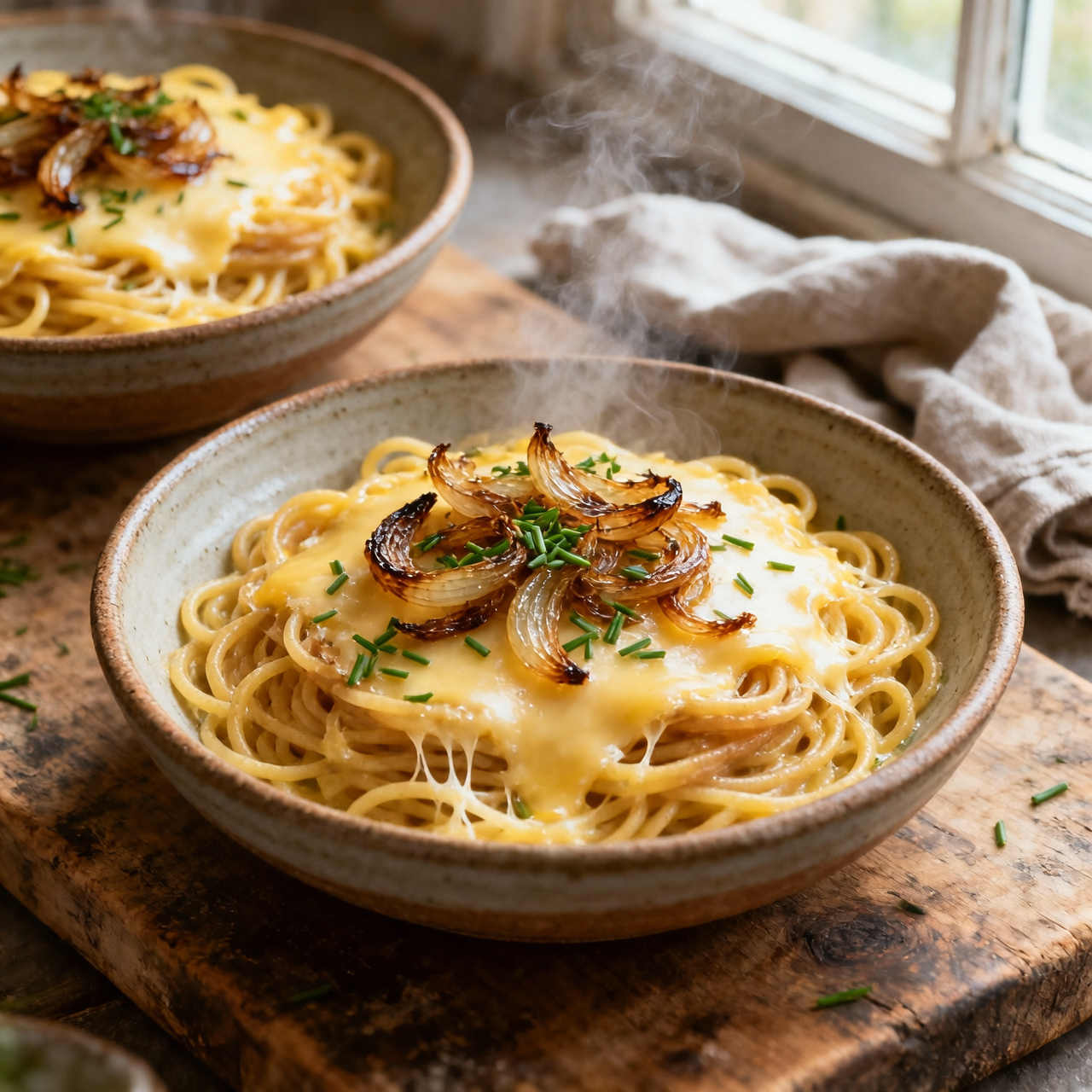
Spaetzle mit Kaese
When I first learned to make spaetzle mit kaese, I didn’t realize I was stepping into a centuries-old conversation between the Swabian and Allgäu kitchens. This dish isn’t merely pasta and cheese; it’s a quiet testament to Alpine resilience, born from the need to stretch simple pantry staples into something deeply nourishing. I’ve always loved how it demands patience and intuition rather than precision. The magic lives in that shaggy, wet dough that refuses to behave like modern pasta, yet yields to a gentle scrape or press. What matters most to me is preserving that tactile honesty. Too often, cooks treat spaetzle like Italian gnocchi or egg noodles, overworking the batter until the gluten tightens into rubbery ropes. Others drown the dish in pre-grated, anti-caking cheese that melts into a waxy film instead of a silken, stringy embrace. The real secret lies in resting the batter just enough to relax, using a bold, melting-friendly blend like Emmental or Bergkäse, and never skipping the final sizzle in butter with toasted onions. I’ve ruined batches by boiling the dumplings too long or letting them sit in water, turning them into sad, swollen pillows. But when you embrace the mess, trust the dough’s slackness, and layer the cheese while everything is still fiercely hot, you’re rewarded with something profoundly comforting. It’s a dish that asks for presence, and in return, it feeds both the body and the memory.
Nutrition
| Per serving | Calories | Protein | Carbs | Fat | Sat fat | Fibre | Sugar | Sodium |
|---|---|---|---|---|---|---|---|---|
| beginner | 634kcal | 28g | 55g | 32g | 19g | 3g | 5g | 1225mg |
| intermediate | 634kcal | 28g | 55g | 32g | 19g | 3g | 5g | 1225mg |
| expert | 634kcal | 28g | 55g | 32g | 19g | 3g | 5g | 1225mg |
Per serving · Ava-estimated — a guide, not a clinical figure.
- 250 gall-purpose flour— sifted for accuracy
- 3 piecelarge egg— room temperature
- 120 mlwhole milk— full fat
- 8 gfine sea salt
- 1 gnutmeg— freshly grated
- 40 gunsalted butter
- 2 pieceyellow onion— thinly sliced
- 250 gaged alpine cheese— rind removed
- 15 gfresh chive— finely chopped
This version is designed for your absolute first attempt, prioritizing confidence over perfection. You will rely on a standard kitchen colander to form the dumplings and a pre-grated cheese blend to streamline assembly. The goal here is to understand the rhythm of the dough without getting bogged down by traditional tools or precise hydration math. Watch closely for the boiling water test: a small spoonful should float to the surface within two minutes. If it sinks and breaks apart, your batter needs a touch more flour. If it feels heavy, add a splash of milk. Do not rush the onions; they are the flavor anchor, and a medium-low heat is non-negotiable to avoid bitter burning. Layering is where beginners often falter. Ensure each component is piping hot before it hits the baking dish, as residual heat is what triggers the cheese melt. You do not need to worry about exact measurements. Trust the visual cues: the mixture should resemble thick pancake batter. If it feels too stiff to scrape, loosen it. This method guarantees a satisfying, cohesive plate every time, building the foundational instincts you will refine later.
Equipment
- large colander— holes should be medium-sized
- mixing bowl— stainless steel or ceramic
- spatula— flat edge for scraping
- baking dish— shallow ceramic preferred
Method
- 1
Bring a large pot of salted water to a rolling boil.
Salt should taste lightly of the sea.
boiling~ 5 min - 2
Whisk flour, eggs, milk, salt, and nutmeg in a large bowl until a thick batter forms.
Do not overmix; small lumps are acceptable.
whisking~ 3 min - 3
Press a quarter of the batter through a standard colander directly into the boiling water using a flat spatula.
Work in small batches to prevent clumping.
pressing~ 4 minTricky bit - 4
Cook the dumplings until they float to the surface, about two minutes, then scoop them out with a slotted spoon.
Transfer immediately to a warm bowl.
boiling~ 2 min - 5
Melt butter in a skillet over medium heat and sauté sliced onions until golden and soft.
Patience prevents burning.
sautéing~ 10 min - 6
Layer the hot dumplings and grated cheese in a baking dish, alternating until all ingredients are used.
Keep covered to retain steam and melt cheese evenly.
layering~ 5 min