
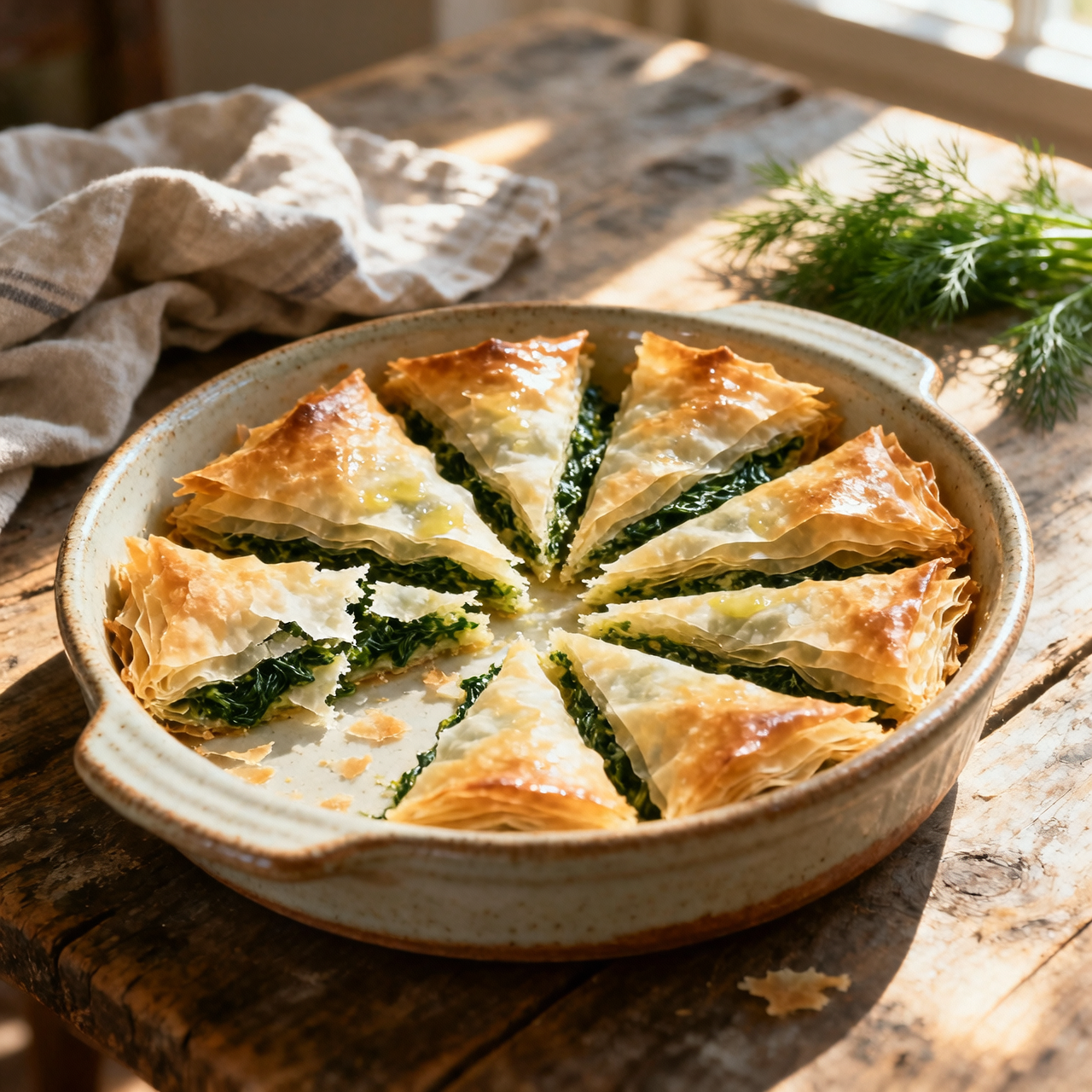
Spanakopita
I first encountered spanakopita in a sun-drenched kitchen in Athens, where my grandmother’s hands moved like seasoned artisans, folding phyllo sheets with a quiet reverence that felt almost sacred. To me, this dish is far more than a simple spinach pie; it is a testament to the Greek philosophy of finding profound joy in humble ingredients. The flaky, butter-kissed layers give way to a vibrant, herbaceous filling that speaks of mountain pastures and coastal breezes. Yet, for all its elegance, spanakopita is notoriously unforgiving to the uninitiated. I have watched countless cooks drown their filling with excess moisture, resulting in a soggy, collapsed crust that betrays the very essence of the dish. The secret, which I learned through years of trial and ruined parchment, lies in the meticulous wringing of the spinach. You must squeeze until your knuckles ache and the greens yield nothing but a dense, emerald paste. Another frequent misstep is neglecting the resting time between brushing each phyllo layer with olive oil and melted butter; rushing this step guarantees brittle sheets that shatter upon baking rather than crisping into delicate, glass-like shards. When approached with patience and respect, spanakopita becomes a centerpiece that bridges generations, offering vegetarians a deeply satisfying, texturally complex experience that never relies on imitation or compromise. It reminds me that true culinary mastery is not about complexity, but about honoring the ingredients enough to let them shine.
Nutrition
| Per serving | Calories | Protein | Carbs | Fat | Sat fat | Fibre | Sugar | Sodium |
|---|---|---|---|---|---|---|---|---|
| beginner | 870kcal | 22g | 62g | 61g | 25g | 6g | 5g | 2210mg |
| intermediate | 580kcal | 15g | 41g | 41g | 17g | 4g | 3g | 1480mg |
| expert | 435kcal | 11g | 31g | 31g | 12g | 3g | 2g | 1110mg |
Per serving · Ava-estimated — a guide, not a clinical figure.
- 500 gfresh spinach— thoroughly washed and dried
- 450 gphyllo dough— thawed if frozen
- 250 gfeta cheese— preferably in brine, patted dry
- 150 gyellow onion— finely diced
- 30 gfresh dill— finely chopped
- 60 mlextra virgin olive oil— high-quality
- 100 gunsalted butter— melted and cooled slightly
- 2 pcslarge eggs— lightly beaten
- 1 gground nutmeg— freshly grated preferred
- 10 gkosher salt— to taste
- 2 gblack pepper— freshly cracked
This version prioritizes structural confidence and forgiving assembly, transforming a traditionally intimidating pastry into an approachable weeknight project. I have stripped away the precision folding in favor of a reliable triangle method that guarantees even layers and consistent baking. The filling relies on straightforward wilting and a quick drain, skipping the traditional resting period without sacrificing flavor. Your primary focus should remain on moisture control: squeeze the spinach aggressively, as trapped water is the sole enemy of a crisp crust. Keep the phyllo sheets covered with a damp towel throughout the process, as exposure to air will render them brittle in seconds. Brush each layer with the butter and olive oil blend generously but swiftly, avoiding heavy pooling that leads to greasy results. Bake on the middle rack to ensure the bottom crisps before the top burns. Watch for a deep, even golden hue rather than a pale straw color, which indicates undercooked dough. Serve warm, accepting minor imperfections as the natural charm of a first attempt. This method guarantees a satisfying, flaky result while teaching the fundamental rhythm of layering and sealing. Once you master the moisture balance here, you will instinctively understand how to handle more delicate variations.
Equipment
- 9x13 inch baking pan— metal preferred for even heat
- pastry brush— silicone or natural bristle
- large colander— for draining spinach
Method
- 1
Preheat the oven to 375°F and grease the baking pan lightly.
Ensure rack is centered.
preheating~ 5 min - 2
Wilt the spinach in a large skillet over medium heat until fully collapsed.
Stir constantly to prevent scorching.
wilting~ 3 min - 3
Transfer the cooked greens to a colander and press firmly to remove all excess liquid.
Use the back of a spoon for maximum extraction.
draining~ 2 minTricky bit - 4
Combine the squeezed spinach, diced onion, crumbled feta, chopped dill, beaten eggs, olive oil, nutmeg, salt, and pepper in a large mixing bowl.
Mix until just uniform to avoid overworking.
combining~ 2 min - 5
Unroll the phyllo dough and cover it immediately with a slightly damp kitchen towel.
Dry edges will tear during assembly.
moisture management~ 1 minTricky bit - 6
Brush one sheet of dough with the melted butter mixture and fold it in half lengthwise.
Keep the brush strokes light and even.
brushing~ 1 min - 7
Place two tablespoons of filling at the bottom corner and fold the dough into a tight triangle, continuing to the end.
Tuck the final edge underneath to seal.
folding~ 2 minTricky bit - 8
Arrange the triangles seam-side down on the prepared pan and bake until deeply golden.
Rotate the pan halfway through for even color.
baking~ 30 min