
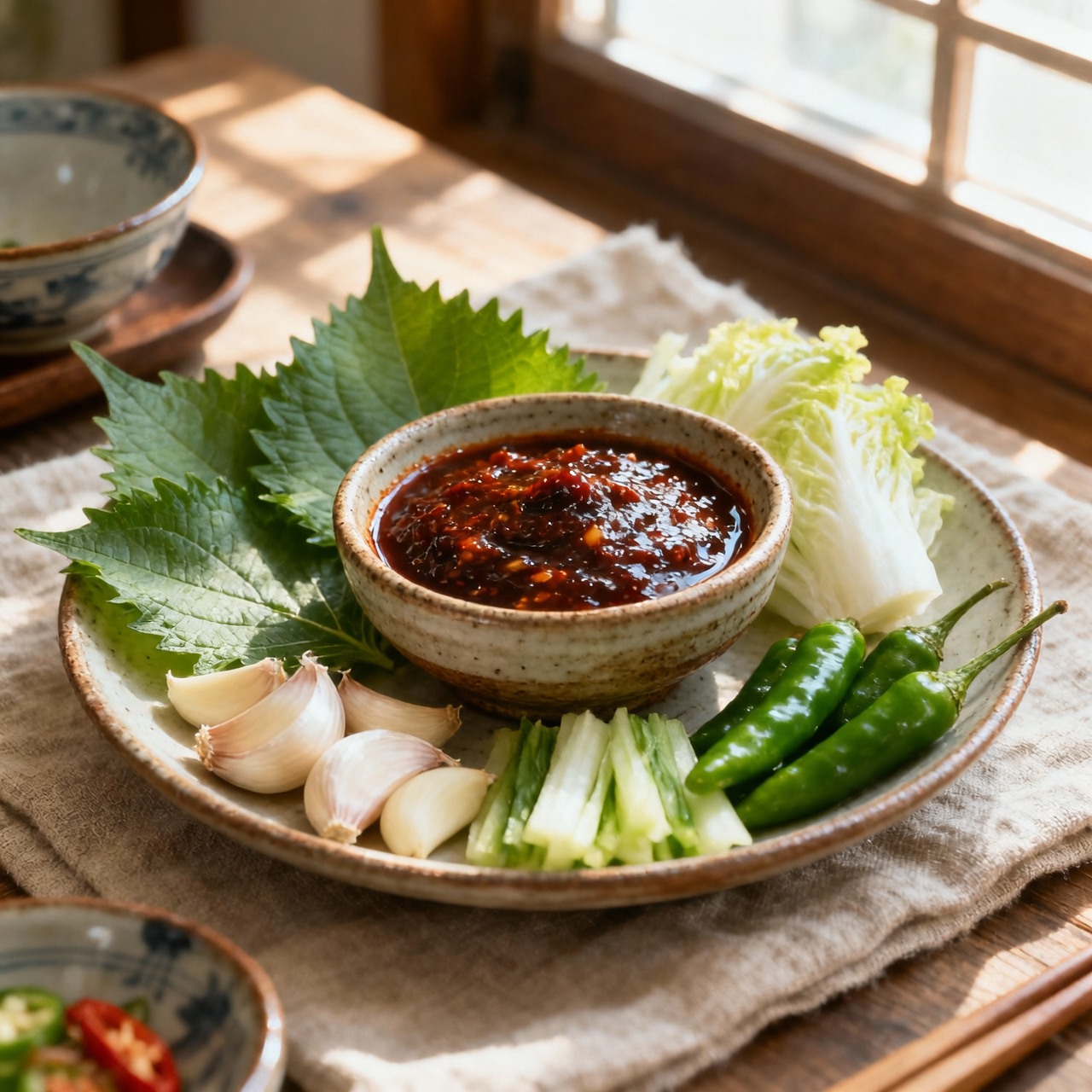
Ssamjang
I’ve always found ssamjang to be the quiet anchor of the Korean table, a deeply savory paste that transforms simple lettuce leaves into complete, handheld meals. Its roots trace back to the communal dining traditions of the Korean peninsula, where fermented staples like doenjang and gochujang were prized for their umami depth and preserving power. Long before modern condiments cluttered our shelves, home cooks blended these aged soybean and chili pastes with toasted sesame oil, minced garlic, and a touch of sweetener to create a versatile dipping sauce. What makes ssamjang so vital to me is its democratic simplicity; it bridges the gap between earthy vegetables and rich proteins without demanding culinary perfection. Yet, despite its straightforward composition, I’ve seen countless batches ruined by well-intentioned missteps. The most frequent pitfall is overwhelming the delicate fermentation notes with too much raw garlic or unbalanced sweetness, which masks the very soul of the paste. Another common error is skipping the resting period after mixing. Ssamjang isn’t a rush-job; it needs time in the refrigerator for the oils to meld and the sharp edges of the aromatics to soften into a cohesive, rounded flavor. I also remind myself that traditional recipes rely entirely on plant-based foundations, making it naturally vegan and remarkably adaptable to modern dietary preferences. When you respect the balance of salty, spicy, sweet, and nutty, you’re not just making a dip—you’re preserving a centuries-old rhythm of Korean home cooking that thrives on patience and restraint.
Nutrition
| Per serving | Calories | Protein | Carbs | Fat | Sat fat | Fibre | Sugar | Sodium |
|---|---|---|---|---|---|---|---|---|
| beginner | 48kcal | 2g | 7g | 2g | 0g | 1g | 3g | 520mg |
| intermediate | 64kcal | 3g | 9g | 4g | 0g | 2g | 4g | 550mg |
| expert | 75kcal | 4g | 8g | 4g | 1g | 2g | 3g | 520mg |
Per serving · Ava-estimated — a guide, not a clinical figure.
- 120 gdoenjang— Korean fermented soybean paste
- 80 ggochujang— Korean red chili paste, verify vegan certification
- 15 mlsesame oil— toasted
- 15 ggarlic— finely minced
- 20 gscallion— finely chopped
- 5 gsesame seed— toasted
- 10 mlmaple syrup— vegan alternative to honey or corn syrup
- 10 mlwater(optional)— add gradually to adjust dipping consistency
This beginner-friendly version strips away traditional fermentation and grinding steps, relying instead on high-quality store-bought pastes to deliver authentic flavor in minutes. You will combine ready-made doenjang (soybean paste) and gochujang (chili paste) as your base, then gently fold in minced garlic, a touch of toasted sesame oil, and a mild sweetener like rice syrup. The goal here is confidence: we prioritize consistent ratios and clear visual cues over artisanal technique. Watch closely as you mix; the paste should transition from separated streaks to a glossy, uniform spread that holds its shape on a spoon. If your mixture feels too thick to coat lettuce leaves smoothly, simply thin it with a teaspoon of water until it reaches a spreadable consistency. Taste and adjust the balance by adding a pinch more sweetener for richness or a dash of sesame seeds for texture. Once blended, let it rest at room temperature for ten minutes to allow the flavors to marry and the garlic to mellow. Store leftovers in a sealed jar in the refrigerator for up to two weeks, making this a reliable, zero-stress staple for weekday lettuce wraps.
Equipment
- Medium mixing bowl— ceramic or glass works best for easy scraping
- Flexible spatula— silicone head ensures no paste is wasted
- Airtight storage jar(optional)— small mason jar, 250ml capacity
Method
- 1
Scoop the store-bought doenjang and gochujang into a medium mixing bowl.
Use a standard 2:1 ratio of soybean paste to chili paste for balanced heat.
measuring~ 1 min - 2
Add the minced garlic, toasted sesame oil, and rice syrup directly over the pastes.
Measure carefully to avoid overpowering the base flavors.
layering~ 1 min - 3
Stir vigorously with a silicone spatula until the mixture becomes a uniform, glossy paste.
Press against the bowl sides to break up any stubborn lumps.
folding~ 2 minTricky bit - 4
Let the blended condiment rest uncovered for ten minutes before serving.
This resting period allows the raw garlic bite to soften into the mixture.
tempering~ 10 min
Cooking from frozen
Thaw overnight in the refrigerator and stir thoroughly to re-emulsify separated oils before serving.
Storage times are a guide — always use your judgement and store food safely.