
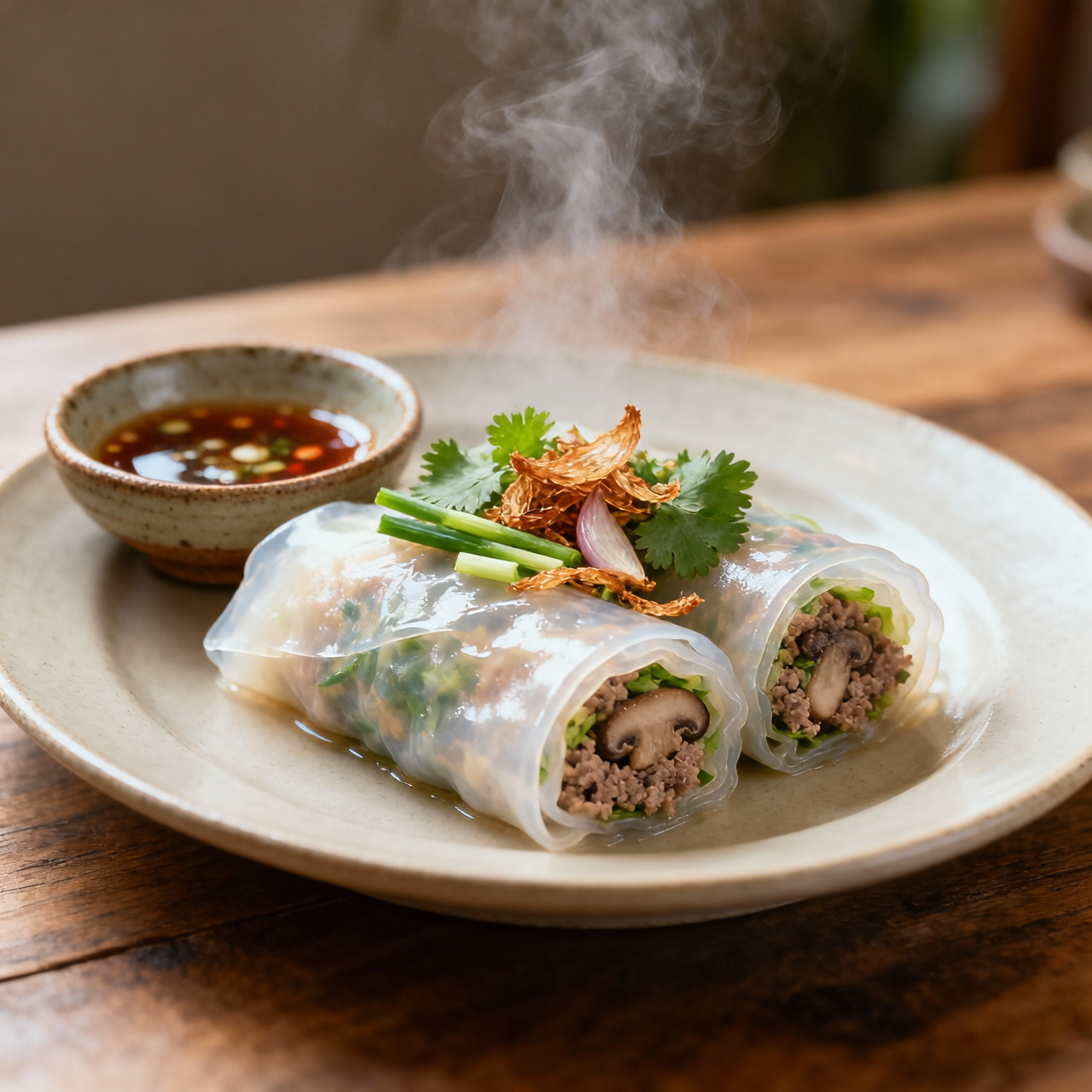
Steamed Rice Rolls (Banh Cuon)
Banh cuon has always been my morning anchor, a quiet testament to the patience required in Vietnamese cooking. Originating in the northern villages of Vietnam, these delicate rolls were traditionally steamed over boiling pots lined with tightly stretched cloth, capturing the essence of a slow, mindful breakfast before the day’s rush. I love making them because the process itself feels like a meditation: whisking rice flour and water until the batter coats a ladle, then watching it transform into a translucent, paper-thin sheet in mere seconds. But I’ve seen too many home cooks surrender to the supermarket aisle, buying pre-packaged rolls that cost nearly twice what fresh ingredients do, yet arrive stiff, gummy, and utterly divorced from their heritage. Those commercial versions rely on stabilizers and pre-cooked drying processes that destroy the signature silkiness, leaving you with a chewy shell that tears at the slightest touch. When you make them from scratch, you avoid that plasticine texture entirely. The real pitfalls usually stem from rushing the batter or overheating the steam. If your mixture sits too long, it separates; if the water boils violently, the sheets blister and stick. You must keep the heat steady, brush the steaming surface lightly with oil, and roll the moment the sheet becomes pliable. Filling them fresh with seasoned minced pork, wood ear mushrooms, and shallots while the sheets are still warm ensures they cling together naturally. This isn’t just breakfast; it’s a lesson in respecting the ingredients’ natural behavior, one fragile, gossamer sheet at a time.
Nutrition
| Per serving | Calories | Protein | Carbs | Fat | Sat fat | Fibre | Sugar | Sodium |
|---|---|---|---|---|---|---|---|---|
| beginner | 345kcal | 14g | 43g | 11g | 4g | 3g | 3g | 590mg |
| intermediate | 460kcal | 21g | 54g | 15g | 4g | 3g | 11g | 820mg |
| expert | 380kcal | 18g | 42g | 15g | 4g | 2g | 7g | 780mg |
Per serving · Ava-estimated — a guide, not a clinical figure.
- 200 gRice flour— Sifted before mixing to remove lumps
- 30 gTapioca starch— Provides elasticity to the steamed sheets
- 600 mlWater— Divided for batter preparation and mushroom rehydration
- 150 gGround pork— Lean cut preferred for the filling
- 15 gDried wood ear mushroom— Soaked until soft then finely minced
- 40 gShallot— Minced for the pork filling mixture
- 45 mlFish sauce— Used for both filling seasoning and dipping sauce base
- 30 mlVegetable oil— Lightly brush steaming surface to prevent sticking
- 10 gFresh cilantro(optional)— Washed and torn for serving
- 50 gBean sprout(optional)— Blanched briefly until crisp-tender
This beginner-friendly approach to bánh cuốn removes the intimidation factor of traditional bamboo steamers and complex batter hydration, focusing instead on a reliable stovetop skillet method that guarantees delicate, translucent rice sheets every time. Unlike the rubbery, overly thick, or chemically stabilized versions sold in plastic tubs at Asian supermarkets—which often cost upwards of eight dollars for a small, preservative-heavy pack and lack the signature silky mouthfeel—this from-scratch version uses just four pantry staples to create a light, fresh-tasting roll that costs a fraction of the price. You will learn to balance a simple rice-and-tapioca batter that stays flexible without tearing, and how to gently poach a savory pork-and-wood-ear filling without overcooking the meat. Watch closely during the steaming step: the sheets are ready the moment they form small bubbles and turn uniformly opaque, usually within forty-five seconds. Over-steaming makes them gummy, while rushing causes tearing. Keep a damp towel nearby to stack finished sheets, and work quickly while the batter is still warm to ensure smooth, professional-looking rolls that rival any street stall.
Equipment
- Wide non-stick skillet— needs a tight-fitting lid to trap steam efficiently
- Heatproof flat plate— must fit inside the skillet without touching the water
- Pastry brush— for lightly greasing the steaming plate between sheets
- Silicone spatula— thin edge helps lift delicate rice sheets cleanly
- Large mixing bowl— room for vigorous whisking to eliminate lumps
Method
- 1
Heat a neutral oil in a small saucepan over medium heat and cook finely minced shallots until fragrant.
Avoid browning; you want a sweet, translucent base for the filling.
sweating~ 2 min - 2
Add ground pork to the pan and break it apart until fully cooked, then stir in finely chopped wood ear mushrooms, fish sauce, and black pepper.
Keep the heat moderate to prevent the lean pork from drying out.
browning~ 5 min - 3
Whisk rice flour, tapioca starch, and cold water in a large bowl until completely smooth and free of lumps.
A brief rest of ten minutes allows the starches to fully hydrate for a stronger sheet.
slurry~ 3 min - 4
Pour enough water into the skillet to reach one centimetre deep, place the heatproof plate upside down in the centre, and bring to a gentle simmer.
The plate should sit level and remain completely above the waterline.
pan-steaming~ 4 minTricky bit - 5
Brush the plate lightly with oil, ladle a thin layer of batter onto the surface, cover tightly, and steam until the sheet forms bubbles.
The sheet is ready when it turns uniformly opaque and lifts easily from the edges.
steaming~ 1 minTricky bit - 6
Slide the cooked sheet onto a damp towel, add a line of filling, and gently fold the edges before rolling tightly.
Work quickly while the rice sheet is still warm and pliable to prevent cracking.
rolling~ 1 min
Storage times are a guide — always use your judgement and store food safely.