
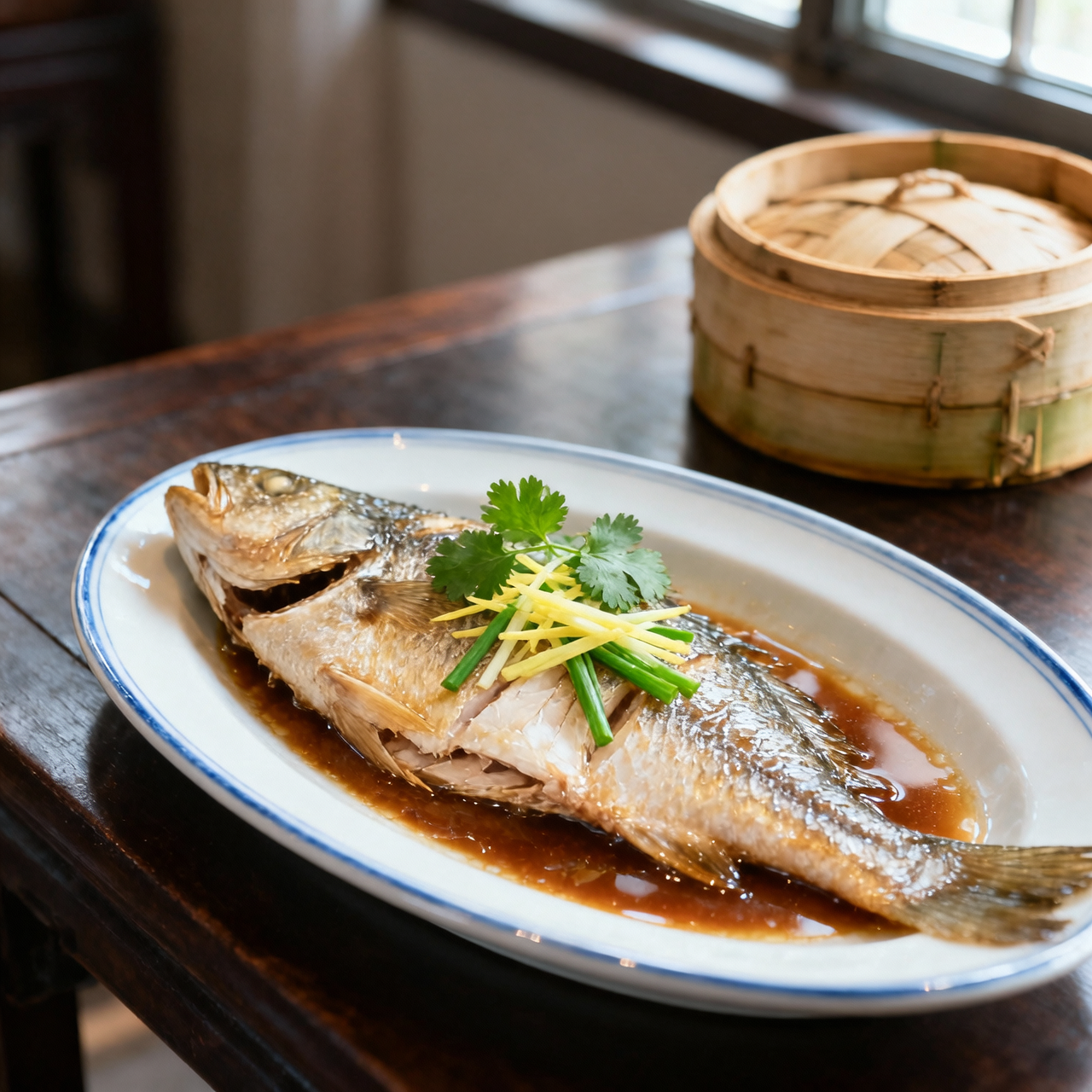
Steamed Whole Fish
I’ve always believed that Cantonese steamed whole fish is less a recipe and more a quiet philosophy on restraint. Born along the Pearl River Delta, where the waters teem with sea bass, pomfret, and mandarin fish, this dish emerged from a culinary tradition that prizes freshness above all else. When I first learned it, I was struck by how it refuses to mask its ingredients; instead, it elevates them through patience and precision. To steam a whole fish properly is to honor the sea and the farmer’s labor in equal measure, transforming a simple preparation into a centerpiece that speaks volumes without shouting. Yet, so many cooks stumble at the very threshold of success. The most frequent misstep is overcrowding the steamer, which traps moisture unevenly and turns delicate flesh rubbery. Another is skipping the crucial drying step before seasoning—patting the fish dry ensures the ginger and scallions cling properly and prevents a soggy, diluted broth. Overcooking is perhaps the gravest sin of all; the moment the eyes cloud and the flesh just begins to flake, the heat must be killed. I always keep a timer nearby, but my real gauge is intuition, built from watching the steam curl and listening to the quiet hiss beneath the lid. When done right, the fish yields a clean, silken bite, dressed only in a whisper of hot oil, light soy, and toasted sesame. It’s a dish that teaches you to trust the ingredient, respect the timing, and never confuse complexity with quality.
Nutrition
| Per serving | Calories | Protein | Carbs | Fat | Sat fat | Fibre | Sugar | Sodium |
|---|---|---|---|---|---|---|---|---|
| beginner | 230kcal | 15g | 5g | 16g | 3g | 1g | 2g | 885mg |
| intermediate | 230kcal | 15g | 5g | 16g | 3g | 1g | 2g | 885mg |
| expert | 230kcal | 15g | 5g | 16g | 3g | 1g | 2g | 885mg |
Per serving · Ava-estimated — a guide, not a clinical figure.
- 1 piecewhole sea bass— scaled and gutted, approximately 750g
- 40 gfresh ginger root— thinly sliced into fine matchsticks
- 5 stalksscallion— shredded lengthwise into fine curls
- 60 mllight soy sauce— Chinese brewed style, not dark
- 45 mlneutral cooking oil— peanut or vegetable, high smoke point
- 10 mltoasted sesame oil— cold-pressed for aroma
- 15 mlShaoxing wine— dry cooking wine for deglazing
- 5 ggranulated sugar— balances salinity
- 1 gwhite pepper— finely ground
- 10 gfresh cilantro(optional)— tender leaves for garnish
This version prioritizes confidence and consistency over tradition, making your first attempt foolproof. Instead of balancing raw soy, wine, and sugar, you will use a high-quality jarred steaming sauce that already contains the correct ratios of umami, sweetness, and aromatics. The focus here is on mastering the two non-negotiable rules: keeping the steamer water at a vigorous rolling boil and resisting the urge to lift the lid. I’ve structured the steps to eliminate guesswork around doneness by relying on a simple visual cue and a quick fork test. Watch for the flesh to turn opaque and pull away cleanly from the bone near the thickest part. The hot oil finish is simplified by using a small saucepan and a lower heat setting to prevent splattering, while still achieving that signature sizzle. You will notice the ginger and scallions are added at the end rather than layered underneath, which reduces prep time and prevents overcooking. This approach guarantees a moist, restaurant-style result even if your knife skills are still developing. Treat the jarred sauce as your training wheels; once you trust the timing, you can graduate to mixing your own.
Equipment
- Large pot with steamer insert— must accommodate a heatproof plate
- Small saucepan— for heating oil safely
- Kitchen thermometer(optional)— optional but helpful for beginners
Method
- 1
Rinse the fish thoroughly under cold water and pat it completely dry with paper towels.
Moisture on the skin prevents proper steam contact.
drying~ 1 min - 2
Place the fish on a heatproof plate that fits inside your largest pot or steamer basket.
Elevate the fish slightly with two crossed chopsticks if needed.
prepping~ 1 min - 3
Fill your pot with two inches of water and bring it to a vigorous rolling boil.
Do not add the fish until the water is actively bubbling.
boiling~ 3 min - 4
Carefully set the plate into the steamer, cover tightly, and steam over medium-high heat.
Set a timer immediately; do not lift the lid.
steaming~ 12 minTricky bit - 5
Remove the plate from the steamer and immediately pour off all accumulated liquid.
This cloudy broth carries strong fishy notes and dilutes the sauce.
draining~ 1 min - 6
Arrange half of the ginger and scallions evenly over the fish.
Layer them loosely to allow the hot oil to penetrate.
garnishing~ 1 min - 7
Warm the jarred steaming sauce in a small bowl and pour it evenly around the edges of the fish.
Avoid pouring directly onto the thickest part to prevent overcooking.
seasoning~ 0 min - 8
Heat the neutral oil in a small saucepan until shimmering, then carefully drizzle it over the aromatics.
Listen for a sharp, immediate sizzle.
blooming~ 2 minTricky bit