
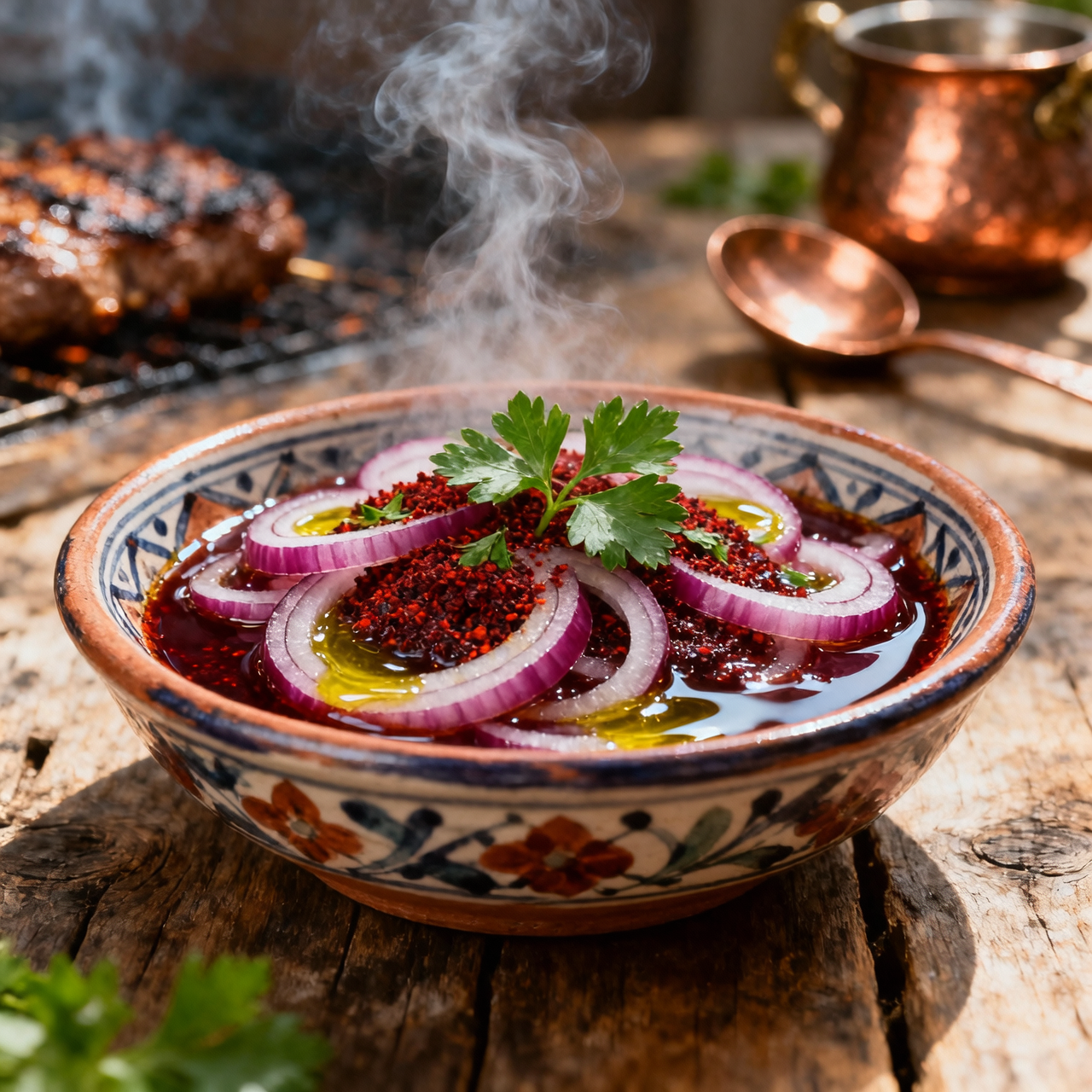
Sumac onions
I have always believed that the soul of Turkish grilling is not found on the skewer, but resting quietly beside it in a small ceramic dish. Sumac onions are that quiet companion, a condiment born from the necessity of cutting through the rich, smoky fat of lamb and beef kebabs with bright, astringent acidity. Historically, this preparation traces back to the Anatolian highlands, where wild sumac grew abundantly and became the primary souring agent before lemons were widely traded. A great version balances the deep burgundy hue and citrusy tang of properly ground sumac with the sharp bite of thinly sliced red onion, all bound by high-quality extra-virgin olive oil. The magic lies in patience: the salt must coax the moisture from the onion cells just enough to soften their harshness without turning them mushy, while the sumac blooms in the oil to release its complex, berry-like notes. The most common pitfall is rushing the resting stage or drowning the onions in cheap oil, which masks the delicate spice and leaves a greasy mouthfeel. Another frequent mistake is using white onions or skipping the acid entirely, resulting in a flat, one-dimensional bite. When executed correctly, the onions should offer a crisp-tender texture with a vibrant, mouth-puckering finish that resets the palate between rich bites. In my library, I treat this not as a garnish, but as an essential structural component of the meal. Whether you are slicing your first onion or curing a jar for service, respect the balance of salt, acid, and earth. This is how Turkish cuisine teaches us that simplicity, when treated with precision, becomes profound.
Nutrition
| Per serving | Calories | Protein | Carbs | Fat | Sat fat | Fibre | Sugar | Sodium |
|---|---|---|---|---|---|---|---|---|
| beginner | 155kcal | 2g | 12g | 12g | 2g | 2g | 4g | 485mg |
| intermediate | 155kcal | 2g | 12g | 12g | 2g | 2g | 4g | 485mg |
| expert | 158kcal | 2g | 13g | 12g | 2g | 2g | 4g | 510mg |
Per serving · Ava-estimated — a guide, not a clinical figure.
- 400 gRed onion— firm, unblemished, preferably organic
- 15 gSumac— finely ground, deep burgundy color
- 45 gExtra-virgin olive oil— cold-pressed, robust flavor
- 20 gFresh flat-leaf parsley— tender leaves only, washed and dried
- 5 gFine sea salt
- 30 gFresh lemon juice— strained, room temperature
This version is designed to remove the intimidation factor and deliver a reliable result on your first try. Instead of sourcing and balancing separate spices and acids, we use a high-quality commercial sumac-lemon paste as a time-saving foundation. The goal here is confidence through simplicity. You will learn the essential technique of salting and massaging the onions to draw out their moisture, which softens their harsh bite without cooking them. Watch the texture closely: the onions should wilt slightly and become translucent at the edges, but still retain a pleasant snap. The pre-mixed paste ensures you hit the right acid-to-spice ratio every time, eliminating guesswork. Simply combine the oil, salt, and paste, fold in the sliced onions, and let the bowl rest. I recommend using a sharp knife or a mandoline on a low guard to achieve uniform slices, as consistent thickness guarantees even seasoning absorption. Do not rush the fifteen-minute resting window; this is where the chemistry happens. If your jarred paste contains visible seeds or stems, give it a quick stir before measuring. This approach guarantees a bright, palate-cleansing condiment that pairs seamlessly with weeknight kebabs or grilled vegetables, proving that excellent Turkish accompaniments are well within your reach.
Equipment
- Medium mixing bowl— glass or ceramic preferred
- Chef's knife— sharp blade ensures clean cuts
- Small whisk— for quick emulsification
Method
- 1
Slice the red onion into uniform half-moons approximately two millimeters thick.
Keep the cuts consistent to ensure even seasoning absorption.
slicing~ 5 min - 2
Transfer the sliced onion to a medium mixing bowl and sprinkle the fine sea salt evenly over the surface.
Salt should coat the layers rather than pool at the bottom.
seasoning~ 1 min - 3
Massage the salted onion gently with clean hands for one minute until it releases visible moisture.
The bowl should feel slightly damp to the touch.
sweating~ 1 minTricky bit - 4
Whisk the extra-virgin olive oil, lemon juice, and jarred sumac paste in a small cup until emulsified.
Vigorously combine to prevent oil separation.
emulsifying~ 1 min - 5
Pour the dressing over the onions, toss thoroughly, and fold in the chopped parsley.
Ensure every slice is lightly coated rather than drowned.
tossing~ 2 min - 6
Let the bowl rest at room temperature for ten minutes before serving alongside grilled meats.
The flavors will marry and the acidity will soften.
resting~ 10 min
Storage times are a guide — always use your judgement and store food safely.