
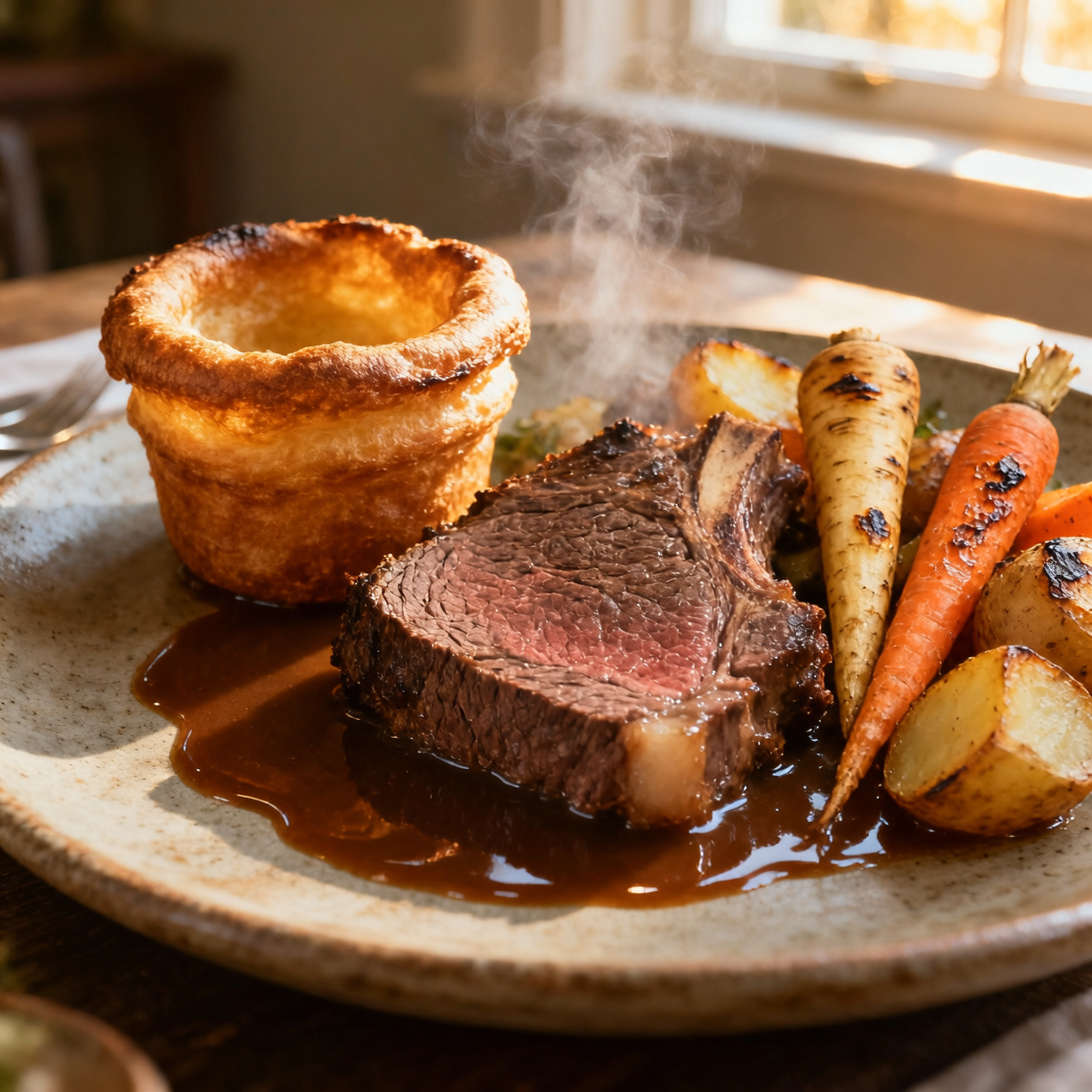
Sunday Roast Beef with Yorkshires
There is something almost sacred about a proper Sunday roast, a ritual that has anchored British households for centuries. When I think of this dish, I don’t just see beef and batter; I see generations gathered around heavy wooden tables, the air thick with the scent of rendered fat and rosemary. The origins trace back to the medieval era, when a joint of meat was placed in the oven before church services, slowly cooking alongside the Yorkshire pudding batter resting in the drippings below. It was born of necessity, thrift, and the rhythm of the week, yet it evolved into the cornerstone of British culinary identity. I’ve spent years perfecting this balance because, to me, it represents more than a meal—it’s a testament to patience and respect for ingredients. The most common pitfalls I see are rushed preparations and a fundamental misunderstanding of temperature control. People often sear the beef too aggressively, sacrificing a gentle, even cook, or they let their oven cool too much before sliding in the Yorkshire tins, resulting in dense, doughy puddings that refuse to rise. Others forget the resting period entirely, carving straight into the meat and watching precious juices spill onto the cutting board. A true Sunday roast demands attention, but not anxiety. It requires trusting the process, honoring the quiet hours of roasting, and understanding that the best results come from restraint. When you finally pull that golden, puffed batter from the tin alongside a perfectly blushing joint, you aren’t just serving dinner. You’re carrying forward a quiet, enduring tradition that has fed families, celebrated milestones, and turned ordinary Sundays into something worth remembering.
Nutrition
| Per serving | Calories | Protein | Carbs | Fat | Sat fat | Fibre | Sugar | Sodium |
|---|---|---|---|---|---|---|---|---|
| beginner | 1550kcal | 80g | 55g | 95g | 38g | 6g | 9g | 1600mg |
| intermediate | 1550kcal | 80g | 55g | 95g | 38g | 6g | 9g | 1600mg |
| expert | 1550kcal | 80g | 55g | 95g | 38g | 6g | 9g | 1600mg |
Per serving · Ava-estimated — a guide, not a clinical figure.
- 1500 gbeef rib roast— bone-in preferred for flavor
- 180 gplain flour— all-purpose, sifted
- 250 mlwhole milk— full-fat, chilled
- 4 pcslarge egg— room temperature
- 120 mlbeef dripping— clarified and hot
- 500 mlrich beef stock— low sodium, homemade preferred
- 1 pcsyellow onion— quartered, skin left on for roasting
- 3 pcscarrot— peeled, halved lengthwise
- 2 pcsparsnip— peeled, quartered
- 10 gfresh rosemary— woody stems removed
- 8 gfresh thyme— leaves stripped from stems
- 20 gfine sea salt— coarse grind for crust
- 5 gblack pepper— freshly cracked
- 30 gunsalted butter— cold, for finishing gravy
- 15 mlred wine vinegar— acid to balance richness
This version prioritizes confidence and clear milestones over culinary perfection. You will use straightforward measurements, rely on a reliable meat thermometer to remove guesswork, and lean on a simplified gravy method that builds flavor without constant whisking. The Yorkshire batter is mixed once and rested while the oven heats, ensuring a consistent rise without the need for precise temperature timing. Watch for the moment the fat in the roasting pan begins to shimmer; this visual cue replaces the guesswork of traditional heat management. If the puddings do not puff to their maximum height, do not worry—they will still be tender and deeply savory. The goal here is to establish a rhythm that fits your schedule, not to chase an exacting standard. Keep your workspace organized, preheat the oven fully before placing the tin inside, and resist the urge to open the oven door during baking. By following these linear steps, you will produce a cohesive, comforting plate that honors the tradition while leaving room for your own kitchen habits to develop. Success is measured by a juicy roast and a gravy that clings properly to the spoon.
Equipment
- Roasting pan— standard depth works fine
- Instant-read thermometer— digital preferred
- 12-cup muffin tin— metal conducts heat better
- Medium saucepan— for gravy reduction
Method
- 1
Preheat the oven to 200°C and place the seasoned beef on a rack inside a roasting pan.
Allow the oven to fully stabilize.
preheating~ 10 min - 2
Whisk the flour, milk, eggs, and salt in a bowl until completely smooth.
No lumps should remain.
whisking~ 2 min - 3
Let the batter rest on the counter while the meat roasts.
Cover loosely with a towel.
resting~ 20 min - 4
Pour beef dripping into the muffin tin and return it to the oven until smoking.
Careful with splatter.
thermal_shocking~ 5 minTricky bit - 5
Pour the rested batter evenly into the hot tin and bake without opening the door.
Resist checking the rise.
baking~ 20 minTricky bit - 6
Remove the beef when the thermometer reads 58°C and transfer it to a board.
Juices must stay inside.
resting~ 15 min - 7
Simmer the pan juices with stock and vinegar until slightly thickened.
Taste before serving.
reducing~ 8 min