
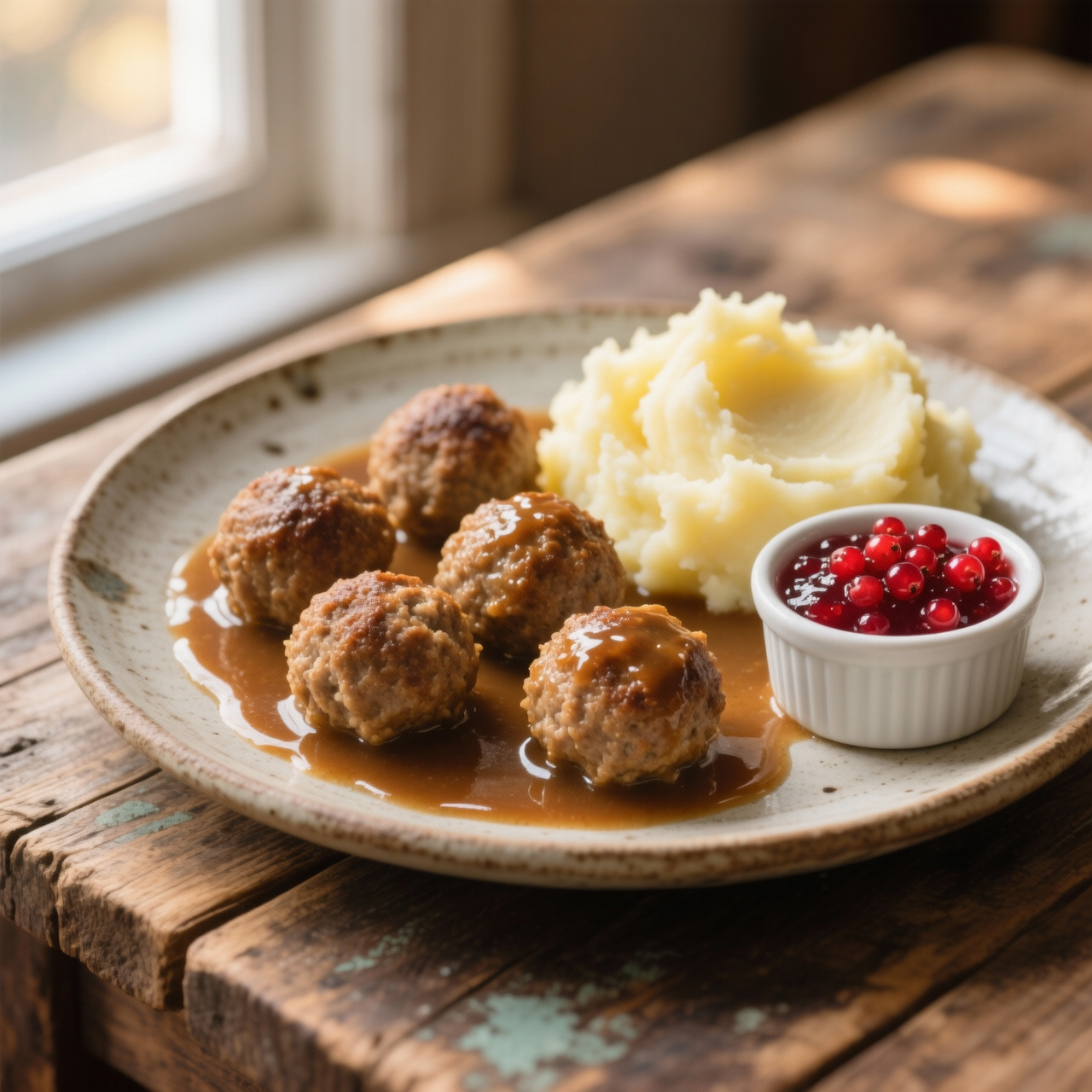
Swedish Koettbullar
When I first learned to make Swedish köttbullar, I thought they were just meatballs. But standing in my grandmother’s Stockholm kitchen, watching the butter sizzle and the allspice bloom, I realized they are a quiet anchor to Scandinavian history. These humble spheres traveled with Charles XII’s soldiers returning from Turkey in the early eighteenth century, slowly adapting to local pantries until they became the heart of every family table and winter holiday. To me, they matter because they embody the Swedish ethos of lagom, never excessive but deeply comforting. They are proof that simplicity, when treated with respect, becomes something profound. Yet, I have seen too many home cooks sabotage that simplicity by rushing the process or ignoring the balance of textures. The most common pitfall is overmixing the meat, which squeezes out the moisture and leaves you with dense, rubbery spheres instead of tender bites. Another frequent mistake is skipping the panade. That gentle soak of breadcrumbs in milk or cream is what keeps the interior supple. Some even fry them at too high a heat, chasing a dark crust while leaving the centers dry. The real secret lies in patience. Chill the mixture before rolling, keep your hands light, and let them brown slowly in butter. When done right, they should yield slightly to the fork, carrying notes of warm allspice and white pepper, ready to rest in a rich, savory gravy. That is when you understand why generations have kept returning to them.
Nutrition
| Per serving | Calories | Protein | Carbs | Fat | Sat fat | Fibre | Sugar | Sodium |
|---|---|---|---|---|---|---|---|---|
| beginner | 640kcal | 28g | 22g | 48g | 23g | 1g | 4g | 1290mg |
| intermediate | 640kcal | 28g | 22g | 48g | 23g | 1g | 4g | 1290mg |
| expert | 640kcal | 28g | 22g | 48g | 23g | 1g | 4g | 1290mg |
Per serving · Ava-estimated — a guide, not a clinical figure.
- 250 gground beef— 80/20 fat ratio preferred
- 250 gground pork— shoulder cut works best
- 1 mediumyellow onion— finely minced or grated
- 120 mlwhole milk— room temperature
- 60 gplain breadcrumb— panko or fresh homemade
- 1 wholelarge egg— lightly beaten
- 2 gground allspice— freshly ground if possible
- 1 gground nutmeg— freshly grated preferred
- 8 gfine sea salt— divided for meat and gravy
- 2 gblack pepper— freshly cracked
- 50 gunsalted butter— cold for meat, softened for gravy
- 400 mlbeef broth— low sodium, rich stock
- 100 mlheavy cream— full fat
- 30 gall-purpose flour— unbleached
- 5 gfresh dill— chopped for garnish
This version prioritizes confidence and consistency over from-scratch labor. While the ingredient list remains identical to the traditional standard, your approach leverages time-saving techniques that guarantee success on your first attempt. You will use a quick panade method by soaking the breadcrumbs directly in warm milk before mixing, which eliminates the guesswork around moisture balance and keeps the meatballs tender even if slightly overmixed. Instead of building a roux from raw flour and butter, you will create the gravy by whisking flour into melted butter off-heat to prevent lumps, then deglazing with pre-warmed broth. This controlled temperature approach removes the intimidation factor of traditional sauce-making. The critical watchpoint here is heat management. Keep your pan at a steady medium setting, never crowding the meatballs, and resist the urge to flip them constantly. A proper sear requires patience; let a deep golden crust form before turning. If the mixture feels sticky, dampen your hands with cold water rather than adding extra flour. This method ensures you achieve the classic springy texture and rich, glossy finish without the stress of advanced culinary timing.
Equipment
- large mixing bowl— glass or stainless steel preferred
- heavy-bottomed skillet— non-stick is acceptable here
- rubber spatula— heat resistant
Method
- 1
Combine milk and breadcrumbs in a bowl and let sit until fully absorbed.
Mixture should look like thick oatmeal.
soaking~ 5 min - 2
Add ground beef, ground pork, egg, salt, pepper, allspice, and nutmeg to the bowl.
Keep ingredients cold until mixing.
combining~ 2 min - 3
Fold the mixture gently with damp hands until just combined.
Stop as soon as ingredients unify.
folding~ 1 min - 4
Roll the mixture into twelve uniform spheres using a light touch.
Do not compress the meat.
shaping~ 5 min - 5
Heat butter in a heavy-bottomed skillet over medium heat until foaming.
Butter should sizzle immediately.
melting~ 1 min - 6
Place meatballs in the pan without crowding and cook undisturbed.
Crowding lowers pan temperature.
pan-frying~ 4 minTricky bit - 7
Flip each meatball once and cook until golden on all sides.
Internal temp should reach 65C.
searing~ 3 min - 8
Remove meatballs, whisk flour into the pan drippings, and slowly add broth and cream.
Add liquid gradually to prevent lumps.
deglazing~ 5 minTricky bit - 9
Return meatballs to the sauce and simmer gently until thickened.
Sauce should coat the back of a spoon.
reducing~ 5 min - 10
Sprinkle with fresh dill and serve immediately.
Garnish just before plating.
plating~ 1 min