
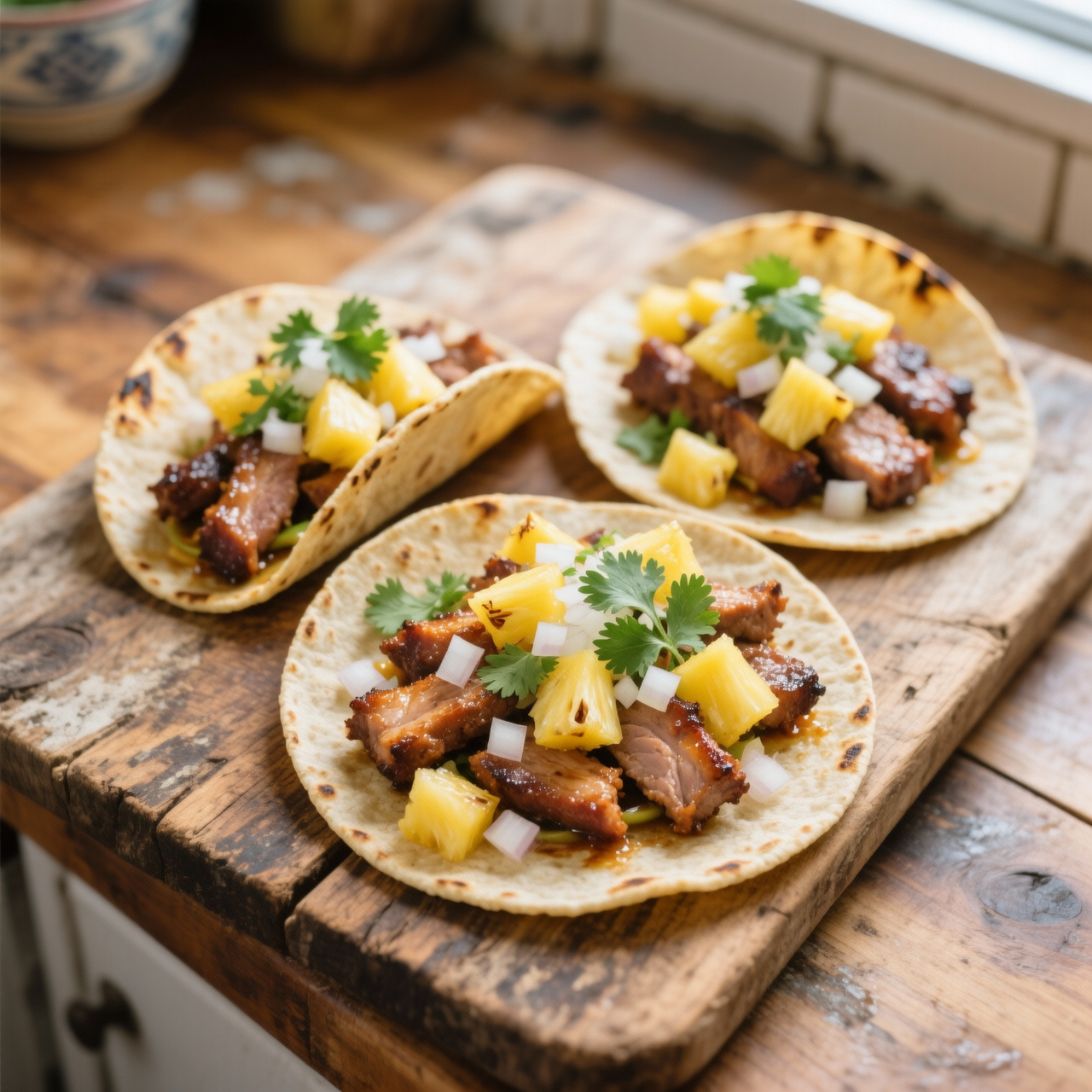
Tacos al Pastor
When I first learned to coax pork into the vibrant, caramelized layers of tacos al pastor, I quickly realized this dish is less a recipe and more a living archive of migration and adaptation. Born in the 1930s when Lebanese shawarma cooks arrived in Mexico City, local taqueros swapped lamb for pork, traded tahini for achiote and guajillo chiles, and crowned the meat with fresh pineapple. That fusion isn’t just historical trivia; it’s the very soul of why this dish matters. It proves how Mexican street food thrives on reinvention, balancing sweet, smoky, and spicy in every bite. Over the years, I’ve watched home cooks stumble into predictable traps. The most common is rushing the marinade—achiote and citrus need at least twelve hours to penetrate the meat properly. Another is treating the vertical spit like a static roast; that rotation isn’t just theatrical, it renders fat continuously and creates those essential crispy edges. When adapting it for home kitchens, I always warn against overcrowding the pan or skipping the pineapple, which isn’t a garnish but a vital acidic counterweight. Finally, using flour tortillas instead of small, double-layered corn ones breaks the structural and cultural rhythm of the taco. I always tell beginners that the magic lives in the fat rendering and the char, so I never shy away from letting the pork crisp in its own juices before slicing it paper-thin. Getting it right demands patience, but the reward is a bite that tastes like history, perfectly balanced.
Nutrition
| Per serving | Calories | Protein | Carbs | Fat | Sat fat | Fibre | Sugar | Sodium |
|---|---|---|---|---|---|---|---|---|
| beginner | 1240kcal | 79g | 85g | 66g | 22g | 16g | 18g | 1840mg |
| intermediate | 1240kcal | 79g | 85g | 66g | 22g | 16g | 18g | 1840mg |
| expert | 1240kcal | 79g | 85g | 66g | 22g | 16g | 18g | 1840mg |
Per serving · Ava-estimated — a guide, not a clinical figure.
- 1500 gpork shoulder— boneless, well-marbled
- 40 gdried guajillo chile— stems and seeds removed before weighing
- 30 gdried ancho chile— preferably pliable and fragrant
- 50 gachiote paste— preferably stone-ground
- 400 gfresh pineapple— ripe but firm, peeled and cored
- 200 gwhite onion— yellow or white variety
- 30 ggarlic clove— fresh, not dried
- 5 gdried oregano— preferably Mexican
- 5 gground cumin— preferably whole seeds
- 1 gground clove— preferably freshly ground
- 5 gcinnamon stick— preferably Ceylon
- 45 mlapple cider vinegar— unfiltered
- 15 gkosher salt— fine-grain
- 16 unitswhite corn tortilla— nixtamalized, six-inch diameter
- 30 gfresh cilantro— tender stems intact
- 4 unitslime— for serving
This path prioritizes confidence over tradition, using a high-quality jarred achiote adobo to bypass the complex chile-soaking and grinding process. You will still build a robust flavor profile, but the heavy lifting is handled by a trusted commercial base. The goal is to understand how the sweet, acidic pineapple interacts with the rich pork, without worrying about rehydrating dried chiles or balancing spice ratios. Marinate for at least two hours, then cook under a broiler or in a hot skillet. Watch for the edges to crisp and the center to reach a safe internal temperature. Do not crowd the pan, as steaming will ruin the caramelized crust. Warm your tortillas separately to ensure pliability. This version teaches you the essential flavor architecture of al Pastor while keeping technique manageable. Focus on timing your pineapple addition so it softens but retains a bright bite. Trust the jarred base, but season aggressively with salt and acid before serving. It is a reliable gateway to the full experience.
Equipment
- rimmed baking sheet— line with parchment for easy cleanup
- heavy-bottomed skillet— cast iron preferred
- sharp chef's knife— for slicing cooked meat
- tongs— heat-resistant silicone or metal
Method
- 1
Slice the pork shoulder into uniform half-inch strips.
Keep thickness consistent for even cooking.
butchery~ 5 min - 2
Combine the pork with the jarred achiote paste, vinegar, and half of the salt in a large bowl.
Massage the paste thoroughly into the meat.
marinating~ 3 min - 3
Cover the bowl and refrigerate the mixture for at least two hours.
Do not exceed four hours to prevent mushy texture.
curing~ 120 min - 4
Arrange the marinated pork in a single layer on the prepared baking sheet.
Crowding will cause steaming instead of browning.
pan-laying~ 1 min - 5
Broil the pork until the edges crisp and the center reaches safe internal temperature.
Flip halfway through the cooking cycle.
broiling~ 10 minTricky bit - 6
Warm the corn tortillas in a dry skillet for twenty seconds per side.
Wrap immediately in a clean kitchen towel to steam.
toasting~ 2 min