
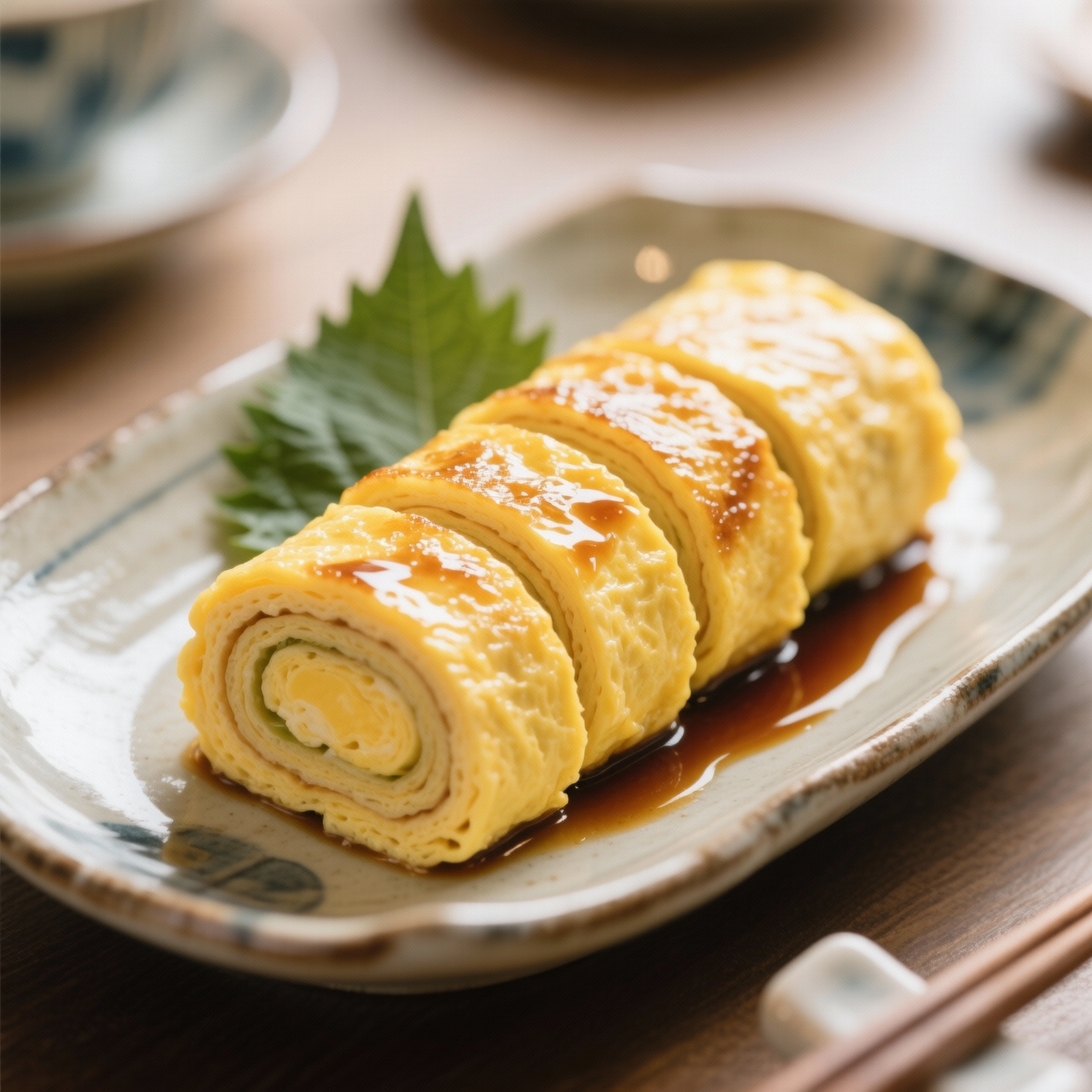
Tamagoyaki (Rolled Omelette)
I’ve always believed that breakfast should feel like a quiet promise to the day ahead, and in Japan, that promise often takes the form of tamagoyaki. Born in the Edo period as a practical way to stretch precious eggs and seasonings, this rolled omelette evolved from a humble home kitchen staple into a refined bento centerpiece. Making it from scratch is an exercise in patience and rhythm, a stark contrast to the pre-packaged slices you find in convenience stores. Those plastic-wrapped alternatives usually cost around three to four dollars for a mere handful of pieces, yet they’re loaded with stabilizers, artificial sweeteners, and a gummy texture that completely misses the point. Real tamagoyaki relies on nothing more than fresh eggs, a touch of soy sauce, a whisper of mirin, and the steady heat of a rectangular pan. The magic lies in the layering: each thin sheet of cooked egg is rolled forward, building a tender, striped log that yields to the chopstick with a gentle bounce. The most common pitfall is rushing the heat. Too hot, and the eggs scorch before they set into delicate layers; too low, and you’re left with a dry, scrambled mess rather than a cohesive roll. Another frequent misstep is skipping the oil between folds, which causes the layers to stick and tear instead of fusing seamlessly. When you take the time to pour, tilt, roll, and repeat with a light hand, you’re not just cooking—you’re practicing a centuries-old meditation. The result is a softly sweet, deeply savory cylinder that transforms a simple morning into something quietly profound, proving that the simplest ingredients, treated with respect, always outperform their mass-produced counterparts.
Nutrition
| Per serving | Calories | Protein | Carbs | Fat | Sat fat | Fibre | Sugar | Sodium |
|---|---|---|---|---|---|---|---|---|
| beginner | 115kcal | 6g | 4g | 8g | 2g | 0g | 3g | 240mg |
| intermediate | 130kcal | 7g | 4g | 10g | 2g | 0g | 2g | 230mg |
| expert | 180kcal | 11g | 4g | 11g | 3g | 0g | 4g | 210mg |
Per serving · Ava-estimated — a guide, not a clinical figure.
- 200 gegg— Beaten until completely uniform in color and texture
- 30 mldashi stock— Use kombu-based stock to maintain vegetarian requirement
- 5 mlsoy sauce— Japanese soy sauce for authentic umami
- 15 mlmirin— Sweet rice cooking wine
- 12 gsugar— Granulated white sugar
- 15 mlneutral oil— Vegetable or canola oil for lightly greasing the pan
Shop-bought tamagoyaki (e.g., from konbini or frozen packs) costs ~$3-4 per pack and relies on heavy preservatives, excessive sugar, and stabilizers that make the texture rubbery. Making it from scratch takes just a few extra minutes but delivers a tender, custard-like bite with a clean, balanced sweetness. At the beginner level, we skip the specialized rectangular tamagoyaki pan and use a standard 8-inch non-stick skillet, rolling the omelette into a simple log shape that’s easier to manage. The key is low, gentle heat and patience: rush it and the layers will tear or brown too quickly. Keep the pan lightly oiled, tilt it to spread each thin layer evenly, and roll immediately while the egg is still slightly glossy on top. Don’t worry about perfect uniformity; the first roll might look rustic, but once you slice it, the beautiful concentric rings will appear. This forgiving approach builds confidence, teaches you the essential heat control needed for Japanese rolled omelets, and guarantees a fresh, additive-free breakfast or bento component every time.
Equipment
- 8-inch non-stick skillet— round works fine, square pan optional
- Flexible silicone spatula— essential for gentle lifting
- Bamboo sushi mat or clean plate(optional)— used for shaping while warm
Method
- 1
Whisk the eggs, dashi, sugar, and soy sauce until completely combined.
Strain through a fine sieve for the smoothest texture.
straining~ 2 min - 2
Heat a lightly oiled 8-inch non-stick skillet over medium-low heat until a drop of water sizzles gently.
Keep the heat low to prevent browning.
tempering~ 1 min - 3
Pour a thin layer of egg mixture into the pan and quickly tilt it to coat the bottom evenly.
Cover with a lid for 10 seconds to set the top slightly.
coating~ 1 minTricky bit - 4
Slide the set egg layer toward the far edge using a spatula and carefully roll it back toward you.
The surface should still look slightly wet for the next layer to bond.
rolling~ 1 min - 5
Push the rolled egg to the far side, re-oil the empty space, pour in more mixture, and lift the roll slightly to let the new liquid flow underneath.
Repeat until all mixture is used.
layering~ 2 minTricky bit - 6
Transfer the finished omelette to a bamboo sushi mat or clean plate and wrap tightly to set its shape while it cools.
Slice into thick pieces once completely cool for clean edges.
setting~ 5 min
Storage times are a guide — always use your judgement and store food safely.