
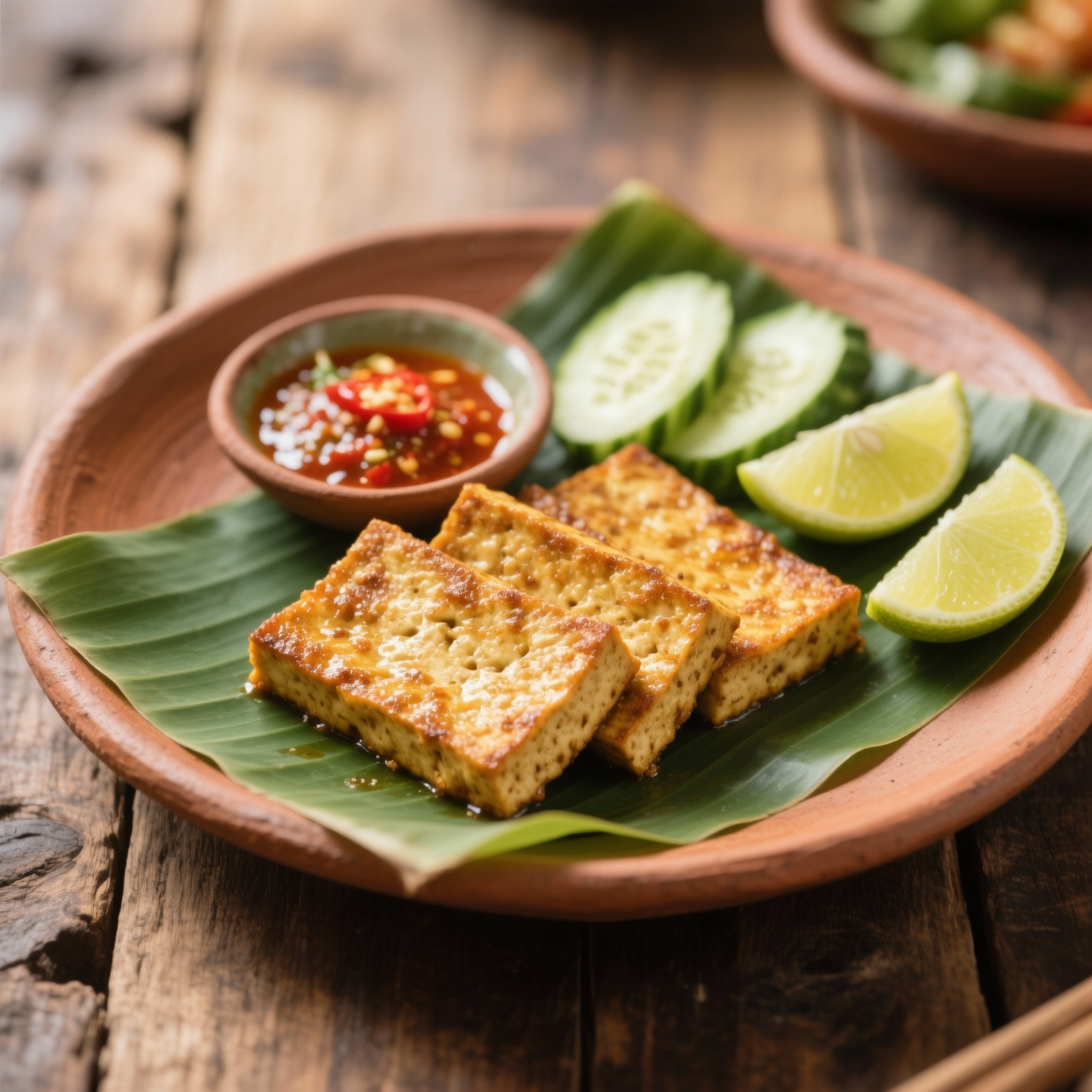
Tempeh
I’ve always believed the best pantry staples breathe, and nothing proves that like tempeh. Born in the humid heart of Java centuries ago, likely from humble kitchen experiments where cooked soybeans met a stray fungal spore, this dense, nutty cake became Indonesia’s quiet protein miracle. Today, you’ll find vacuum-sealed blocks in Western supermarkets for four or five pounds each, wrapped in plastic and often pasteurised until the living cultures are entirely dead. That’s the tragedy: you’re paying premium prices for a dormant slab that tastes vaguely of cardboard and requires heavy marinating to mask its flatness. Making it yourself strips away that compromise. You start with whole soybeans, split them by hand, boil them gently, and inoculate them with a pinch of pure Rhizopus oligosporus culture. The magic happens when you pack them into a breathable mould and wait. Within twenty-four hours, a pristine white mycelial web binds everything into a firm, earthy brick. The process demands patience and a steady hand, but it rewards you with a deeply savoury, almost mushroom-like depth that shop versions simply cannot replicate. The most common pitfall is rushing the drying stage after boiling; if the beans stay wet, unwanted bacteria will bloom before the good mould can colonise. Another frequent misstep is overheating your incubation space. Keep it around thirty degrees Celsius, and let nature do its quiet work. When you finally slice into your own freshly fermented block, the clean snap and rich aroma will convince you that waiting for a living food is always worth the extra care.
Nutrition
| Per serving | Calories | Protein | Carbs | Fat | Sat fat | Fibre | Sugar | Sodium |
|---|---|---|---|---|---|---|---|---|
| beginner | 210kcal | 18g | 12g | 10g | 2g | 6g | 3g | 10mg |
| intermediate | 320kcal | 28g | 15g | 16g | 3g | 7g | 3g | 15mg |
| expert | 200kcal | 18g | 8g | 10g | 1g | 5g | 3g | 1mg |
Per serving · Ava-estimated — a guide, not a clinical figure.
- 500 gsoybean— Dried, hulled and split
- 2000 mlwater— For soaking, boiling, and rinsing
- 30 mlwhite vinegar— Acidifies beans to prevent unwanted bacteria before inoculation
- 3 gtempeh starter— Contains Rhizopus oligosporus spores for fermentation
Store-bought tempeh blocks typically run $5 to $7, often taste faintly metallic or overly bitter, and contain dead cultures from pasteurization or unwanted grain fillers. Making your own at home costs a fraction of that and yields a living, nutty-sweet block with a firm, sliceable crumb. This beginner-friendly approach strips away traditional intimidation by focusing on three critical control points: acidifying the cooking water, ensuring absolute dryness before inoculation, and maintaining a steady, warm environment. You will skip the labor-intensive skin removal step, relying instead on a slightly longer simmer and a precise vinegar addition to lower the pH, which gives the Rhizopus starter a competitive advantage against spoilage molds. Watch closely for uniform white growth; any black or green spots indicate contamination, so discard those blocks. A simple oven with just the pilot light on or a wrapped cooler works perfectly for incubation. Once the beans are completely bound into a solid cake, the fermentation is finished and ready to slice.
Equipment
- Large saucepan— at least 3-quart capacity for simmering
- Colander or steamer insert— for draining and drying
- Food thermometer— critical for checking cooling and incubation temps
- Perforated zip bags or shallow containers— poke holes for airflow during fermentation
Method
- 1
Cover whole soybeans with plenty of cold water and soak overnight.
Beans will roughly double in size.
soaking~ 480 min - 2
Drain the beans and rub them vigorously in a clean kitchen towel to loosen the hulls.
Do not worry about removing every single skin.
de-hulling~ 5 min - 3
Simmer the beans in fresh water with two tablespoons of white vinegar until completely tender.
The acid lowers pH to block unwanted bacteria.
acidifying~ 45 min - 4
Drain thoroughly and spread the beans on a clean tray until bone-dry and cool to the touch.
Residual heat or moisture will kill the starter.
drying~ 15 minTricky bit - 5
Sprinkle the tempeh starter evenly over the cooled beans and toss until thoroughly coated.
Use less than one teaspoon for two cups of beans.
inoculating~ 2 min - 6
Press the inoculated beans firmly into perforated bags or shallow containers.
Eliminate air pockets so the mycelium can bridge the gaps.
compacting~ 5 min - 7
Incubate the packed beans at 85°F to 88°F until a dense white mycelium binds the cake.
Check at 24 hours; extend to 36 if still loose.
incubating~ 1740 minTricky bit
Cooking from frozen
Thaw completely in the fridge before reheating gently in a dry pan to avoid sogginess.
Storage times are a guide — always use your judgement and store food safely.