
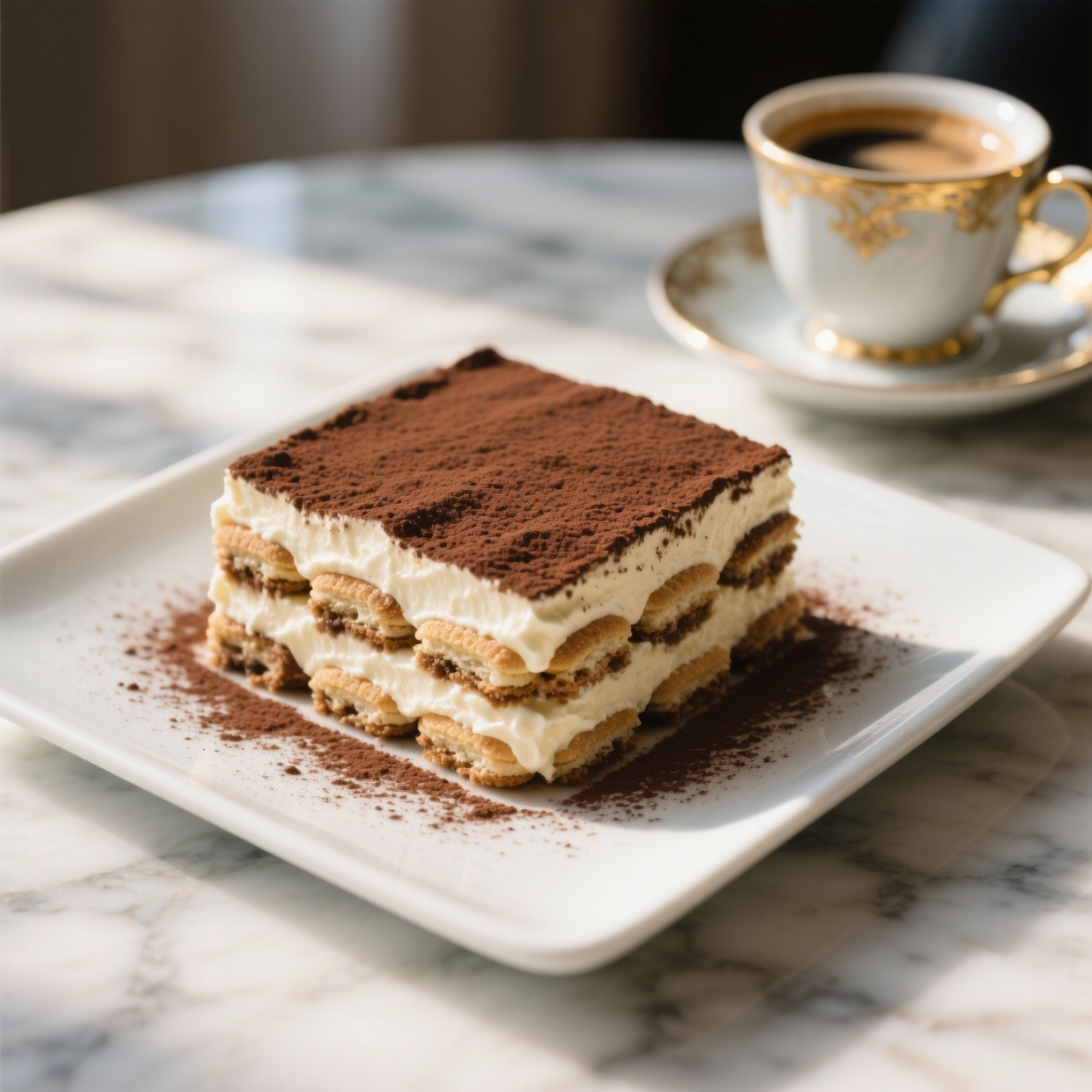
Tiramisu
I have always believed that Tiramisu is less a recipe and more a quiet testament to Italian ingenuity. Born in the Veneto region, likely in the late 1960s or early 1970s, it translates literally to pick me up, a fitting name for a dessert built on espresso and mascarpone that gently awakens the palate. To me, this dish matters because it embodies the Italian philosophy of restraint and harmony. There are no heavy reductions or elaborate garnishes, just the honest layering of soaked ladyfingers, rich cream, and bitter cocoa. Yet, its simplicity is precisely where most home cooks falter. The most common pitfall is rushing the soak. If you dunk the savoiardi too long, they collapse into a soggy mush; if you barely brush them, the dessert becomes a dry, crumbly disappointment. Temperature control is equally unforgiving. Mascarpone must be gently folded into whipped eggs and sugar, never beaten aggressively, or it will curdle and split. And then there is the alcohol. While traditional recipes often call for Marsala or dark rum, I have learned to treat it as a whisper, not a shout, ensuring it complements rather than overpowers the coffee. Patience is the real secret ingredient. Tiramisu must rest in the refrigerator for at least six hours, sometimes overnight, allowing the flavors to marry and the structure to set into something sliceable yet impossibly tender. When you finally serve it, you are not just handing over a dessert. You are offering a piece of Italian history, carefully balanced, quietly profound, and entirely worth the wait.
Nutrition
| Per serving | Calories | Protein | Carbs | Fat | Sat fat | Fibre | Sugar | Sodium |
|---|---|---|---|---|---|---|---|---|
| beginner | 510kcal | 10g | 46g | 30g | 17g | 2g | 30g | 225mg |
| intermediate | 510kcal | 10g | 46g | 30g | 17g | 2g | 30g | 225mg |
| expert | 510kcal | 10g | 46g | 30g | 17g | 2g | 30g | 225mg |
Per serving · Ava-estimated — a guide, not a clinical figure.
- 120 gladyfingers— savoiardi style, dry and crisp
- 250 gmascarpone cheese— full-fat, chilled
- 3 piecelarge eggs— room temperature, separated
- 75 ggranulated sugar— fine crystal
- 240 mlbrewed espresso— strong, cooled to room temperature
- 30 mlsweet Marsala wine— authentic Italian variety
- 15 gunsweetened cocoa powder— Dutch-process preferred
- 1 gfine sea salt
This version prioritizes accessibility and confidence over strict tradition. You will rely on a stabilized, jarred mascarpone blend and pre-whipped cream to bypass the delicate folding process, ensuring the mixture holds its structure without the risk of overworking raw eggs. The espresso is prepared using a strong instant coffee concentrate, which guarantees consistent flavor without requiring specialized brewing equipment. Your main focus will be on the assembly and the crucial chilling phase. Watch closely when dipping the ladyfingers; a one-second per side rule prevents them from disintegrating before they reach the dish. Do not worry about achieving perfect stiff peaks or precise temperature control, as the stabilized ingredients compensate for minor variations. The goal here is a reliably delicious, crowd-pleasing result that captures the essential coffee-and-cream harmony. I strongly recommend using a shallow rectangular dish to maximize surface area for even layering. Resist the urge to skip the overnight rest, as the brief chill time provided is merely a guideline; a full twelve hours will still yield vastly superior texture and flavor integration. Trust the process, keep your movements gentle, and you will achieve a beautiful, sliceable dessert on your very first attempt.
Equipment
- large mixing bowl— stainless steel or glass
- rubber spatula— heat resistant
- 8x8 baking dish— clear glass preferred
Method
- 1
Combine the jarred mascarpone blend with the cooled espresso in a large bowl.
Mix gently until smooth.
combining~ 2 min - 2
Dip each ladyfinger quickly into the espresso mixture, one second per side.
Do not soak.
dipping~ 1 minTricky bit - 3
Layer half the ladyfingers in the dish and spread half the cream mixture evenly.
Use the flat side of a spatula.
layering~ 3 min - 4
Repeat the layering process and refrigerate until firm.
Minimum eight hours.
chilling~ 480 min - 5
Dust the top generously with cocoa powder before slicing.
Sift from a height for even coverage.
dusting~ 1 min