
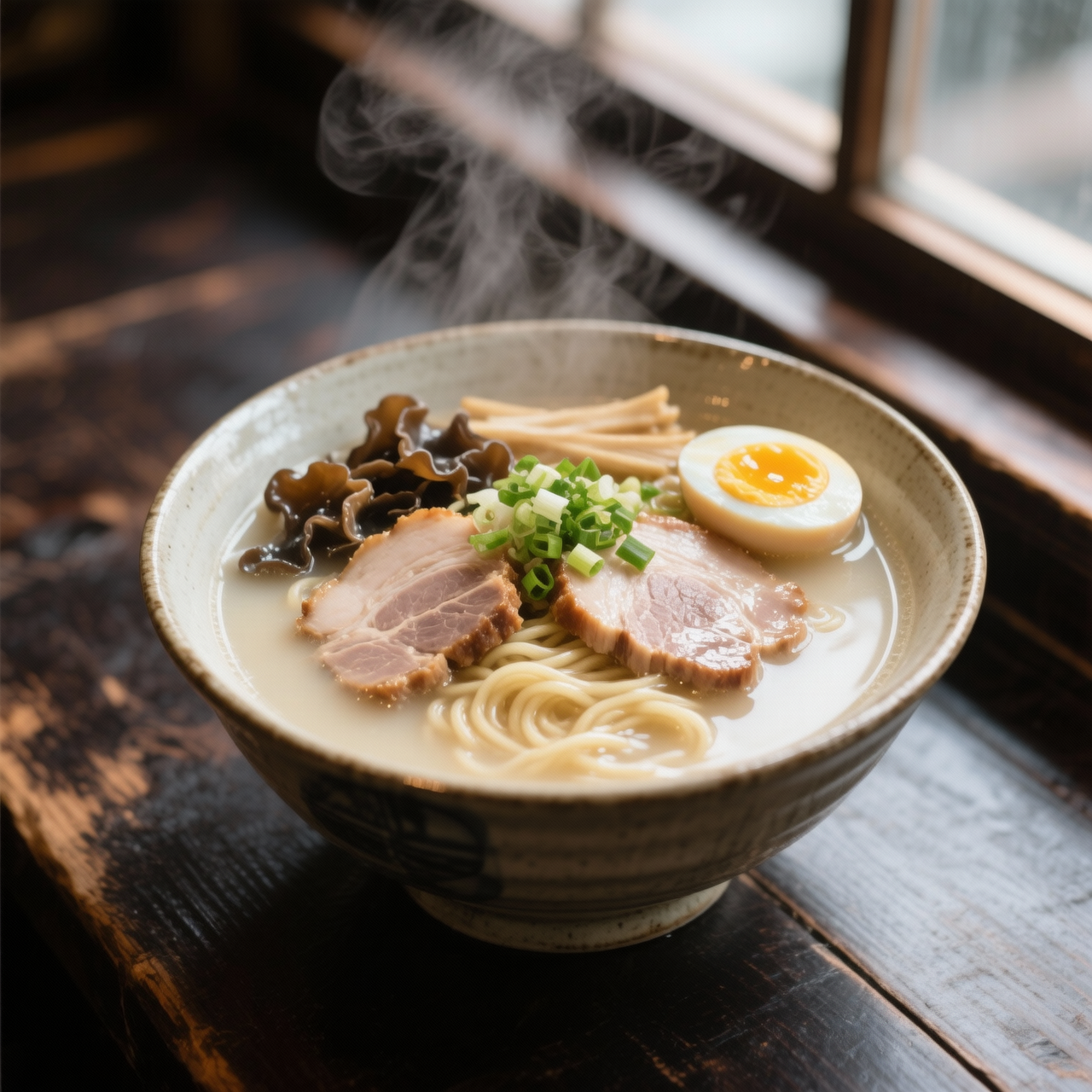
Tonkotsu Ramen
I’ve spent countless hours watching pork bones surrender their marrow to a rolling boil, learning that true tonkotsu ramen isn’t just a dish but a meditation on patience. Born in the post-war streets of Fukuoka, this broth was originally a humble attempt by street vendors to stretch every ounce of flavor from leftover trotters and knuckles, yet it evolved into a culinary emblem of Kyushu’s relentless pursuit of depth. When I make it, I’m honoring generations of cooks who understood that greatness hides in the mundane. The magic lies in the violent, sustained boil that emulsifies collagen and fat into that signature milky opacity, transforming humble scraps into liquid silk. Yet so many stumble at the first hurdle. Home cooks often simmer gently, mistaking restraint for refinement, which yields a clear, thin stock entirely missing the unctuous body that defines tonkotsu. Others rush the process, skipping the crucial pre-blanching step that removes impurities, leaving behind a muddy, gamey broth that masks rather than elevates the delicate pork essence. Temperature control, relentless stirring to prevent scorching, and the willingness to let it roll for twelve hours or more are non-negotiable. It’s easy to be seduced by shortcuts like powdered concentrates or pressure cookers, but they strip away the alchemy that only time and heat can forge. When done right, the broth coats the tongue, carries the weight of tradition, and transforms a simple bowl of noodles into something profoundly nourishing. I make it not because it’s convenient, but because it reminds me that some of the most beautiful things in cooking demand exactly what we’re least willing to give.
Nutrition
| Per serving | Calories | Protein | Carbs | Fat | Sat fat | Fibre | Sugar | Sodium |
|---|---|---|---|---|---|---|---|---|
| beginner | 920kcal | 30g | 64g | 58g | 18g | 4g | 5g | 1800mg |
| intermediate | 920kcal | 30g | 64g | 58g | 18g | 4g | 5g | 1800mg |
| expert | 920kcal | 30g | 64g | 58g | 18g | 4g | 5g | 1800mg |
Per serving · Ava-estimated — a guide, not a clinical figure.
- 1500 gpork leg bone— split open to expose marrow
- 500 gpork trotter— cleaned and halved
- 400 gpork belly— skin-on, tied into a log
- 60 ggarlic— unpeeled
- 40 gginger— thickly sliced
- 80 gscallion— white and green parts separated
- 400 gramen noodle— fresh, alkaline wheat noodles
- 80 mlsoy sauce— high-quality Japanese usukuchi
- 40 mlmirin— hon mirin, not cooking wine
- 30 gblack sesame paste— unsweetened, toasted
- 4 wholesoft-boiled egg— marinated in tare overnight
- 4 wholenori sheet— yaki-nori grade
- 3000 mlwater— filtered, for broth base
- 20 mlneutral oil— for frying aromatics
This version prioritizes accessibility without sacrificing the core flavor profile that defines the dish. Instead of dedicating an entire weekend to extracting gelatin, you will rely on a high-quality tonkotsu base concentrate that already contains the emulsified pork essence. The goal here is to build confidence through controlled assembly rather than prolonged extraction. Watch your heat carefully when diluting the concentrate; too aggressive a boil will cause the jarred emulsion to break and turn greasy, while too low a temperature will leave the soup thin. I strongly recommend preparing your tare and toppings in advance, as the final assembly moves quickly once the water boils. The noodles will cook in under two minutes, so keep your bowls warmed and your plating station organized. Do not rush the soft-boiled eggs or the chashu pork, as these elements carry the dish’s seasoning. If the broth feels flat, adjust with a few drops of soy sauce or a pinch of salt rather than adding more water. Trust the process, focus on timing your components, and you will produce a deeply satisfying bowl that honors the tradition while fitting comfortably into a busy weeknight.
Equipment
- large stockpot— minimum 5-quart capacity
- fine-mesh strainer— for clear broth transfer
- whisk— silicone or metal
Method
- 1
Blanch the pork leg bones and trotters in boiling water for two minutes, then drain and rinse thoroughly.
Removes surface blood and impurities.
blanching~ 2 min - 2
Sauté the sliced ginger and unpeeled garlic in neutral oil until fragrant, then add water and the blanched bones.
Keep heat at medium to avoid burning.
sautéing~ 3 min - 3
Simmer the broth gently, then whisk in the black sesame paste and soy sauce until fully dissolved.
Prevent the paste from clumping.
dissolving~ 15 minTricky bit - 4
Boil the fresh noodles in a separate pot until tender, drain immediately, and divide among warmed bowls.
Noodles cook quickly and become mushy if left standing.
boiling~ 2 min - 5
Ladle the hot broth over the noodles, arrange the sliced pork, halved eggs, and scallions, then garnish with nori.
Serve immediately while piping hot.
plating~ 1 min