
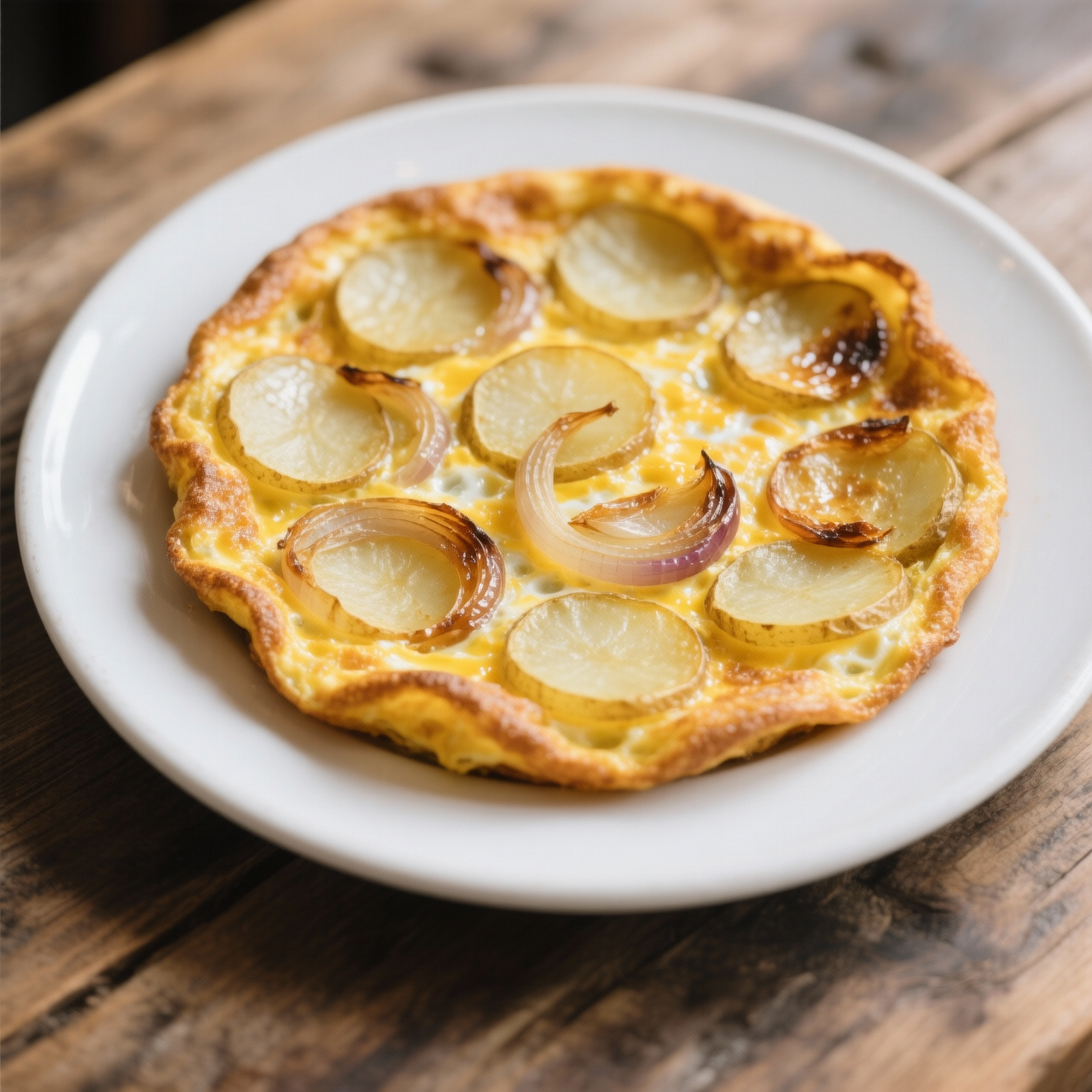
Tortilla española
I first understood the quiet power of a proper tortilla española when I watched my grandmother coax it into existence over a low flame, patient as a clockmaker. This humble potato-and-egg omelette isn’t just a Spanish staple; it’s a cultural anchor, born from necessity in the nineteenth century and refined into a celebration of restraint. When you replace the chilled-aisle supermarket version—usually a rubbery disc costing around three pounds, packed with stabilisers and drowning in bland, pre-cooked potatoes—you reclaim a dish that actually tastes like time and care. The magic lies entirely in the slow confit of thinly sliced potatoes and onions in generous olive oil, followed by the crucial resting period where the eggs and starch marry into a custardy emulsion. Skip the oil bath for a quick fry, and you’ll end up with dry, disjointed chunks. Rush the flip, and you’ll face a shattered pancake instead of a proud, golden dome. The real secret is patience: cook the potatoes until they yield like butter, drain them thoroughly, let the mixture sit off the heat for ten full minutes, and use a plate, not a lid, to turn it with confidence. There are no shortcuts here, no powdered thickeners or jarred blends to fake the texture. Every ingredient must be real, every step deliberate. When done right, the tortilla emerges with a creamy centre, crisp edges, and a depth that no factory line could ever replicate. It’s a reminder that the simplest foods demand the most respect, and that from-scratch cooking isn’t just a preference—it’s a quiet rebellion against convenience.
Nutrition
| Per serving | Calories | Protein | Carbs | Fat | Sat fat | Fibre | Sugar | Sodium |
|---|---|---|---|---|---|---|---|---|
| beginner | 320kcal | 10g | 35g | 16g | 3g | 3g | 3g | 250mg |
| intermediate | 380kcal | 12g | 30g | 22g | 4g | 3g | 4g | 300mg |
| expert | 310kcal | 12g | 28g | 18g | 4g | 3g | 3g | 380mg |
Per serving · Ava-estimated — a guide, not a clinical figure.
- 600 gPotato— Waxy variety preferred, peeled and thinly sliced
- 6 unitEgg— Large, at room temperature
- 300 mlOlive oil— Extra virgin, for confit and shallow frying
- 8 gSalt— Fine sea salt
- 150 gOnion(optional)— Yellow or sweet, thinly sliced
Chilled supermarket tortillas typically cost £3–£5 for a dense, rubbery disc packed with stabilisers and cheap seed oils that mask bland, undercooked potatoes. This beginner version delivers the authentic, custardy centre and crisp edges entirely from scratch, using only potatoes, eggs, olive oil, onion, and salt. The main difference here is technique: instead of the traditional deep-poaching method that requires careful oil temperature management, we gently simmer thinly sliced potatoes in a shallow layer of good olive oil, which is far more forgiving and easier to control on a standard home stove. Watch for the potatoes to become completely tender and translucent without browning or breaking apart. The trickiest moment is the flip, so we use a large plate to invert the omelette confidently rather than tossing it in the air. Keep the heat strictly on medium-low to prevent the eggs from scrambling or drying out. Your goal is a softly set centre that still yields to a gentle press. Serve it warm or at room temperature, and you will immediately taste the difference between a real Spanish staple and its processed aisle counterpart.
Equipment
- Heavy-bottomed pan— non-stick is highly recommended for the flip
- Large dinner plate— must be wider than the pan
- Colander— for draining cooking oil
- Chef's knife and cutting board— for uniform vegetable slicing
Method
- 1
Peel the potatoes and slice them into uniform three-millimetre rounds, then thinly slice the onion.
Consistent thickness ensures even cooking throughout.
mise en place~ 5 min - 2
Place the sliced vegetables in a heavy pan with olive oil and cook over medium-low heat until completely tender.
The oil should barely bubble; do not let the edges colour or crisp.
poaching~ 15 min - 3
Drain the vegetables thoroughly in a colander, reserving the oil, and let them cool slightly.
Excess moisture will make the final omelette soggy and fragile.
straining~ 2 min - 4
Whisk the eggs with salt in a large bowl, fold in the warm vegetables, and let the mixture rest.
Resting allows the potato starches to absorb the egg for better cohesion.
folding~ 5 min - 5
Heat two tablespoons of the reserved oil in a non-stick pan and pour in the egg mixture.
Tilt the pan gently to distribute the eggs evenly across the base.
searing~ 4 min - 6
Slide a large plate over the pan, invert it to drop the tortilla onto the plate, and slide it back into the pan.
A confident, swift motion prevents tearing or folding the edges.
inverting~ 1 minTricky bit - 7
Tuck the edges inward with a spatula and cook until the centre is softly set but still jiggly.
Remove from heat immediately once it yields to a gentle press.
carryover cooking~ 3 min
Cooking from frozen
Thaw completely in the fridge overnight, then reheat gently in a covered pan or low oven to preserve the custard-like texture.
Storage times are a guide — always use your judgement and store food safely.