
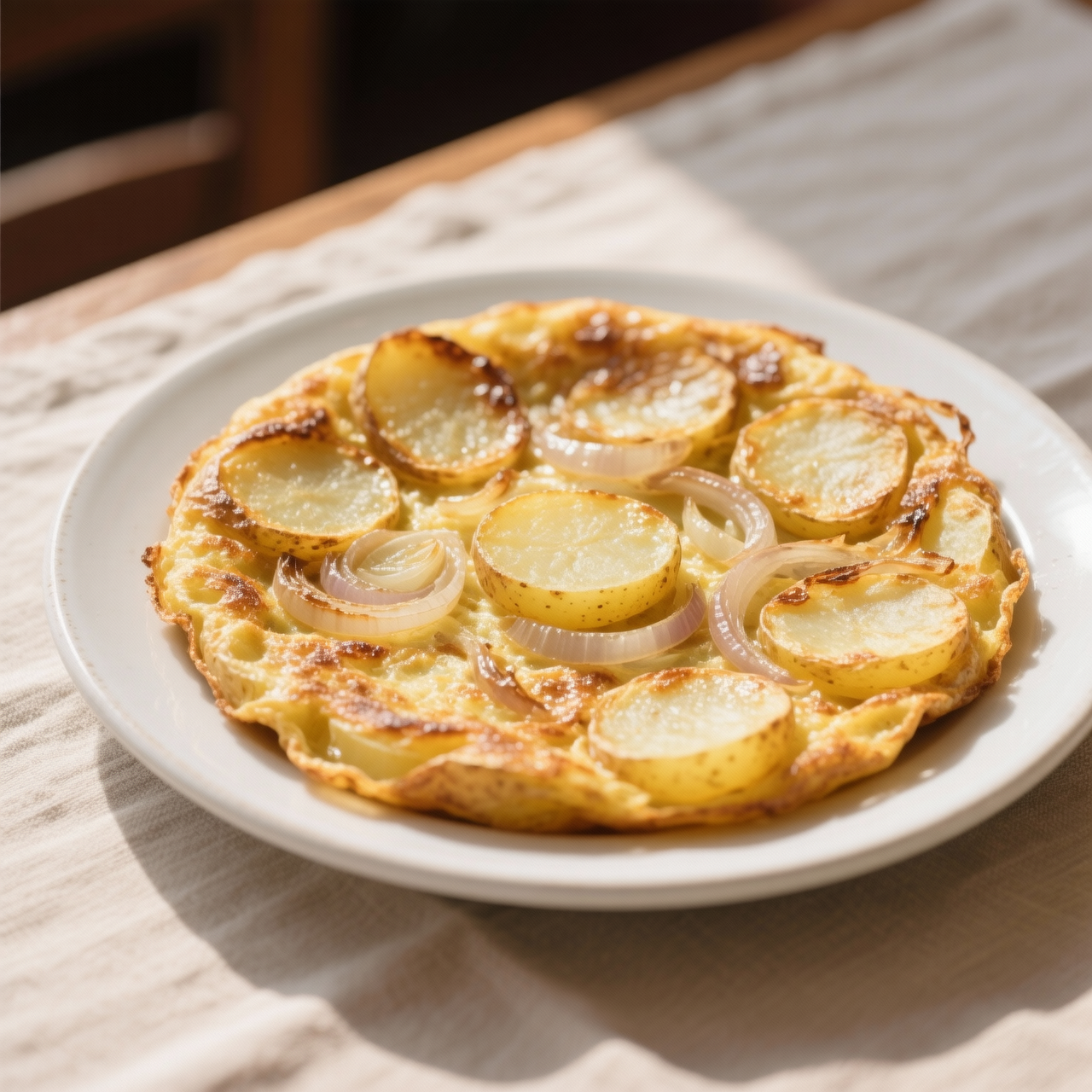
Tortilla Espanola
When I first learned to make tortilla española in a sunlit Madrid kitchen, I quickly realized this dish is less a simple meal and more a quiet test of patience. Born in the nineteenth century among rural Spanish cooks who stretched scarce ingredients, it evolved from peasant sustenance into a national emblem of comfort and community. I have always loved how it demands nothing extravagant, just eggs, potatoes, and olive oil, yet insists on absolute respect for technique. What matters most is the alchemy of confit and fold. The potatoes must surrender slowly in generous olive oil, turning translucent without browning, while the eggs act as both binder and canvas. Too many home cooks rush the process, frying the potatoes at high heat until they crisp, which ruins the signature melt in your mouth texture. Others overcook the eggs, chasing firmness instead of that luxuriously jammy center that defines a proper tortilla. I have watched countless well meaning attempts collapse into dry omelets simply because the cook flipped too aggressively or skipped the resting phase that allows the structure to set. This dish is not about perfection, it is about intention. Every slice tells a story of restraint, of trusting the ingredients to harmonize rather than forcing them into submission. When you finally cut into a properly made tortilla and watch the custard like interior yield, you understand why Spaniards guard their recipes fiercely. It is a humble masterpiece, and it rewards those willing to slow down.
Ingredients
- 600 gpotato— waxy variety, peeled
- 150 gonion— sweet yellow variety
- 4 largeegg— room temperature
- 120 mlolive oil— extra virgin
- 5 gsalt— fine sea salt
Method
Pick a skill levelThis version prioritizes confidence over perfection. You will bypass the traditional slow confit by using the microwave to gently soften the potatoes and onions, saving you time while still achieving the necessary tenderness. The goal here is to eliminate the anxiety of the flip. We will use a sturdy dinner plate as a reliable guide for turning the tortilla, ensuring the structure remains intact without requiring advanced wrist technique. Watch closely for the egg to set around the edges while the center retains a slight jiggle; overcooking is the most common mistake at this stage. I recommend using a quality non-stick pan to guarantee a clean release. The oil amount is measured precisely so you can drain the excess without losing the essential flavor that binds the dish. Focus on slicing your potatoes uniformly so they cook at the same rate, and resist the urge to rush the resting period. A five-minute pause before slicing allows the residual heat to finish the center and gives the proteins time to relax. You will end with a cohesive, sliceable wedge that proves this classic is entirely within your reach.
Method
- 1
Slice potatoes and onions uniformly thin using a sharp chef knife.
Three millimeters ensures even cooking.
slicing~ 10 min - 2
Combine potatoes, onions, and olive oil in a microwave-safe bowl and cover loosely.
Vent the lid slightly to release steam.
steaming~ 5 min - 3
Heat the mixture in the microwave until the potatoes are completely tender but not falling apart.
Stir halfway through to distribute heat evenly.
par-cooking~ 8 min - 4
Whisk eggs and salt in a separate bowl until fully blended and slightly frothy.
Avoid whipping to keep the texture dense.
whisking~ 1 min - 5
Drain excess oil from the potatoes, reserving one tablespoon, and fold the mixture into the eggs.
Let it sit for two minutes to absorb flavor.
tempering~ 2 min - 6
Pour the mixture into a preheated non-stick pan and cook over medium heat until the edges set.
Use a spatula to gently push cooked edges toward center.
coagulating~ 4 min - 7
Cover the pan with a dinner plate, invert carefully, and slide the tortilla back into the pan to cook the second side.
Move with deliberate confidence to prevent tearing.
inverting~ 3 minTricky bit
Here we step into the standard home-cook rhythm, embracing the traditional stovetop confit without the pressure of professional precision. You will slowly cook the sliced potatoes and onions in olive oil over medium-low heat, allowing them to soften completely without browning. The key difference at this level is learning to manage your pan temperature and recognizing the exact moment the potatoes yield to gentle pressure. I will guide you through tempering the beaten eggs with the warm potato mixture, which ensures a seamless emulsion and a uniformly tender texture. The flip remains the central challenge, but with a properly seasoned heavy skillet and a steady, confident motion, you will master it. Pay attention to the sound of the eggs hitting the oil; a quiet sizzle indicates the heat is correct, while a loud crack means the pan is too aggressive. We will aim for a slightly creamy interior that holds together when sliced, balancing structural integrity with that signature soft center. Resting the finished tortilla on a wire rack prevents a soggy bottom, and a precise knife cut will reveal your progress.
Method
- 1
Peel and slice potatoes and onions into uniform half-moons using a chef knife.
Consistent thickness is critical for even heat distribution.
slicing~ 15 min - 2
Heat olive oil in a heavy-bottomed skillet over medium-low until shimmering but not smoking.
A bread crust should sizzle gently without browning.
heating~ 2 min - 3
Submerge the potatoes and onions in the warm oil, adjusting heat to maintain a gentle simmer.
Do not stir aggressively to preserve the slices.
confiting~ 20 min - 4
Whisk eggs and salt vigorously until the yolks and whites are completely homogenized.
Incorporate minimal air for a dense crumb.
whisking~ 2 min - 5
Drain the potatoes and onions through a fine mesh strainer, reserving the infused oil.
Let excess oil drip away for exactly one minute.
draining~ 2 min - 6
Combine the warm potato mixture with the beaten eggs and let it rest briefly.
The residual heat will slightly thicken the eggs.
tempering~ 3 min - 7
Return the mixture to the skillet with a splash of reserved oil and cook until the bottom is golden.
Use an offset spatula to check crust formation.
setting~ 5 minTricky bit - 8
Flip the tortilla using a plate, tuck the edges inward, and cook until the center remains softly set.
Keep the pan off the heat during the flip.
inverting~ 3 minTricky bit
This iteration honors the strict discipline of the Spanish tavern, where the tortilla is treated as a study in thermal control and timing. You will execute a true low-temperature oil bath, keeping the fat between one hundred and ten and one hundred twenty degrees Celsius to coax the starches out of the potatoes without triggering the Maillard reaction. The onion is added at the precise midpoint to infuse the oil with sweetness without caramelizing. I expect you to monitor the egg mixture closely, folding it into the warm potatoes just long enough for the proteins to begin coagulating slightly before returning everything to the pan. The flip is executed without a plate, using only the skillet curvature and a practiced wrist flick to create a seamless, domed shape. You will watch for the telltale ring of set egg forming around the perimeter, then immediately reduce the heat to trap a perfectly runny, custard-like center. A mandatory ten-minute rest is non-negotiable, allowing the internal temperature to equalize and the flavors to marry. The final cut should yield a glossy, clean slice that demonstrates absolute command of heat and ingredient ratios.
Method
- 1
Julienne the potatoes and finely dice the onion, keeping the cuts precise and uniform.
Uniformity ensures identical thermal conductivity.
slicing~ 20 min - 2
Place olive oil in a carbon steel skillet and monitor with a thermometer until it reaches exactly one hundred ten degrees Celsius.
Precise temperature prevents starch gelatinization from turning mushy.
heating~ 3 minTricky bit - 3
Submerge the vegetables in the controlled oil bath, maintaining temperature with low flame adjustments.
Add onion at the ten-minute mark to layer sweetness.
confiting~ 25 minTricky bit - 4
Crack eggs into a chilled stainless steel bowl and whisk until completely homogenous but not aerated.
A dense egg base yields the traditional creamy texture.
emulsifying~ 2 min - 5
Strain the potatoes and onions, shaking off excess oil, and immediately fold them into the eggs.
Work quickly while the potatoes are still hot.
tempering~ 3 min - 6
Return the mixture to the skillet over medium-low heat and shape the edges with a spatula.
Form a slight dome to encourage even center cooking.
setting~ 4 minTricky bit - 7
Execute a free-flip by tossing the skillet with a sharp upward wrist motion.
Catch it cleanly in the pan to preserve structural integrity.
inverting~ 0 minTricky bit - 8
Cook the second side briefly over very low heat, then remove from burner and rest for ten minutes.
Resting is mandatory for the custard center to stabilize.
resting~ 10 min