
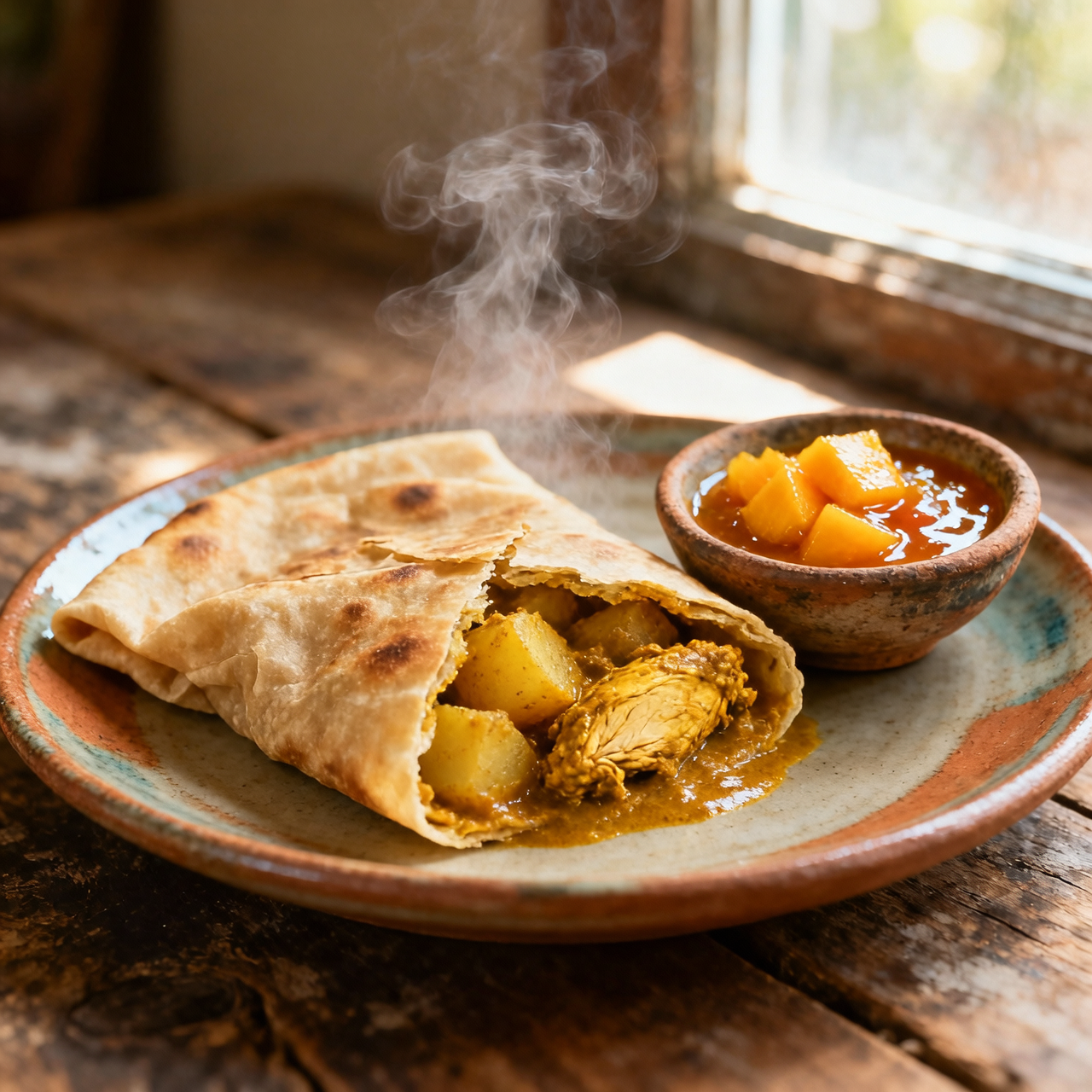
Trinidadian Curry Roti
I’ve always believed that Trinidadian curry roti is less a meal and more a quiet negotiation between history, heat, and patience. When Indian indentured laborers arrived on these shores in the mid-nineteenth century, they brought more than just their spices; they carried the memory of flatbreads cooked over open flames. Over generations, those doughs met the bold, earthy rhythms of Caribbean curry, and what emerged was roti—not merely wrapped, but woven into the fabric of everyday life. For me, this dish matters because it refuses to be rushed. You can’t shortcut the dough’s rest, you can’t skip the slow bloom of geera and turmeric, and you certainly can’t ignore the way the filling should cling to the bread like a promise. Too many cooks fall into the same traps: overworking the dough until it turns tough, drowning the curry in water instead of coaxing out its natural oils, or sealing the roti so tightly it bursts on the tawa. The secret isn’t in perfection; it’s in listening to the dough as it sighs into place, watching for those golden blisters that tell you it’s ready to be folded. Every crease holds a story of migration, adaptation, and the stubborn joy of making something from scratch when time feels scarce. When I press the filling into the dough and roll it out with flour-dusted hands, I’m not just cooking—I’m keeping a conversation alive between the old world and the new. That’s why this roti demands respect, and why, when done right, it tastes like home.
Ingredients
- 300 gall-purpose flour— sifted
- 50 gsplit yellow pea— rinsed and dried
- 120 mlwater— room temperature
- 5 gsalt— fine sea salt
- 30 mlvegetable oil— divided use
- 400 gchicken thigh— boneless, cut into 2-inch pieces
- 200 grusset potato— peeled and cubed
- 150 gyellow onion— finely diced
- 15 ggarlic clove— minced
- 15 gginger root— freshly grated
- 30 gTrinidadian curry powder— medium heat
- 1 wholescotch bonnet pepper— pierced with a knife
- 5 gcumin seed— whole
- 3 gfenugreek leaf— dried, crushed
- 200 mlcoconut milk— full fat, unsweetened
- 20 gcilantro— roughly chopped
Method
Pick a skill levelThis version prioritizes accessibility without sacrificing the soul of the dish. You will work with pre-measured, readily available pantry staples, and the dough relies on a simplified hydration ratio that eliminates guesswork. Instead of traditional hand-toasting of whole spices, you will use a reliable commercial curry powder that delivers consistent flavor profiles. The key here is managing heat control; curry powder burns easily, so keep your burner at a steady medium and never let the pan smoke. Watch the dough closely during the resting phase, which is non-negotiable for tenderness, so resist the urge to rush it. When rolling, apply light, even pressure rather than forceful pounding, which tears the delicate layers. If your roti sticks to the pan, your heat is too low or the surface is too dry; adjust immediately. The curry filling is designed to be forgiving, simmering gently until everything melds into a cohesive, gravy-rich mixture. Trust the visual cues: the dough should spring back slowly when poked, and the curry should coat the back of a spoon thickly. Follow the timing precisely, and you will achieve a deeply satisfying first attempt that builds genuine confidence for future iterations.
Method
- 1
Combine the all-purpose flour, split yellow pea, salt, and water in a large mixing bowl.
Mix until a shaggy mass forms.
kneading~ 5 min - 2
Cover the dough with a damp kitchen towel and let it rest undisturbed.
Do not skip this hydration phase.
resting~ 20 min - 3
Heat half the vegetable oil in a heavy-bottomed pan over medium heat.
Oil should shimmer but not smoke.
heating~ 2 min - 4
Add the diced yellow onion and sauté until translucent.
Stir occasionally to prevent browning.
sweating~ 5 min - 5
Stir in the curry powder, minced garlic clove, grated ginger root, and pierced scotch bonnet pepper.
Cook only until fragrant to avoid burning.
blooming~ 2 minTricky bit - 6
Add the chicken thigh pieces, cubed russet potato, cumin seed, and crushed fenugreek leaf.
Toss thoroughly to coat the protein and vegetables.
toasting~ 3 min - 7
Pour in the coconut milk and reduce the heat to a gentle simmer.
Cover partially and stir every ten minutes.
simmering~ 20 min - 8
Divide the rested dough into four portions and roll each into a thin circle on a floured surface.
Use even, outward pressure from the center.
rolling~ 6 minTricky bit - 9
Cook each roti on a dry skillet over medium-high heat, flipping once golden spots appear.
Press gently to encourage puffing.
dry-roasting~ 5 min - 10
Brush the hot rotis with remaining oil, fold into quarters, and serve alongside the curry.
Garnish with fresh cilantro.
finishing~ 2 min
This approach assumes comfort with foundational techniques and focuses on balancing textures and layering flavors from scratch. You will prepare your own dhalpuri dough by dry-roasting and grinding the split yellow peas, which adds a crucial earthy depth that pre-ground blends cannot replicate. The curry base requires careful spice tempering; you will bloom the curry powder in hot oil just until fragrant, then immediately introduce the coconut milk to halt the cooking and prevent bitterness. Monitor your dough hydration closely, as humidity and flour absorption vary, so add water by the tablespoon until the dough reaches a soft, pliable state. When cooking the roti on a hot tawa or heavy skillet, look for the characteristic golden-brown spots and gentle puffing, which indicate proper steam entrapment. Flip with confidence and press lightly with a clean cloth to encourage even layering. For the filling, sear the chicken first to develop fond, then deglaze with coconut milk before adding the potatoes, ensuring every bite carries concentrated flavor. The goal is a harmonious balance where the flaky, slightly charred roti complements a rich, aromatic curry without becoming soggy or overwhelming.
Method
- 1
Dry-toast the split yellow pea in a clean skillet until fragrant, then cool and grind to a coarse meal.
Grind in short pulses to prevent turning into paste.
grinding~ 7 min - 2
Mix the ground pea, all-purpose flour, salt, and water, kneading vigorously until smooth and elastic.
Add water one tablespoon at a time as needed.
kneading~ 8 minTricky bit - 3
Cover the dough tightly and let it rest at room temperature to fully relax the gluten network.
Resting ensures effortless stretching later.
resting~ 30 min - 4
Heat oil in a heavy skillet over medium-high heat and sear the chicken thighs until browned on all sides.
Do not crowd the pan to ensure proper caramelization.
searing~ 6 min - 5
Remove the chicken, lower the heat, and add the onion, garlic, ginger, and scotch bonnet pepper.
Deglaze the pan with a splash of coconut milk if sticking occurs.
sautéing~ 5 min - 6
Add the curry powder, cumin, and fenugreek, stirring constantly to bloom the spices in the residual fat.
The mixture should darken slightly and release a nutty aroma.
blooming~ 2 minTricky bit - 7
Return the chicken to the pan, add the potatoes, and pour in the remaining coconut milk.
Bring to a gentle bubble before reducing heat.
braising~ 25 min - 8
Roll each dough portion into a thin disc, then fold and roll again twice to create distinct internal layers.
Keep the surface lightly floured to prevent tearing.
laminating~ 8 minTricky bit - 9
Cook the roti on a preheated tawa or heavy skillet until deeply blistered and golden.
Flip when edges lift and steam pockets form.
dry-roasting~ 4 min - 10
Stack the finished rotis, brush with oil, cover with foil, and serve immediately with the curry.
Garnish with chopped cilantro.
finishing~ 3 min
This iteration demands precision, patience, and respect for traditional Indo-Caribbean methodology. You will soak and grind the split yellow peas to a fine meal before incorporating it into the dough, creating a true dhalpuri structure that yields distinct, buttery layers when properly laminated. The resting period extends to allow complete gluten relaxation and starch hydration, which is essential for effortless rolling. Curry preparation begins with toasting whole coriander, cumin, and turmeric, followed by dry-grinding to your preferred heat tolerance. You will employ the traditional bunjying technique, frying the curry base in hot oil until the masala separates from the fat and darkens to a rich mahogany, developing complex Maillard compounds. The dough is rolled using a rhythmic, back-and-forth motion that stretches rather than compresses, then folded and rolled again to multiply the internal strata. Cooking happens over high, direct heat on a seasoned tawa, where rapid steam expansion creates dramatic blistering. You will finish by brushing the roti with clarified ghee or hot oil, allowing it to rest briefly so the layers set. This version rewards meticulous technique with an authentic, restaurant-grade result that honors the dish’s heritage.
Method
- 1
Soak the split yellow pea in cold water for two hours, then drain completely and grind into a fine, dry flour.
Sift to remove any coarse hulls for maximum tenderness.
milling~ 10 minTricky bit - 2
Combine the ground pea, all-purpose flour, and salt, adding warm water gradually while kneading for fifteen minutes.
Dough must pass the windowpane test for optimal elasticity.
developing~ 15 min - 3
Coat the dough in a thin film of oil, cover, and rest in a warm, draft-free environment for two hours.
Extended fermentation allows starch hydration and gluten relaxation.
autolyzing~ 120 min - 4
Toast whole coriander, cumin, and turmeric seeds until fragrant, then dry-grind into a fine masala.
Store in an airtight container until ready to use.
tempering~ 5 min - 5
Heat oil in a heavy dutch oven until shimmering, then add the fresh onion, garlic, ginger, and scotch bonnet.
Fry until the aromatics turn deep golden brown.
caramelizing~ 8 min - 6
Add the freshly ground masala and fenugreek, frying continuously until the oil separates from the spice paste.
This bunjying technique develops complex Maillard flavors.
blooming~ 4 minTricky bit - 7
Incorporate the chicken thighs and cubed potatoes, searing briefly before pouring in the full-fat coconut milk.
Simmer uncovered to reduce the sauce to a rich, clinging consistency.
reducing~ 30 min - 8
Divide the rested dough, stretch each piece by hand into a large, paper-thin sheet, then fold into a tight coil.
Coiling creates the signature flaky dhalpuri layers.
laminating~ 10 minTricky bit - 9
Flatten the coils and cook on a fiercely hot, seasoned tawa until dramatic blisters form and char appears.
Press firmly with a cloth to force steam expansion.
dry-roasting~ 3 min - 10
Brush the hot rotis with hot ghee or oil, stack them to trap residual steam, and serve immediately.
Garnish with freshly torn cilantro.
finishing~ 3 min