
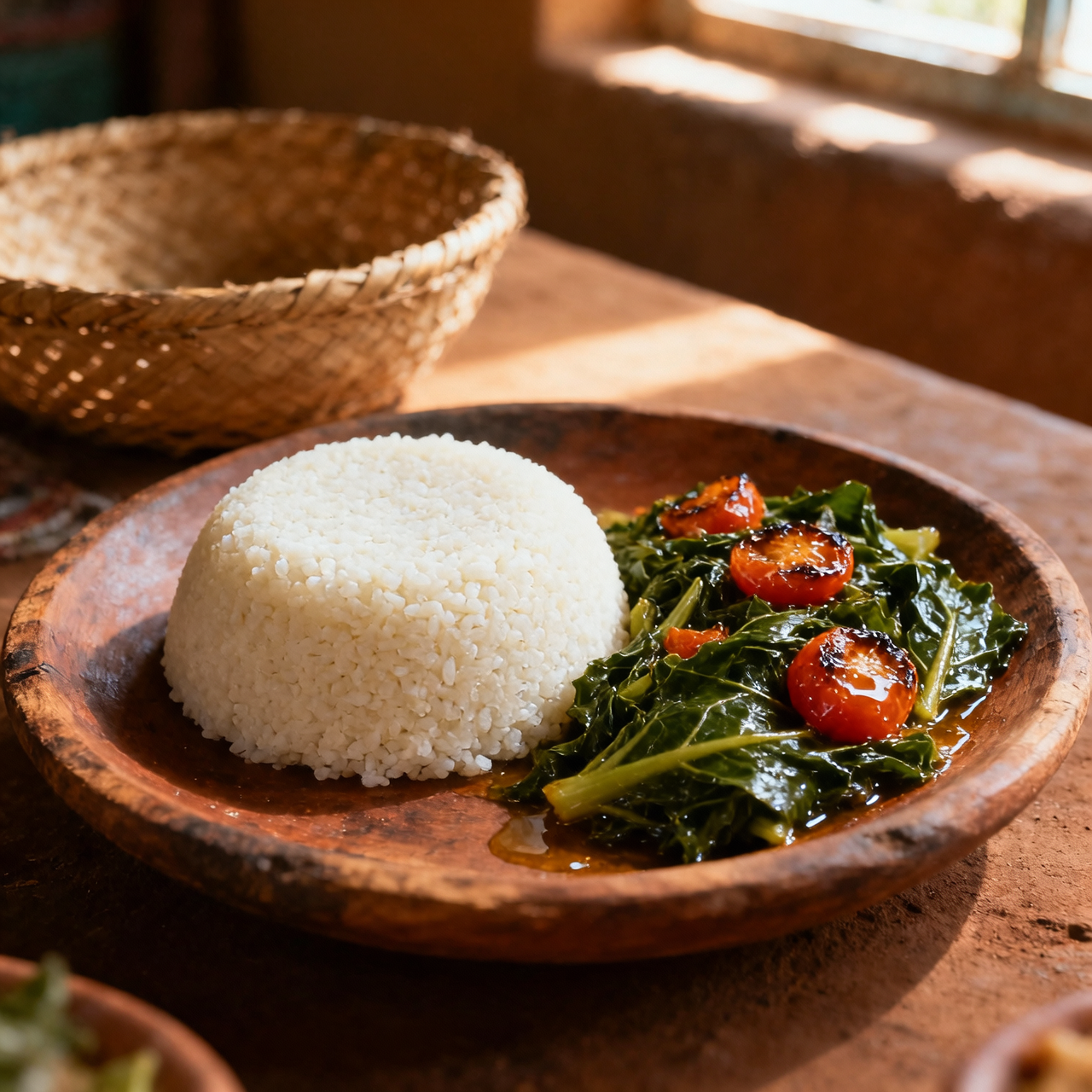
Ugali with Sukuma Wiki
When I first learned to stir ugali and sukuma wiki together, I quickly realized this pairing is far more than a simple combination of maize flour and sautéed collard greens. Rooted deeply in the everyday kitchens of East Africa, this dish carries the quiet resilience of generations who turned humble, accessible ingredients into profound nourishment. While some mistakenly label it under broader regional banners, its true heartbeat belongs to the Swahili-speaking communities and rural homesteads where every meal is a meditation on resourcefulness. To me, it matters because it strips away culinary pretense and returns us to what food fundamentally is: grounding, honest, and deeply communal. The magic lies in the texture and timing. Ugali demands patience; you must pour the maize flour into boiling water gradually, stirring vigorously until it forms a firm, dough-like mass that holds together when pressed. Too little water, and it crumbles into dry powder. Too much, and it becomes a sticky paste that refuses to release from the pot. Meanwhile, the sukuma wiki requires a deft hand with heat. Greens should be added in stages, quickly wilted with just enough oil, onions, and tomatoes to enhance their earthy bitterness without drowning them. A common pitfall I see repeatedly is rushing the greens until they turn mushy, or undercooking the ugali until it leaves a raw, chalky taste on the palate. True mastery comes from respecting each component’s rhythm. When done right, the dense, comforting starch and the bright, savory greens create a harmony that sustains both body and spirit, proving that simplicity, when handled with care, is the highest form of culinary art.
Nutrition
| Per serving | Calories | Protein | Carbs | Fat | Sat fat | Fibre | Sugar | Sodium |
|---|---|---|---|---|---|---|---|---|
| beginner | 570kcal | 15g | 100g | 16g | 3g | 14g | 8g | 1030mg |
| intermediate | 570kcal | 15g | 100g | 16g | 3g | 14g | 8g | 1030mg |
| expert | 570kcal | 15g | 100g | 16g | 3g | 14g | 8g | 1030mg |
Per serving · Ava-estimated — a guide, not a clinical figure.
- 400 gmaize flour— finely ground white cornmeal
- 800 mlwater— divided for boiling and cooking
- 600 gcollard green— tough stems removed, leaves thinly sliced
- 300 gyellow onion— thinly sliced
- 450 groma tomato— diced
- 12 ggarlic clove— minced
- 20 gfresh ginger— grated
- 45 mlvegetable oil— high smoke point neutral oil
- 10 gsea salt— fine grain or kosher
- 2 gblack pepper— freshly ground
- 5 gcumin— ground or whole seeds
- 5 gcoriander seed— whole or lightly toasted
- 3 gred chili flake— adjust to heat preference
- 15 mllemon juice— freshly squeezed
This version prioritizes confidence and clarity, leaning on convenient shortcuts without sacrificing the dish core character. You will use a ready-made spice paste and pre-sliced greens to eliminate prep friction, allowing you to focus entirely on mastering the ugali hydration and texture. The key here is patience during the final stir; rushing the flour addition will create lumps, while stopping too early yields a gummy center. Watch for the telltale signs of readiness: the mixture will pull cleanly from the pot sides, and the surface will develop a smooth, matte finish that holds its shape when scooped. For the greens, avoid overcooking; they should retain a slight bite and vibrant emerald hue. Keep your wooden spoon moving in steady, rhythmic circles rather than frantic whips to ensure even heat distribution. This approach guarantees a reliable, comforting first attempt that teaches you the essential timing and visual cues before you graduate to grinding your own spices or managing raw flour ratios. Trust the process, listen to the pan, and you will achieve a consistently satisfying result every time.
Equipment
- heavy-bottomed pot— non-stick coating is acceptable here
- wooden spoon— sturdy handle for continuous stirring
Method
- 1
Bring half of the measured water to a vigorous boil in a heavy-bottomed pot.
Water must roll steadily before flour is added.
boiling~ 5 min - 2
Heat the vegetable oil in a large skillet over medium heat.
Oil should shimmer but never smoke.
tempering~ 2 min - 3
Sauté the sliced onions and minced garlic until soft and translucent.
Stir frequently to prevent sticking.
sweating~ 7 min - 4
Fold the jarred spice paste, diced tomatoes, and sliced greens into the skillet and cover.
Steam for two minutes to wilt the leaves evenly.
braising~ 4 min - 5
Pour the maize flour into the boiling water while stirring continuously until a thick dough forms.
Press firmly against the sides to eliminate lumps.
incorporating~ 10 minTricky bit