
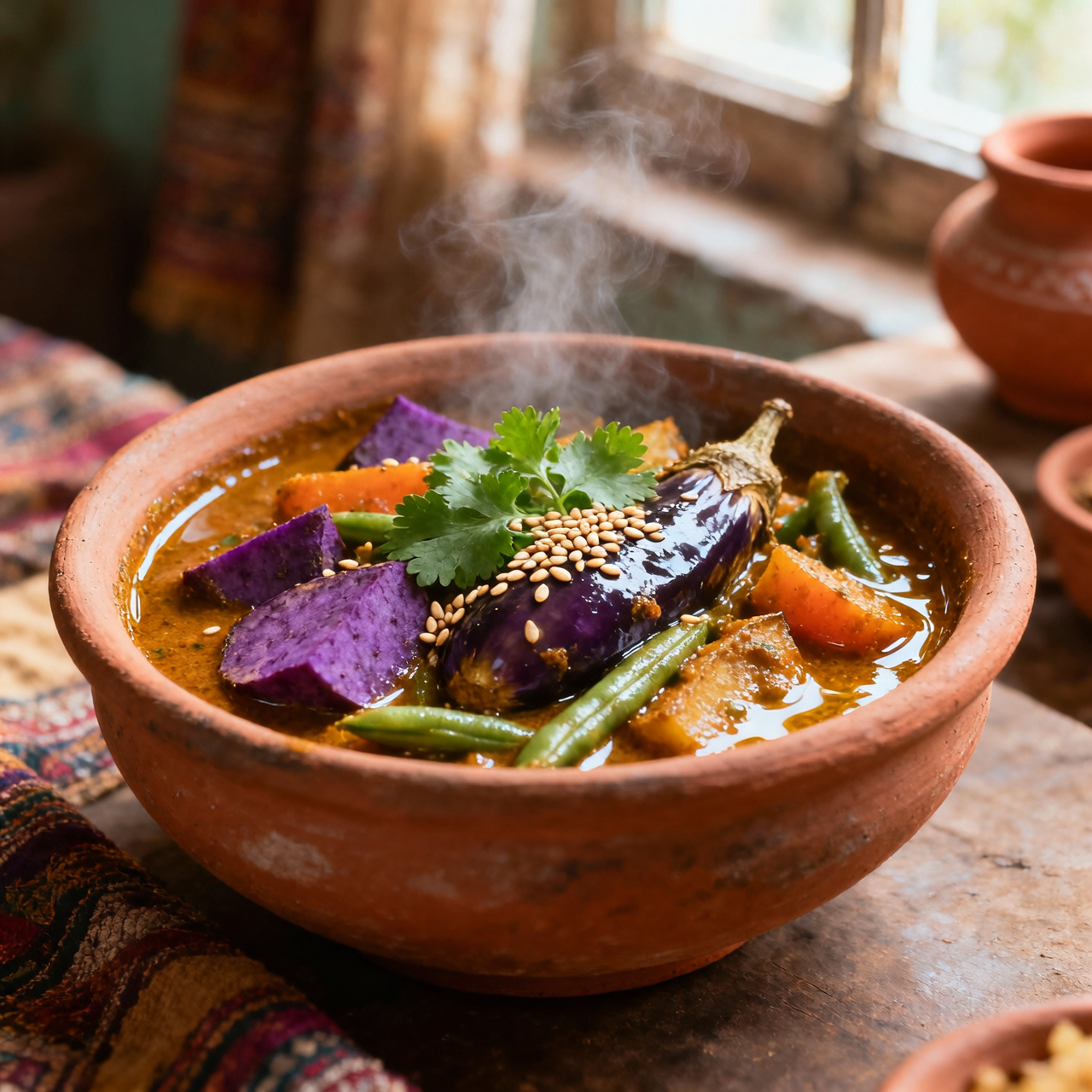
Undhiyu
When I first learned to make undhiyu, I quickly realized it is less a simple vegetable medley and more a winter ritual carved into Gujarati soil. The name itself, derived from the Gujarati word for upside down, nods to its ancient origins: clay pots sealed and buried in the earth, slow-roasted by smoldering embers so the fragrant steam would rise upward through the layers. Today, I honor that heritage on my stovetop, but the spirit remains unchanged. Undhiyu is the heartbeat of Uttarayan, the kite-flying festival that marks the sun’s northward turn, and it matters profoundly because it celebrates seasonal abundance without compromise. Every ingredient, from purple yam and raw banana to fresh fenugreek dumplings and tender green peas, speaks to the winter harvest, woven together with a masala that balances earthy warmth and gentle sweetness. Yet, I have seen too many versions falter. The most frequent misstep is rushing the process, which turns distinct vegetables into a uniform, waterlogged mush. Another is neglecting the layered tempering; undhiyu demands patience, with each spice bloomed in oil before meeting the vegetables. Overcrowding the pot, skipping the slow simmer, or relying on out-of-season substitutes dulls the very essence of the dish. When I cook it, I treat it as a quiet meditation. The goal is never just to feed, but to preserve a lineage of mindful, plant-based cooking that asks us to listen to the seasons, respect the ingredients, and trust that time will coax out a depth no shortcut can replicate.
Nutrition
| Per serving | Calories | Protein | Carbs | Fat | Sat fat | Fibre | Sugar | Sodium |
|---|---|---|---|---|---|---|---|---|
| beginner | 520kcal | 10g | 60g | 27g | 5g | 12g | 8g | 980mg |
| intermediate | 520kcal | 10g | 60g | 27g | 5g | 12g | 8g | 980mg |
| expert | 520kcal | 10g | 60g | 27g | 5g | 12g | 8g | 980mg |
Per serving · Ava-estimated — a guide, not a clinical figure.
- 250 gPurple yam— peeled and cut into uniform chunks
- 200 gGreen banana— peeled and sliced diagonally
- 150 gBaby eggplant— halved lengthwise
- 200 gWaxy potato— peeled and cubed
- 150 gFresh flat bean— trimmed and halved
- 50 gFresh fenugreek leaf— finely chopped
- 50 gRaw peanut— blanched
- 20 gWhite sesame seed— raw or lightly toasted
- 40 gFresh coconut— firm and freshly grated
- 2 wholeGreen chili— slit lengthwise
- 20 gFresh ginger— peeled and roughly chopped
- 3 wholeGarlic clove— peeled
- 0.5 gAsafoetida powder— pure resin, not wheat-blended
- 5 gCumin seed— whole and dried
- 10 gGround coriander— freshly milled
- 2 gTurmeric powder— high-pigment variety
- 3 gRed chili powder— Kashmiri variety preferred
- 15 gJaggery— grated or finely chopped
- 60 mlMustard oil— unrefined and cold-pressed
- 20 gFresh cilantro— leaves and tender stems
- 15 mlLemon juice— freshly squeezed
- 10 gSea salt— fine grain
This version prioritizes confidence and consistency over traditional labor. We replace the time-intensive spice grinding process with a high-quality, pre-made undhiyu masala paste, which already contains the essential toasted cumin, coriander, and fenugreek base. Your primary focus shifts entirely to mastering vegetable staging and moisture control. Because jarred pastes vary widely in salt and heat, always taste your gravy before adding the final seasoning. The most critical technique here is gentle simmering; boiling aggressively will fracture the delicate eggplant and turn your potatoes into a starchy slurry. Keep the lid slightly ajar during the final twenty minutes to allow excess liquid to evaporate naturally, leaving you with a glossy, clinging masala rather than a watery stew. Watch for the oil to separate at the edges of the pan, which signals that the spices have properly cooked out their raw edge. This approach guarantees a deeply flavorful, restaurant-style result in under an hour without requiring specialized equipment or advanced knife skills.
Equipment
- Large heavy skillet— non-stick is perfectly acceptable
- Silicone spatula— for gentle folding
Method
- 1
Heat mustard oil in a large heavy skillet over medium heat until shimmering, then reduce to low.
Oil should shimmer but not smoke.
tempering~ 2 min - 2
Add asafoetida and jarred spice paste, stirring constantly until the oil begins to separate.
Cook for exactly one minute to remove raw aroma.
blooming~ 3 min - 3
Add potatoes, purple yam, and peanuts, tossing to coat evenly in the spice mixture.
Ensure every piece is lightly coated.
sautéing~ 5 min - 4
Pour in one cup of water, cover tightly, and cook over low heat until the root vegetables begin to soften.
Maintain a low bubble to prevent breaking.
simmering~ 15 minTricky bit - 5
Uncover and add green banana, flat beans, eggplant, and green chilies, cooking until all vegetables are fork-tender.
Stir gently halfway through.
braising~ 12 min - 6
Fold in chopped fenugreek leaves, jaggery, fresh cilantro, and lemon juice, then let rest off the heat before serving.
Taste and adjust salt before serving.
finishing~ 2 min