
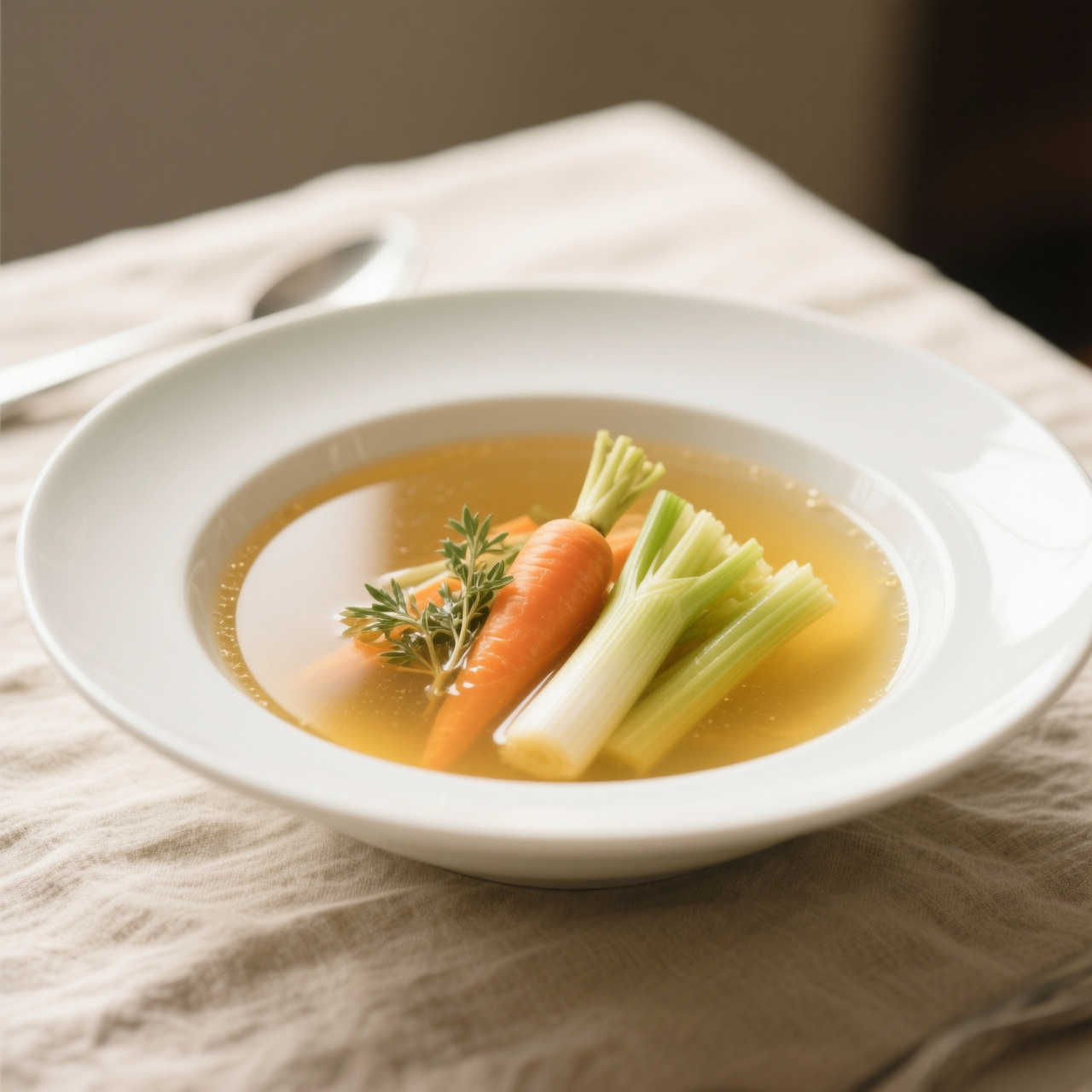
Vegetable stock
As Ava, I see vegetable stock as the quiet heartbeat of countless kitchens, a universal elixir that transcends borders. While meat-based broths have deep, specific cultural lineages, vegetable stock is a beautifully ambiguous creation, born from the frugal necessity of using every scrap of the garden. It matters because it is the ultimate canvas; it builds the foundation of soups, risottos, and sauces without imposing a heavy, singular flavor profile. The magic lies in the balance of aromatics—onions for sweetness, carrots for earthiness, celery for depth, and perhaps a parsnip or leek for complexity. However, I see home cooks fall into a few common pitfalls time and again. The first is using starchy vegetables like potatoes or turnips, which turn the broth cloudy and gummy. The second is overcooking; unlike a beef bone broth that needs hours to break down collagen, vegetables surrender their essence in about forty-five minutes. Push it to two hours, and you extract bitter, muddy compounds that ruin the delicate balance. Finally, skipping the rough chop. There is no need for meticulous brunoise here; a rough, generous chop maximizes surface area and extracts flavor efficiently. When you treat this liquid gold with respect, freezing it in portions or reducing it to a concentrated paste, you ensure that the soul of your garden is always ready to elevate your next culinary endeavor.
Nutrition
| Per serving | Calories | Protein | Carbs | Fat | Sat fat | Fibre | Sugar | Sodium |
|---|---|---|---|---|---|---|---|---|
| beginner | 35kcal | 1g | 7g | 0g | 0g | 1g | 4g | 450mg |
| intermediate | 45kcal | 1g | 9g | 1g | 0g | 2g | 4g | 120mg |
| expert | 35kcal | 2g | 6g | 1g | 0g | 2g | 3g | 850mg |
Per serving · Ava-estimated — a guide, not a clinical figure.
- 300 gonion— roughly chopped
- 200 gcarrot— roughly chopped
- 150 gcelery— roughly chopped
- 20 ggarlic clove— smashed
- 150 gleek(optional)— roughly chopped and washed
- 30 gparsley— fresh, stems included
- 10 gthyme— fresh sprigs
- 2 gbay leaf— dried
- 5 gblack peppercorn— whole
- 2000 mlwater— cold
This beginner-friendly approach to vegetable stock removes the intimidation of traditional stock-making by relying on straightforward techniques and a clever shortcut. Instead of spending hours slowly caramelizing tomato paste for deep umami, we simply stir in a spoonful of high-quality jarred tomato paste to instantly build a rich, savory baseline. The vegetable prep is equally forgiving: there is no need for precise knife work. A rough, rustic chop is all you need, as everything will be strained out anyway. We will guide you through the essential simmering process, ensuring you extract maximum flavor without overcomplicating the steps. You will learn to watch for a gentle bubble rather than a rolling boil, which keeps the stock clear and prevents bitter flavors from the vegetable skins. By the end of this simple 50-minute process, you will have a vibrant, foundational liquid that elevates soups, risottos, and sauces. It is the perfect confidence-building first attempt, proving that a delicious, from-scratch vegetable stock is well within your reach on a busy weeknight, with plenty left over to freeze for future culinary adventures.
Equipment
- Large stockpot or heavy-bottomed pan— non-stick is fine here, but stainless steel is ideal for clear stocks
- Fine-mesh strainer— essential for achieving a clear, debris-free liquid
- Chef's knife and cutting board— a sharp knife makes the rough chopping much faster
Method
- 1
Roughly chop all vegetables into large, uneven chunks.
Don't worry about perfect dice; rustic pieces are fine since they will be discarded.
chopping~ 10 min - 2
Add vegetables to the pot with cold water and stir in the jarred tomato paste.
Starting with cold water helps extract flavors gently as it heats.
combining~ 2 min - 3
Bring the pot to a boil over high heat, then immediately reduce to a gentle simmer.
Look for small bubbles breaking the surface, not a violent rolling boil.
simmering~ 30 minTricky bit - 4
Skim any foam or impurities that rise to the top during the first ten minutes.
This keeps your final stock clear and clean-tasting.
skimming~ 5 min - 5
Carefully pour the stock through a fine-mesh strainer into a large bowl, discarding the solids.
Do not press hard on the vegetables, or your stock will become cloudy.
straining~ 5 min
Cooking from frozen
Thaw overnight in the fridge or gently reheat directly from frozen in a saucepan.
Storage times are a guide — always use your judgement and store food safely.