
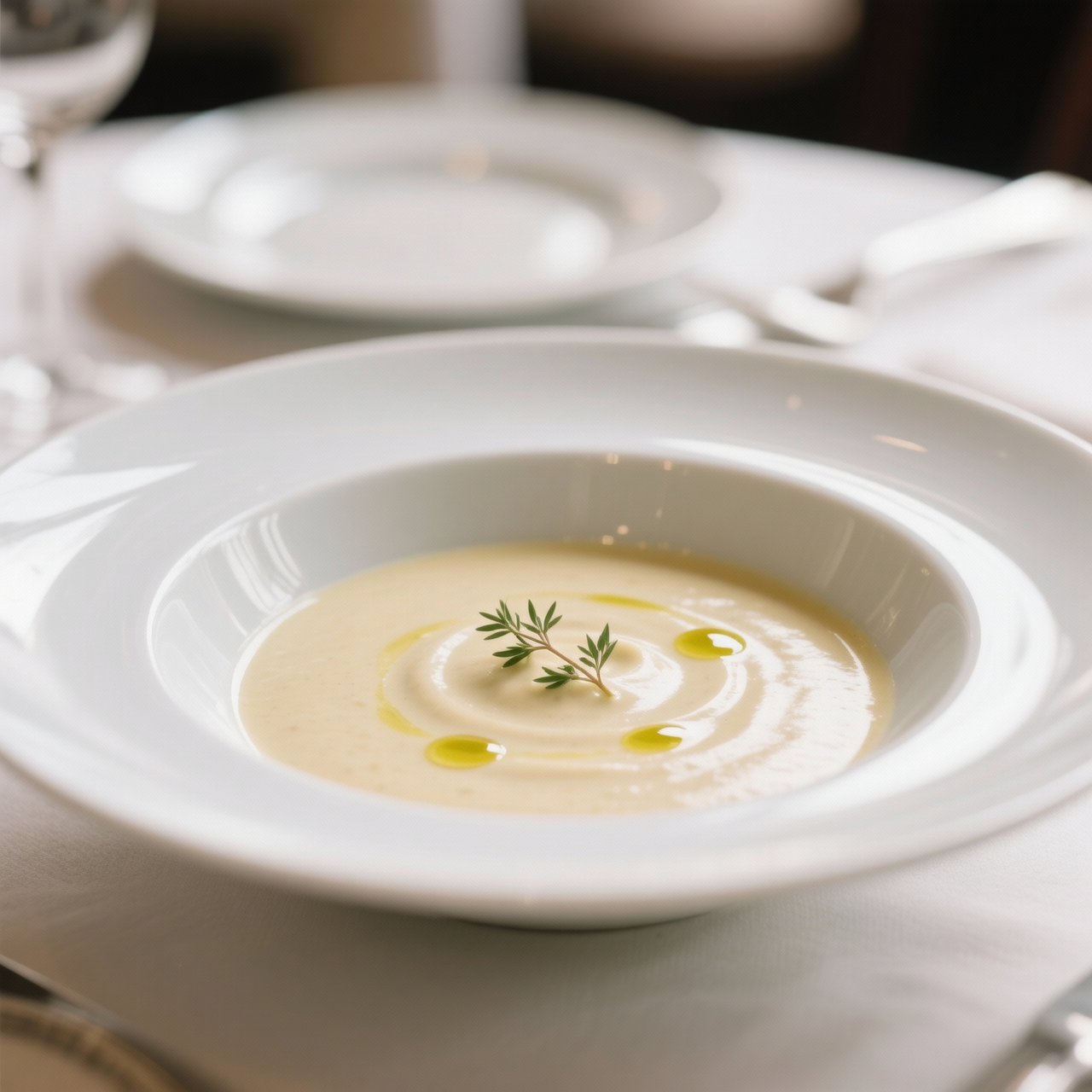
Velouté sauce
I’ve always believed that French cuisine is built on a foundation of patience and precision, and nowhere is that more evident than in the velouté. Born in the grand kitchens of nineteenth-century France, Auguste Escoffier elevated it alongside béchamel and espagnole as one of the five mother sauces, a testament to its quiet versatility. Unlike the rich, dairy-forward béchamel, the velouté relies on a light, clarified stock, whether chicken, veal, or fish, swapped seamlessly into a classic white roux. What makes it matter to me is its elegant neutrality; it does not shout, but rather elevates, acting as a refined canvas for herbs, mushrooms, seafood, or a splash of wine. Yet, its simplicity is a double-edged sword. The most common pitfall I see is rushing the roux. You must cook the flour and butter long enough to lose its raw, pasty taste, but never so long that it browns and compromises that signature pale, silky finish. Temperature control is equally unforgiving. If the stock hits the pan too cold, you will get lumps that vigorous whisking cannot rescue. Too hot, and the proteins in the stock will seize, turning a potential silk into a grainy mess. I always warm my stock separately, pouring it in a slow, steady stream while whisking constantly. Then comes the gentle simmer, where the starch granules fully swell and the sauce achieves that velvety texture that gives it its name. Patience here is not optional; it is the difference between a flat, starchy glaze and a luxurious, cohesive base that will carry the rest of your dish. Master the velouté, and you have essentially mastered half of classical French saucemaking.
Nutrition
| Per serving | Calories | Protein | Carbs | Fat | Sat fat | Fibre | Sugar | Sodium |
|---|---|---|---|---|---|---|---|---|
| beginner | 155kcal | 4g | 6g | 13g | 8g | 0g | 1g | 450mg |
| intermediate | 145kcal | 3g | 9g | 11g | 7g | 0g | 1g | 540mg |
| expert | 215kcal | 7g | 11g | 16g | 9g | 0g | 1g | 470mg |
Per serving · Ava-estimated — a guide, not a clinical figure.
- 500 mllight stock— chicken, veal, or fish; strained and kept warm
- 50 gunsalted butter— cut into cubes
- 50 gall-purpose flour— sifted
- 2 gfine sea salt— adjust to taste
- 1 gground white pepper— freshly ground
This beginner-friendly approach to classic French velouté strips away the intimidation factor by leaning on reliable shortcuts and clear, step-by-step guidance. Instead of spending hours simmering homemade stock, you will use a high-quality store-bought chicken or vegetable broth as your foundation. The key to a silky sauce without lumps lies in how you combine the fat and flour; we will form a simple, quick roux in a heavy pan, then gradually whisk in your room-temperature broth to guarantee a smooth texture. Keep your heat at a gentle medium-low throughout the process, and never stop stirring during the initial thickening phase. Watch closely as the sauce begins to coat the back of a spoon—that is your visual cue it is ready. If any small lumps appear, a quick pass with a handheld immersion blender will rescue it instantly. This method prioritizes consistency over perfection, giving you a dependable base that you can confidently season, serve alongside poultry or seafood, or chill and store for later use. Practice the gentle simmer and steady whisk, and you will master this essential mother sauce in no time.
Equipment
- Heavy-bottomed saucepan— ensures even heat distribution to prevent scorching
- Silicone whisk— flexible edges help scrape corners and prevent lumps
- Fine-mesh sieve(optional)— for a final smooth pass if desired
Method
- 1
Melt the butter in a heavy-bottomed saucepan over medium-low heat until it stops foaming.
Watch closely; butter burns quickly at high heat.
melting~ 1 min - 2
Whisk in the flour all at once and cook the mixture for two minutes while stirring constantly.
The paste should look like wet sand and smell slightly toasted.
making a roux~ 2 min - 3
Gradually pour in the warm stock in three additions, whisking vigorously after each pour until completely smooth.
Adding liquid too fast will cause stubborn lumps.
incorporation~ 3 minTricky bit - 4
Bring the sauce to a gentle simmer and cook uncovered for fifteen minutes, stirring occasionally.
Small bubbles should barely break the surface; boiling will make it gluey.
simmering~ 15 min - 5
Remove from the heat, stir in salt and pepper to taste, and strain through a fine-mesh sieve.
A quick pass guarantees restaurant-smooth texture for beginners.
straining~ 1 min
Cooking from frozen
Thaw overnight in the refrigerator, then gently reheat over low heat while whisking to re-emulsify and restore a smooth texture.
Storage times are a guide — always use your judgement and store food safely.