
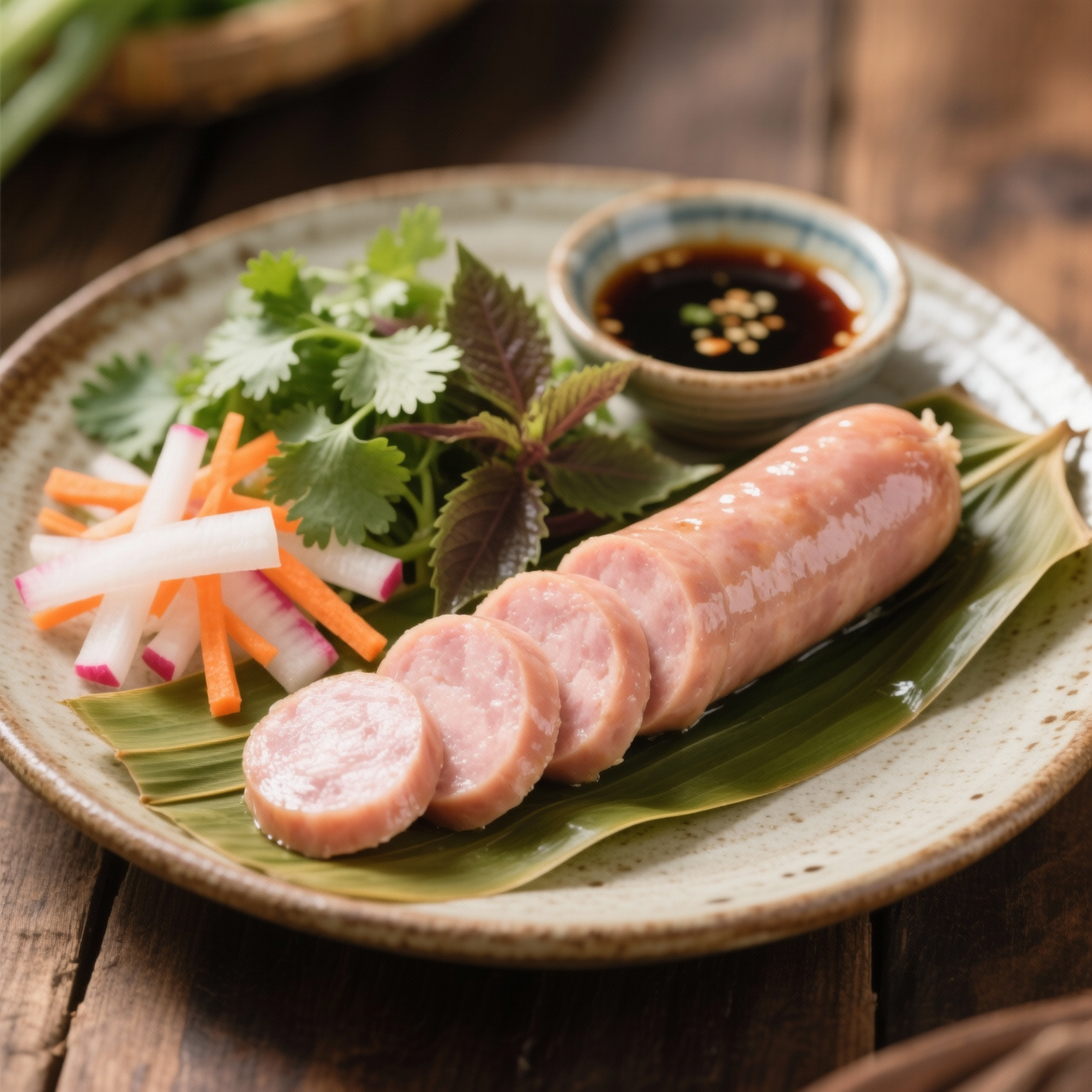
Vietnamese Pork Sausage (Cha Lua)
I still remember the first time I tasted authentic cha lua in a bustling Hanoi alleyway, wrapped in fresh banana leaves and sliced alongside steamed rice. It was nothing like the rubbery, pre-packaged rolls you find in Western supermarkets, which usually run about six to eight dollars a pack and taste suspiciously like starch and artificial smoke. Those commercial shortcuts rely on phosphates and cheap binders, sacrificing the delicate, bouncy texture that defines a proper Vietnamese pork sausage. Making it from scratch matters because it returns the dish to its roots: just lean pork, fish sauce, garlic, and black pepper, pounded until the myosin proteins bind into a springy, cohesive loaf. The real pitfall most home cooks hit is skipping the cold grind or overworking the meat into a paste that turns dense and dry when steamed. Temperature is everything. You must keep everything ice-cold to prevent the fat from separating, and you have to knead the meat vigorously until it becomes tacky and glossy. Wrapping it tightly in plastic wrap or banana leaves before steaming ensures that signature smooth, pale exterior and prevents water from seeping in. I always steam mine in a long, tight roll, let it cool completely, then freeze it whole or in thick slices. It is a true batch hero that scales effortlessly, saving you hours later while delivering a clean, deeply savory protein that elevates everything from banh mi to pho. When you taste the clean snap of homemade cha lua, you will never look back at the supermarket version again.
Nutrition
| Per serving | Calories | Protein | Carbs | Fat | Sat fat | Fibre | Sugar | Sodium |
|---|---|---|---|---|---|---|---|---|
| beginner | 380kcal | 28g | 4g | 28g | 9g | 0g | 1g | 720mg |
| intermediate | 210kcal | 19g | 5g | 12g | 4g | 0g | 2g | 720mg |
| expert | 240kcal | 22g | 3g | 16g | 5g | 0g | 1g | 520mg |
Per serving · Ava-estimated — a guide, not a clinical figure.
- 500 gpork shoulder— trimmed of excess fat and cut into small cubes
- 45 mlfish sauce— traditional Vietnamese preferred
- 15 gsugar— white granulated
- 5 gbaking powder— aluminum-free for optimal texture
- 5 gblack pepper— freshly ground
- 10 ggarlic— peeled
- 60 mlice water— kept very cold to maintain meat temperature
- 1 piecebanana leaf— about 30 cm square, passed briefly over heat to soften
- 100 cmcooking twine— food-safe natural fiber
This beginner-friendly version strips away the traditional mortar-and-pestle pounding and complex starch-binding ratios, replacing them with a reliable food-processor method and a forgiving steaming technique. Store-bought Chả Lụa typically costs $6–$8 per loaf, but it relies heavily on phosphates, excess sodium, and fillers that mask inferior meat quality. By keeping it entirely from scratch, you control the texture and flavor while saving nearly half the cost. The goal here is confidence: we use a standard blender or food processor to emulsify the pork shoulder and fat until perfectly smooth, then wrap the mixture tightly in banana leaves or parchment for steaming. Watch your meat temperature closely during blending; if it starts to feel warm, pause and chill the bowl. Overheating breaks the protein structure and yields a crumbly sausage instead of a firm, bouncy slice. Keep the steamer at a steady, gentle simmer rather than a rolling boil to prevent the casing from splitting. This approach guarantees a clean, sliceable loaf perfect for sandwiches, rice bowls, or charcuterie boards, and it scales beautifully for batch-freezing.
Equipment
- Food processor— Must have a sharp blade for proper emulsion
- Steamer basket— Bamboo or metal both work
- Banana leaves or parchment paper— For wrapping the sausage roll
Method
- 1
Chill the pork shoulder and pork fat until nearly frozen, then cut them into uniform one-inch cubes.
Cold meat prevents the emulsion from breaking during blending.
chilling~ 10 min - 2
Pulse the meat and fat in the food processor with fish sauce, black pepper, minced garlic, and potato starch until a smooth, pale paste forms.
Scrape down the sides halfway through to ensure even mixing.
emulsifying~ 5 minTricky bit - 3
Transfer the mixture onto a sheet of banana leaves or parchment, then roll it into a tight, even cylinder.
Apply firm, even pressure to eliminate air pockets.
rolling~ 5 min - 4
Secure both ends of the roll with kitchen twine, then place it seam-side down in a preheated steamer.
Keep the water level below the rack to avoid boiling the casing.
steaming~ 5 minTricky bit - 5
Cover and steam over medium heat until the internal temperature reaches 160°F, then let it rest completely before slicing.
Resting allows the proteins to set for clean cuts.
resting~ 30 min
Cooking from frozen
Thaw overnight in the refrigerator and slice while still firm for immediate use.
Storage times are a guide — always use your judgement and store food safely.