
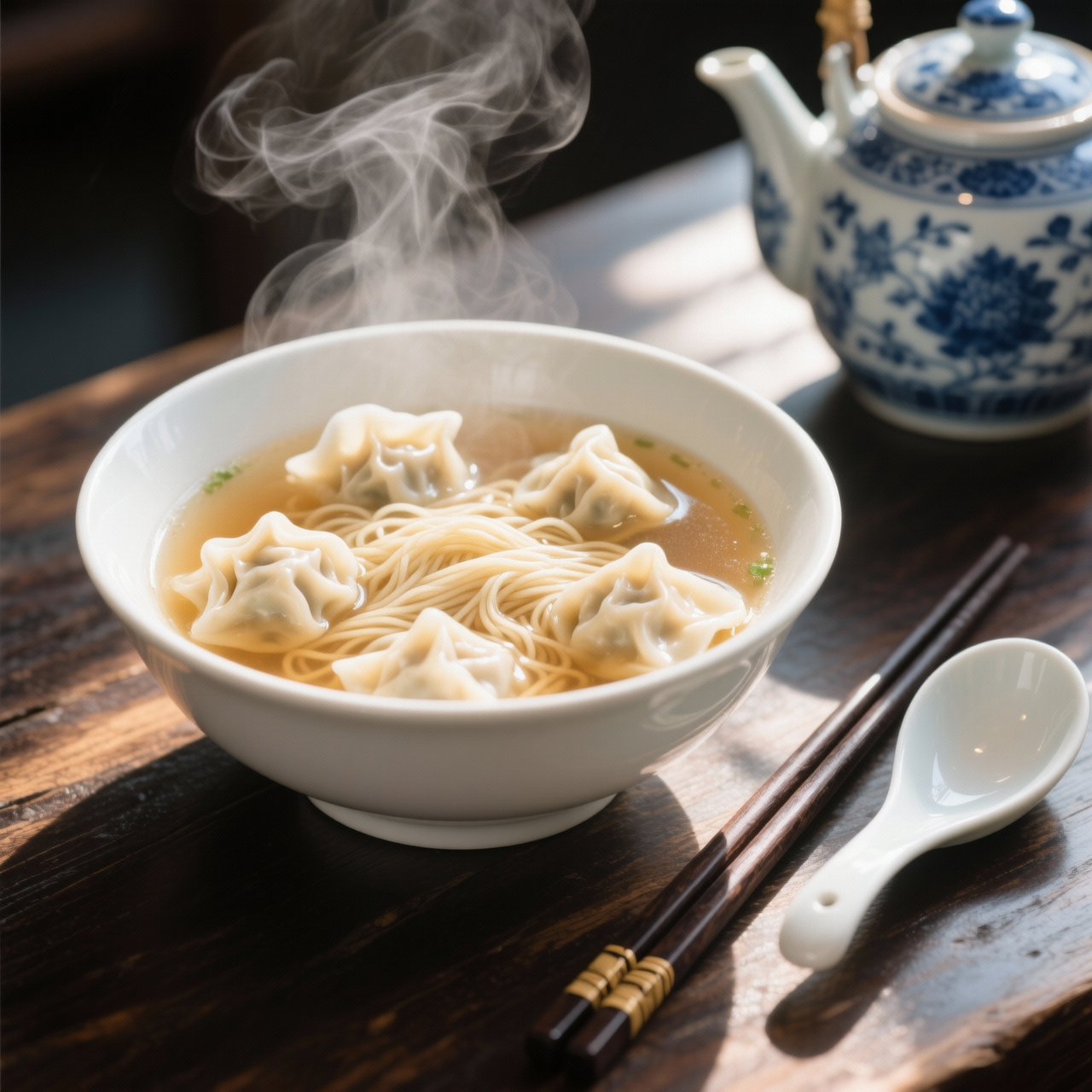
Wonton Noodle Soup
I’ve always believed that a true Cantonese wonton noodle soup isn’t just a bowl of broth and wrappers; it’s a quiet testament to patience, balance, and respect for tradition. Growing up, I watched my grandmother fold pork and shrimp filling into translucent dough squares with a rhythm that felt almost meditative, each pleat sealing in generations of technique. The origins of this dish trace back to Guangzhou’s bustling teahouses and street stalls, where it emerged as a humble yet refined staple designed to showcase the harmony between delicate egg noodles, savory broth, and the subtle sweetness of fresh pork. What makes it matter to me is how unforgiving it can be to shortcuts. Rush the broth by relying on bouillon cubes, and you lose the soul of the dish. Overwork the wonton filling, and the texture turns dense instead of springy. Even the noodles demand exact timing—boil them a minute too long, and that signature al dente snap dissolves into mush. I’ve seen countless home cooks drown their bowls in heavy soy sauce or skip the crucial step of blanching the noodles separately, unaware that these small missteps mask the clean, umami-rich clarity that defines Cantonese cooking. When done right, though, the soup sings. The broth should be almost transparent, carrying the quiet depth of simmered pork bones, dried flounder, and a whisper of rock sugar, while the wontons float like little silk pouches, their filling tender and lightly seasoned. This recipe isn’t about complexity; it’s about precision. It’s about understanding that in Cantonese kitchens, restraint often speaks louder than abundance.
Nutrition
| Per serving | Calories | Protein | Carbs | Fat | Sat fat | Fibre | Sugar | Sodium |
|---|---|---|---|---|---|---|---|---|
| beginner | 815kcal | 45g | 92g | 26g | 7g | 5g | 5g | 1850mg |
| intermediate | 815kcal | 45g | 92g | 26g | 7g | 5g | 5g | 1850mg |
| expert | 815kcal | 45g | 92g | 26g | 7g | 5g | 5g | 1850mg |
Per serving · Ava-estimated — a guide, not a clinical figure.
- 300 gpork shoulder— lean, finely minced
- 150 graw shrimp— peeled, deveined, and finely chopped
- 30 piecewonton wrapper— square, store-bought or homemade
- 400 gfresh egg noodle— thin, alkaline style
- 1500 mlchicken stock— low-sodium, clear
- 30 gdried shrimp— soaked in warm water
- 15 mlsesame oil— toasted
- 30 mllight soy sauce— naturally brewed
- 10 grock sugar— crushed
- 5 gground white pepper— freshly ground preferred
- 3 stalkscallion— thinly sliced
- 200 gbaby bok choy— halved lengthwise
- 1 wholeegg— large, for binding
- 15 gcornstarch— for dusting and thickening
- 20 gginger— unpeeled, for broth infusion
This version is designed for your first confident attempt without sacrificing the soul of the dish. We bypass the time-consuming process of hand-pressing noodles or clarifying stock for hours, leaning instead on high-quality store-bought wrappers and a streamlined broth built on a solid store-bought chicken base. The focus here is entirely on mastering the wonton fold and achieving the perfect broth-to-noodle ratio. You will learn how to properly hydrate the filling so it remains tender rather than dense, and how to balance soy, rock sugar, and white pepper to mimic the subtle sweetness of a traditional Cantonese stock. Watch your water temperature closely when blanching the noodles and vegetables; overcooking is the most common beginner mistake, turning springy noodles into mush. The folding technique requires patience but rewards you with a satisfying, uniform dumpling that cooks evenly. Keep your workspace lightly dusted with cornstarch to prevent sticking, and assemble the bowls methodically: broth first, then noodles, then wontons, and finally a quick scallion garnish. By following these guided steps, you will build a reliable foundation that tastes remarkably authentic while fitting comfortably into a weeknight schedule.
Equipment
- large stockpot— minimum 5-quart capacity
- fine-mesh strainer— for broth clarification
- mixing bowl— large, non-reactive
Method
- 1
Combine ground pork, chopped shrimp, sesame oil, soy sauce, cornstarch, and egg in a large bowl.
Keep all ingredients cold until mixing.
binding~ 5 min - 2
Stir the mixture vigorously in one direction until it becomes glossy and cohesive.
This develops the protein matrix for a bouncy texture.
kneading~ 2 min - 3
Place a teaspoon of filling into the center of each wonton wrapper.
Do not overfill or the wrapper will tear.
portioning~ 3 min - 4
Dampen the edges with water, fold diagonally, and press firmly to seal.
Remove air pockets to prevent bursting.
sealing~ 5 min - 5
Bring the chicken stock to a gentle simmer with ginger, rock sugar, and dried shrimp.
Simmer, never boil, to keep the broth clear.
infusing~ 10 minTricky bit - 6
Strain the broth through a fine-mesh sieve into a clean pot and season with white pepper.
Taste and adjust before serving.
straining~ 1 min - 7
Blanch the egg noodles and bok choy in boiling water for exactly two minutes, then drain.
Rinse briefly under cool water to stop cooking.
shocking~ 2 minTricky bit - 8
Divide noodles and vegetables among bowls, ladle hot broth over them, and float the wontons on top.
Serve immediately to preserve texture.
plating~ 2 min