
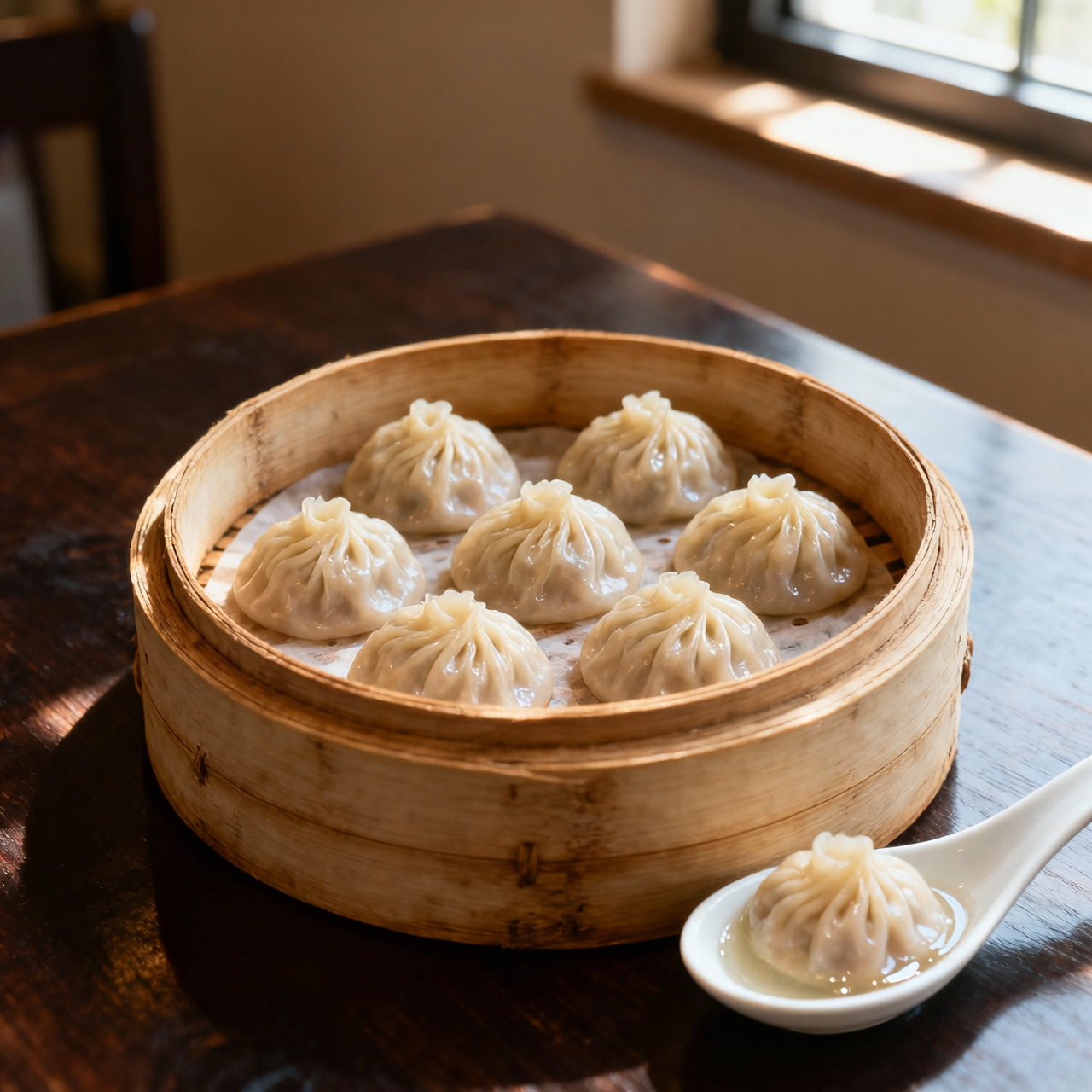
Xiao Long Bao
When I first learned to fold xiao long bao, I quickly discovered that these delicate Shanghai dumplings are as much a lesson in patience as they are in flavor. Born in the bustling teahouses of nineteenth-century Jiangnan, they were conceived as edible vessels of broth and seasoned pork, wrapped in a paper-thin skin that defies the very laws of physics. To me, they matter because they capture the essence of Jiangnan culinary philosophy: harmony, precision, and the quiet celebration of technique over spectacle. Every pleat is a promise, and every steam basket holds a miniature world. Yet, I have also watched countless kitchens fall prey to their most notorious pitfalls. Many rush the gelatinous pork aspic, boiling it too vigorously until it turns cloudy and loses its silkiness, or they overwork the dough, trading elasticity for a dense, chewy wrapper that tears at the slightest tug. The greatest tragedy, though, is underestimating the heat. Steam too long and the dumplings collapse into soggy ruins; steam too briefly and the broth remains cold while the pork stays raw. I always remind myself that xiao long bao demands respect for timing, a gentle hand, and an unwavering eye. When done correctly, the first bite releases a warm, savory tide that justifies every misfolded wrapper and every burned fingertip. It is not merely a snack to be consumed quickly, but a quiet ritual that connects me to generations of Shanghainese cooks who understood that true mastery lies in the invisible details.
Nutrition
| Per serving | Calories | Protein | Carbs | Fat | Sat fat | Fibre | Sugar | Sodium |
|---|---|---|---|---|---|---|---|---|
| beginner | 595kcal | 32g | 51g | 28g | 9g | 2g | 2g | 640mg |
| intermediate | 595kcal | 32g | 51g | 28g | 9g | 2g | 2g | 640mg |
| expert | 595kcal | 32g | 51g | 28g | 9g | 2g | 2g | 640mg |
Per serving · Ava-estimated — a guide, not a clinical figure.
- 250 gall-purpose flour— high-protein wheat flour preferred
- 150 mlwarm water— around 40C for optimal dough hydration
- 300 gpork shoulder— finely minced with a 20 percent fat ratio
- 150 gpork skin— cleaned and blanched for gelatin extraction
- 400 mlchicken stock— low-sodium and clarified
- 15 mllight soy sauce— traditional brewed variety
- 15 mlShaoxing wine— authentic rice cooking wine
- 20 gfresh ginger— divided between filling and garnish
- 20 gscallions— finely minced white and green parts
- 10 mlsesame oil— toasted for filling aroma
- 5 gwhite sugar— balances savory notes
- 15 mlblack vinegar— Chinkiang variety for dipping
This pathway prioritizes structural confidence over artisanal perfection. Instead of dedicating hours to simmering pork skin for aspic, you will rely on a concentrated broth gelatin that sets reliably in the refrigerator, removing the most unpredictable variable for first-time cooks. The dough is mixed using a forgiving hydration ratio and rested just long enough to become pliable, avoiding the frustration of tearing wrappers during your initial attempts. I recommend using a simple pinch-and-pull folding method rather than chasing traditional pleat counts; a secure seal matters far more than decorative symmetry. Watch your filling temperature closely, as warm gelatin will melt prematurely and ruin the soup pocket. Steam gently with the lid tightly closed to prevent pressure fluctuations that cause ruptures. If a dumpling leaks, do not panic; simply note the weak spot and adjust your seal on the next. The goal here is a reliable, repeatable process that builds muscle memory and delivers a satisfying broth-to-meat ratio without overwhelming your kitchen. Focus on consistency, embrace minor imperfections, and let the foundational techniques become second nature before advancing.
Equipment
- large mixing bowl— wide rim helps kneading
- rolling pin— standard wooden
- bamboo steamer— lined with parchment paper
Method
- 1
Dissolve the store-bought pork broth concentrate in warm water and chill until firm.
Must be completely solid before mixing.
chilling~ 30 min - 2
Combine flour and warm water in a bowl until a shaggy mass forms.
Water temperature matters more than exact volume.
hydration~ 2 min - 3
Knead the dough briefly until smooth, then wrap and rest for twenty minutes.
Do not skip resting, or the wrappers will snap.
autolyse~ 20 min - 4
Divide the dough into twenty-four equal pieces and roll each into a thin circle.
Aim for even edges to prevent tearing.
rolling~ 5 minTricky bit - 5
Fold the chilled broth cubes into the seasoned pork mixture until evenly distributed.
Keep the filling cold to prevent melting.
folding~ 3 minTricky bit - 6
Place one tablespoon of filling into each dough circle and pinch the edges together loosely.
Seal completely but leave a small air pocket at the top.
sealing~ 10 minTricky bit - 7
Arrange the dumplings on parchment-lined bamboo steamers, spacing them two inches apart.
Overcrowding causes sticking and ruptures.
spacing~ 2 min - 8
Steam over rapidly boiling water for twelve minutes, then remove and serve immediately.
Lid must stay closed to trap essential steam.
steaming~ 12 min