
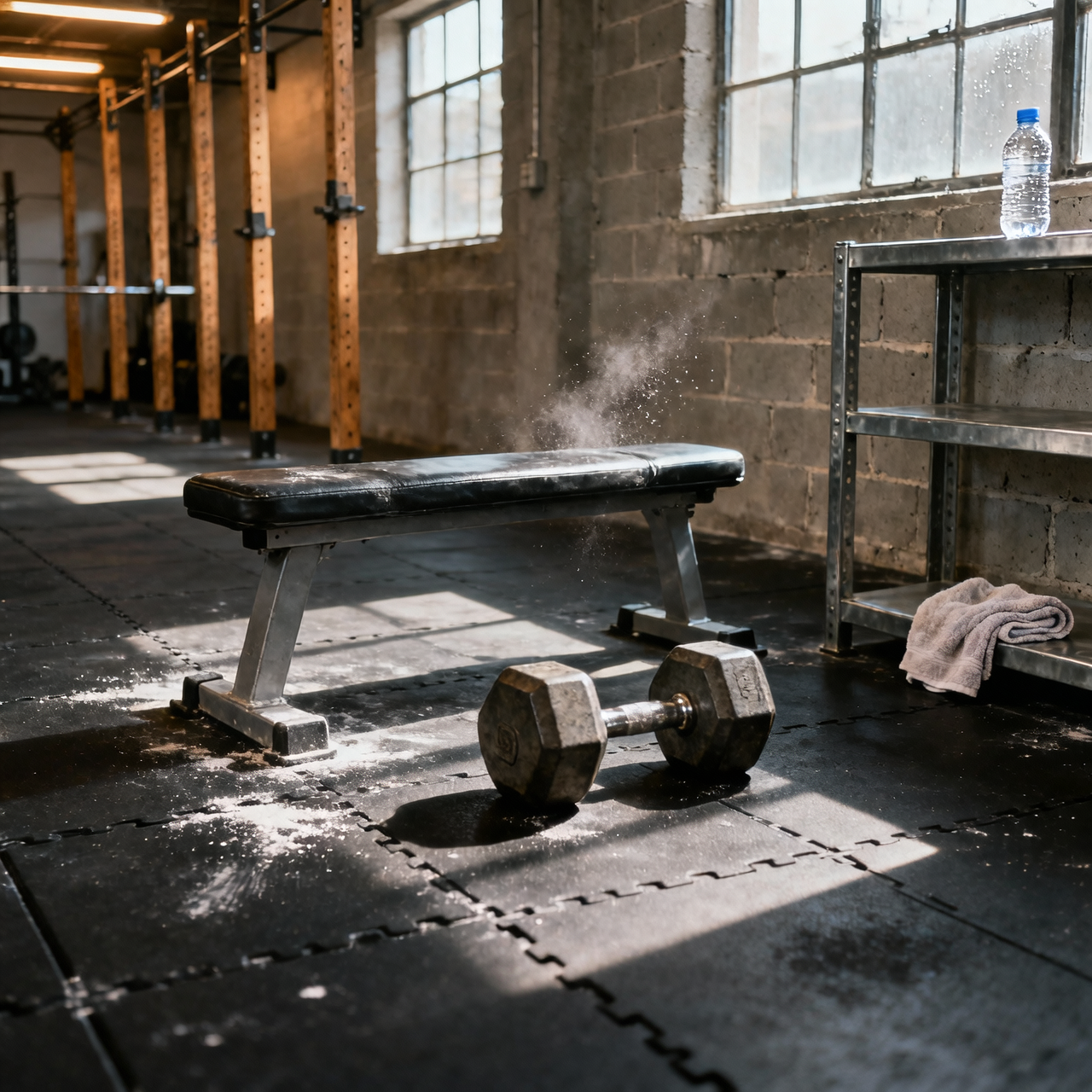
Dumbbell Bench Press
dumbbell-bench-press
When I lock into this press, I immediately feel a deep, controlled stretch across my chest as the weights descend. My shoulders stay packed, my core stays braced, and the dumbbells track smoothly without a single wobble. Every rep should feel grounded and deliberate, translating into a clean, powerful drive that lights up my pecs and triceps while keeping my joints completely safe.
If you're new to this
When you first learn this movement, focus entirely on control rather than weight. Start with lighter dumbbells so you can master the path. As you lower the weights, keep your elbows tucked at roughly a forty-five-degree angle from your ribs; letting them flare straight out to the sides will quickly strain your shoulder joints. If you feel your lower back lifting excessively off the bench or your shoulders rolling forward, pause, reset your scapular position, and reduce the load. True muscular failure here means you can no longer press the weights back up to the starting position with good form, not that your joints ache. Stop the set the moment your form breaks or you feel sharp pain. It is completely normal for your arms to shake slightly near the end of a challenging set, but never sacrifice a stable shoulder girdle to grind out a rep. Trust the process, prioritize a full, pain-free range of motion, and let your chest do the heavy lifting.
Common mistakes
Most lifters ruin this exercise by allowing their shoulder blades to protract off the bench, which shifts the load away from the chest and directly onto the anterior deltoids and rotator cuffs. Another frequent error is using excessive weight that forces an exaggerated bounce off the bottom of the movement or causes the lower back to hyperextend violently. Many also flare their elbows to ninety degrees, creating unnecessary shear force in the shoulder joint. Finally, dropping the dumbbells inward toward each other or letting them drift past the midline disrupts the natural pressing arc and compromises joint alignment. Keeping the shoulder blades pinned, controlling the descent without bouncing, maintaining a moderate elbow tuck, and tracking the weights vertically will instantly correct these issues and maximize chest activation.
Routine
- Sets
- 3
- Reps
- 8-12
- Rest
- 90s
- Tempo
- 2-0-2-0
- Frequency
- 2-3x/week
Increase the dumbbell weight by 2.5 to 5 lbs once you can successfully complete all prescribed sets at the top of the rep range with controlled form.
Muscles
- Chest
- Shoulders
- Triceps
- Upper back
- Abs
- Forearms
Equipment
- Dumbbells
- Bench
- 1
Sit on the center of a flat bench with a dumbbell resting vertically on each thigh.
- 2
Plant your feet firmly on the floor shoulder-width apart and retract your shoulder blades against the pad.
- 3
Lie back while guiding the dumbbells to your lower chest, keeping your elbows angled at 45 degrees from your torso.
- 4
Press both weights straight up until your arms are nearly extended, exhaling steadily through the upward phase.
- 5
Lower the dumbbells slowly toward the sides of your chest until your upper arms align parallel to the floor, inhaling deeply throughout the descent.
- 6
Pause briefly at the bottom without letting the weights touch your torso, maintaining constant muscle tension.
- 7
Drive the dumbbells upward in a controlled path, exhaling forcefully as you pass the midpoint of the lift.
- 8
Repeat the lowering and pressing sequence for the target repetitions while keeping your glutes and back flat against the bench.
- 9
Bring the dumbbells to your thighs one at a time after the final rep, keeping your wrists straight and core braced.
- 10
Roll to your side and sit up slowly before placing the weights securely on the floor.