
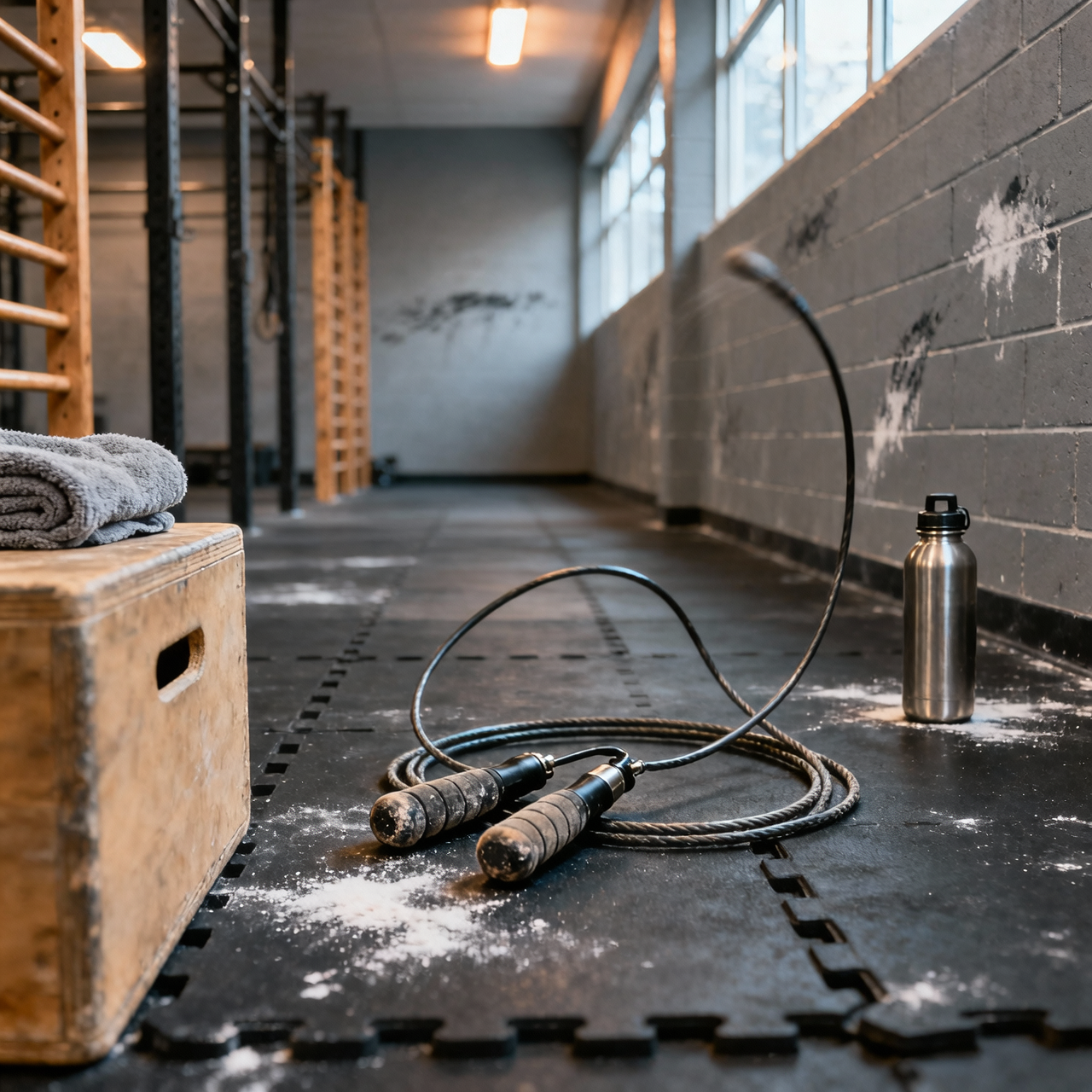
Jump Rope
jump-rope
When you find your groove, the rope stops being a tool and becomes pure rhythm. I love that light, springy rebound through your forefoot, paired with a steady breath that never fights the tempo. Your shoulders drop, your wrists drive the spin, and every rotation lands with a soft, predictable whisper. Good reps feel effortless, like you are barely grazing the ground while completely locked into the flow.
If you're new to this
As you begin, focus entirely on timing before speed. It is completely normal to trip repeatedly in your first sessions, so treat early trips as feedback rather than failure. If your shoulders start hiking toward your ears or your arms swing wide like wings, pause, reset your elbows, and restart with slower, deliberate wrist flicks. Your calves should burn before your lungs give out, which means your jumping height is likely creeping upward. Stop immediately if you feel sharp pain in your shins, knees, or ankles, and step off the rope to shake out your legs. A common compensation is landing flat-footed or letting your knees cave inward; keep your weight centered over your midfoot and track your knees over your toes. Progress by mastering ten clean, quiet jumps in a row before adding duration. Remember that consistency beats intensity here, and every successful sequence rewires your coordination. Trust the rhythm, keep your movements small, and celebrate the quiet landings.
Common mistakes
Most practitioners sabotage their efficiency by swinging from the shoulders instead of isolating the wrists, which drains energy and disrupts the rope’s arc. Jumping excessively high is another frequent error, creating unnecessary joint stress and breaking the continuous rebound rhythm that makes this movement so effective. Many also grip the handles like hammers, creating forearm tension that travels up the kinetic chain and ruins wrist mobility. Finally, letting the rope strike the floor too hard indicates poor timing and excessive force, often caused by rushing the cadence instead of trusting a steady, metronomic pace. Correcting these habits means embracing economy of motion over raw power.
Routine
- Sets
- 3
- Reps
- 30-60 sec
- Rest
- 45s
- Frequency
- 3-5x/week
Increase continuous jump time by 15-30 seconds per set or advance to complex variations like double-unders.
Muscles
- Calves
- Cardiovascular
- Forearms
- Quadriceps
- Abs
Equipment
- Jump rope
- 1
Measure the rope by stepping on its center and pulling the handles to your armpits, trimming excess length if necessary.
- 2
Stand with feet hip-width apart, hold the handles with a relaxed grip, and position the rope behind your heels.
- 3
Tuck elbows close to your ribs, point wrists forward, and exhale steadily as you engage your core and establish a stable starting posture.
- 4
Rotate your wrists to swing the rope forward in a controlled arc while inhaling deeply through your nose.
- 5
Jump lightly on the balls of your feet as the rope approaches, landing with soft knees and an upright torso.
- 6
Maintain a steady cadence by keeping jumps low and consistent, exhaling briefly with each lift-off.
- 7
Keep your gaze forward and shoulders relaxed, avoiding excessive arm swinging or heavy foot strikes.
- 8
Bring the rope to a complete stop at your feet, step over it safely, and take three slow breaths to reset your heart rate.